
According to a Toltec myth, Quetzalcoatl, the god of light, planted cacao trees in the southern lands of Mexico and gave the people a divine bitter spicy drink made from its seeds – a sort of cocoa or chocolate – to make them strong and eager to love. Although everything that we know as chocolate bars is originally rooted in the myth of Quetzalcoatl, in some cases a new mythical connection can be seen – the connection with Classical Antiquity. Chocolate bars that people like so much often bear names rooted in both Greek and Roman mythologies.

Milky Way, the oldest in our selection, was created over one hundred years ago and has been in production since 1924. Its name evokes the star myth of baby Heracles being breastfed by Hera at Athena’s request or as a result of Zeus’ deceit. As the anxious goddess rejected Heracles, her divine milk sprang to the night sky. The bar, released by “Mar-O-Bar Company”, quickly became a hit which allowed the small local company to develop and become globally prosperous as it is known today. Although the bar was originally named after its milk drink taste and not the Milky Way galaxy (derived nota bene from the Greek word γάλα/“gala” – milk), eventually the producers added the recognizable motif of stars to the characteristic blue wrapping, which strengthens the galaxy myth connotation.

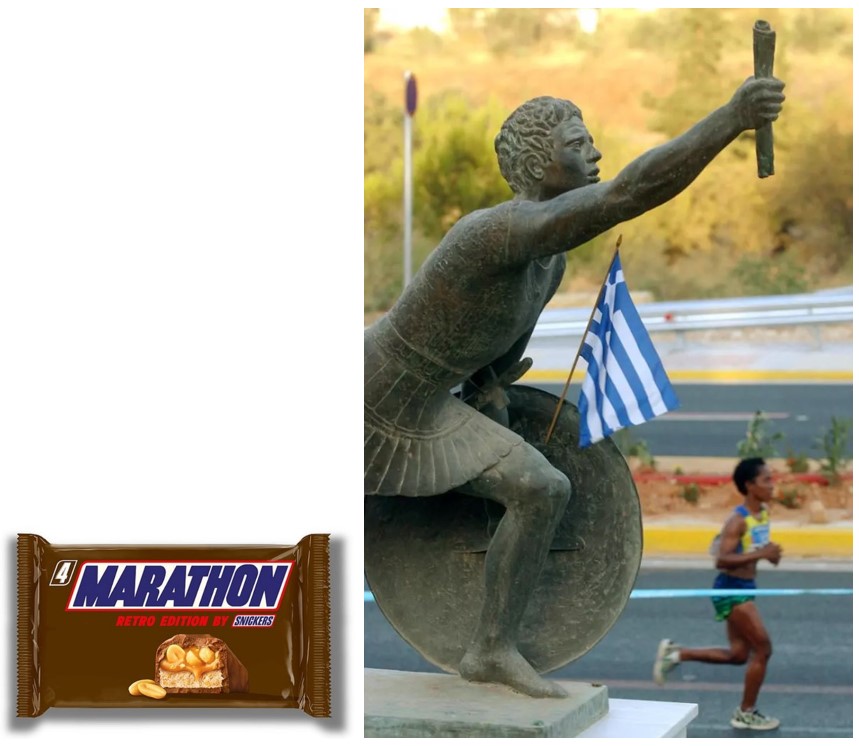
In 1930 the Mars company created a bar made of nougat, caramel, peanuts, and chocolate, that is known today as Snickers. It was, however, at first named Marathon and under this name the bars were produced until 1990. The name was not chosen because of special interest in Greek history, but surprisingly to commemorate the horse belonging to the family.
The Mars bar is another example for a tricky ancient name of a chocolate bar. It was created in 1932 and originally named after its creator, Forrest Edward Mars, son of the American candy magnate. The inventor modified his father’s recipe for the Milky Way bar to adjust it to European market. Even though the bar was not directly named after the god Mars, worshipped in Rome as the god of war and ancestor of noble Romans, the connection still appeared in people’s minds. During WW2 its advertisement appealed to power and strength rather than to a taste as it was to provide energy (“Energising! Because it includes Glucose”) and to nourish people exhausted by war (“Nourishing! Because it contains milk”). Mars bars were later even more connected to the Roman god as 3 million of them accompanied the British soldiers at the Falklands military campaign in 1982. The god of war would have been pleased.

Mars in the Roman pantheon was accompanied by the goddess Bellona and the same situation can be observed on the chocolate market. Bellona bars, sold in Lidl as their own trademark, soften the image of the warrior goddess, giving her as much sweetness as if she were Venus herself.

When in Greece, the chocolate Olympian gods greet the tourist at the airport gift shop. One of the mythical sets available is a set of 20 mini-bars adorned with details of ancient art. It presents chocolate lovers with the most important ancient Greek gods: their images in ancient sculpture or vase painting, and short descriptions on the back side of the set.

The descriptions are created with the youngest gourmet in mind as they are short and provide basic, but the most relevant information on Twelve Olympians in English. Gods are described on the left, and on the right goddesses. The creators included 13 Olympian gods in the same set. Hestia, who is described on the back of the box as the oldest from the included gods, is in fact deprived of her own chocolate representation. This refers directly to mythology as she is always said to choose to live among people and being replaced on the Olympus by Dionysus. So, she is also replaced in this chocolate Olympus by Dionysus’ little bar.

– photo by Marta Pszczolińśka.
What is particularly interesting in this set is the description of Ares: he is directly said not to be liked by his parents! There is no explanation why, but the reader can assume that it is because his professional interests need to be softened when presented to children, and not because he was a nasty child. He is contrasted with his brother Hephaestus, who is depicted as peaceful and hardworking despite also being connected to warfare. No information follows whether others liked him but we can assume this peaceful attitude is approved above all.
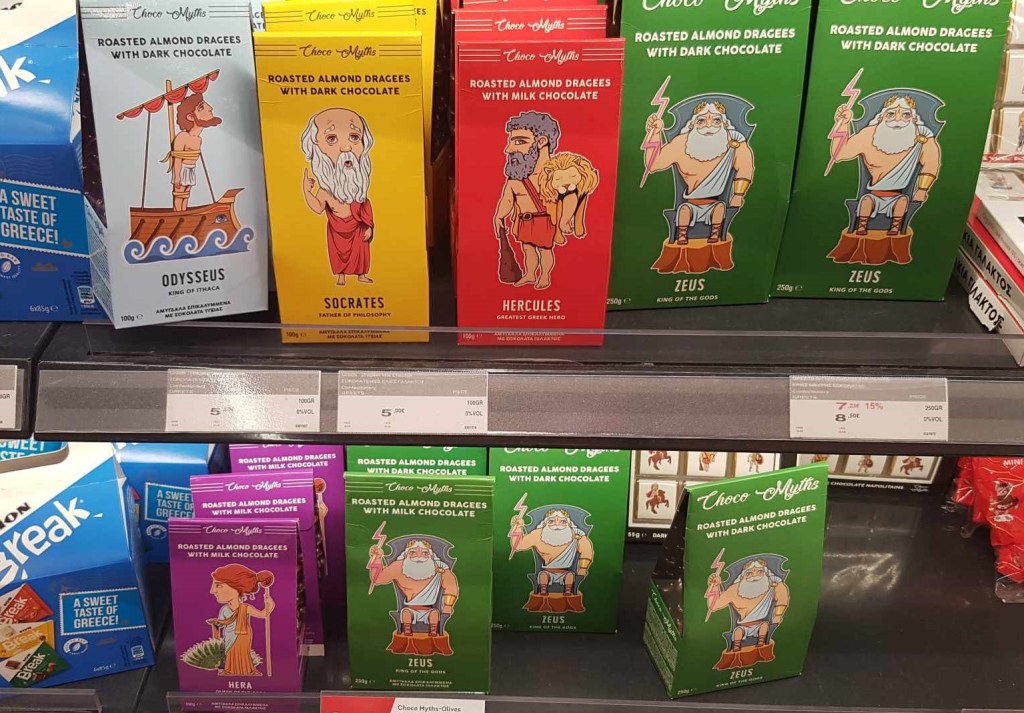
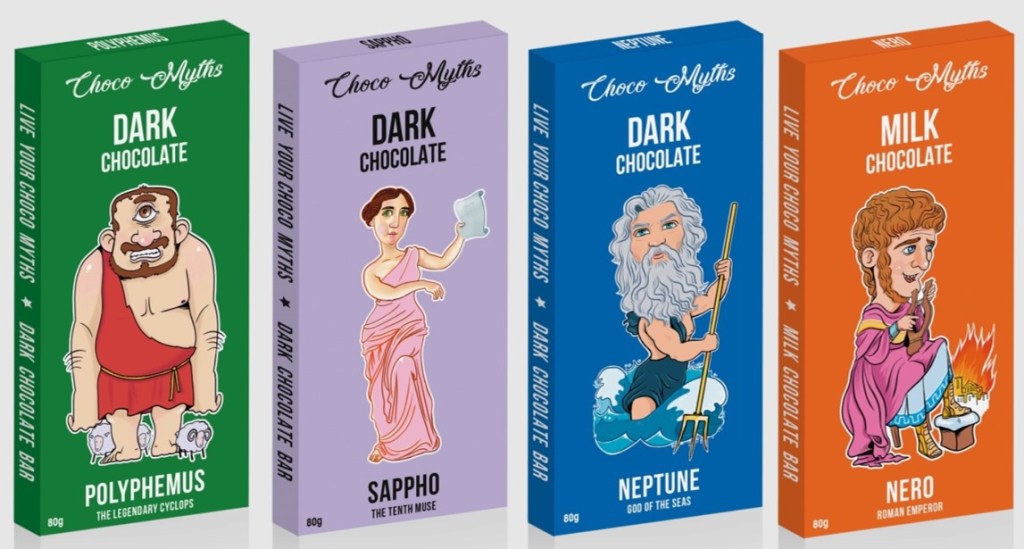
Choco Myths chocolate boxes, bars, biscuits, or roasted almonds dragees in colourful packages with images of Greek gods, goddesses, heroes, philosophers, and other historical characters appeal to children and adults another way. They use quite different style of mythical representations – ancient sculptures and vase painting are replaced by images drawn in a comic manner by the Greek caricaturist Dimitris Georgopalis. As all the characters are drawn in similar way, the images use the most characteristic elements relevant for particular characters to differentiate them one from another. For instance, Zeus is placed on a big throne and holds a thunderbolt, Hera is accompanied by a peacock, Poseidon emerges from waves holding his trident, Athena stands fully armed holding the Gorgoneion shield in her left hand, Hercules (and not Heracles!) holds his club and the lion’s skin, Odysseus is tied to the mast of his ship, Circe points out at a swine with her wand, Homer walks on a cane, Alexander the Great spurs the horse. Light colours, expressive lines, and contrastive composition spark attention, but Choco Myths are more than only a comic drawings on a box. While delighting the sweet content, the eater can read description from the box, easy to understand and to remember even for children. For instance, one can get to know who Socrates was, when and where he lived, what his philosophical statements and fate were, and can also read one of his famous quotes. Quite a lot of information for a few moments of enjoying chocolate bites.


A similar set of Choco Myths is prepared for the Romans. Counterparts of Greek gods: Jupiter, Juno, Neptune, Minerva, Mercury, and Venus are the same as Greek gods but one – with alteration of the drawing of Jupiter (who is presented younger than Zeus), standing with his thunder and long sceptre in hands, and accompanied by his eagle. The descriptions of Roman gods, however, are adjusted to their Latin versions – the presentation of Venus as “the mother of Rome” highlights her role as Aeneas’ mother and the ancestor of Romulus and Remus, while Aphrodite’s description is focused on her role in causing the Trojan War by bribing Paris. Historical figures can also be found in the Choco Myths collection, such as Spartacus, Julius Caesar, Mark Antony, Cleopatra, Caligula, Nero, and Marcus Aurelius.
The choice is abundant. If you don’t like to be devoured by Polyphemus like Odysseus’ mates, you can devour Polyphemus by yourselves. Good appetite!
Post by Marta Pszczolińska, placed by Olga Strycharczyk
 Our Mythical Childhood Blog