
See also Rhianna Wallace’s post on Ancient and Modern Entanglements: Roman Wall Paintings
Katerina Volioti, Lecturer in History at the University of Roehampton, has many years of experience in designing and delivering modules that blend in perspectives from Art History, the Social Sciences, and Digital Humanities. One of these modules is Art & Life in the Ancient World, which has been particularly popular with international students in Spring Term 2024. Over to Katerina: “Here, we publish coursework for this module by Lauren Husz, our Study Abroad student from the USA. Lauren’s work is a nuanced reflective report on ancient sculptures: How did statues change from the Archaic to the Classical period? Discuss with reference to at least one Archaic statue (male or female) and one Classical statue (male or female). The latter could be a Classical statue that survives as a Roman copy. The report signals that Classical Art is for all in the modern world and that students without a background in Classics can learn quickly, develop deep insights, and submit coursework of a high academic standard. It is with great pleasure as module tutor that I introduce Lauren below.”
My name is Lauren Husz and I am currently studying abroad at the University of Roehampton in Southwest London. When not abroad, I am completing a dual major in Art and Education at Central College in Pella, Iowa, USA. When I complete my studies, I aspire to become a K-12 art educator. In my spare time, I love being with family and friends and coaching my high school’s color guard team. As an art student, I was initially intrigued by the course Art and Life in the Ancient World at Roehampton, as I was used to interacting with great works of art. However, after beginning the course, I quickly learned just how different studying Classics can be. In this course, led by Dr Katerina Volioti, we did not just look at works of art, but rather we connected the objects with their historical contexts. Diving into the lives of ancient people allowed me to learn just how adaptable Classics and Ancient History can be to us all today. While a lack of knowledge in this area of study may seem daunting to any university student, the learning process allowed me to see that Classical Art is for everyone, not just published Classicists. The lives of ancient individuals are far more relatable to our lives today than one might imagine – making this subject of study engaging to students like me.
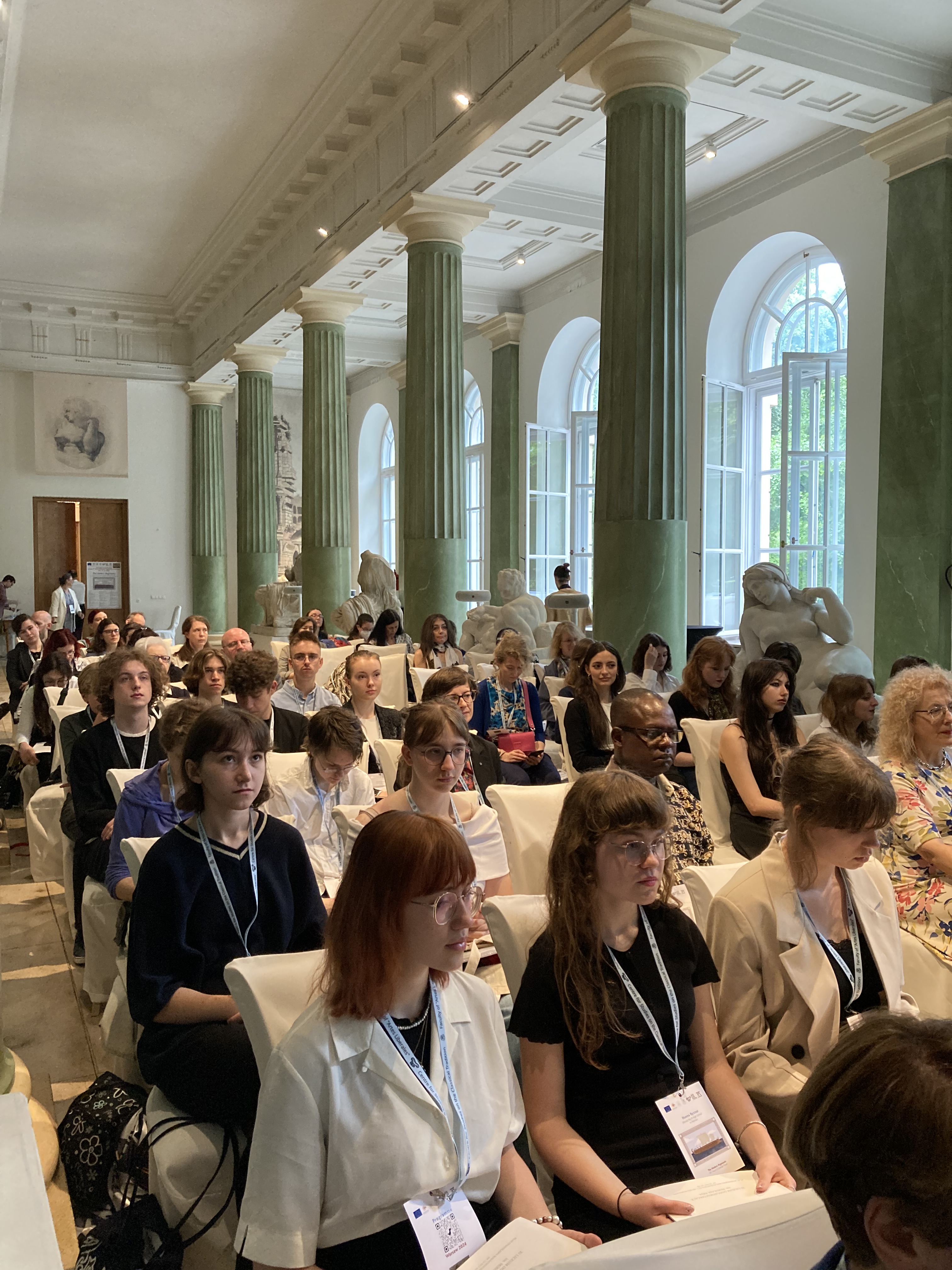
We are indebted to Professor Katarzyna Marciniak, Faculty of “Artes Liberales”, University of Warsaw, for creating such a wonderful opportunity for Roehampton students to share their insights with wider audiences, following on from Prof. Marciniak’s talk about the new ERC Modern Argonauts project during Roehampton Futures week in Spring 2024.
Artistic styles evolve and shift from one period to the next. A specific shift in style is observable in stone bodies from the Archaic period (ca. 650–480 BC) and the Classical period (ca. 480–323 BC). Although such shifts in style have occurred numerous times throughout history, I will argue changes in any artistic style rely on the connected relationship between past and present periods. This concept is supported by several pieces of scholarship, which specifically suggest the Classical period is influenced by its predecessor, the Archaic period. To observe this change in stone bodies, what better example than the sculptures on the West and East pediments of the Temple of Aphaia? Using the Archaic example of a warrior on the West pediment and the Classical example of a warrior on the East pediment, I will highlight their contrasting styles and focus on the continuity that exists between both periods.

The historical context of the Temple of Aphaia helps us contextualize its pedimental sculptures. Built on the island of Aegina in ca. 500 BC, the Temple of Aphaia acted as a countryside shrine to the goddess Athena. In this case, Aphaia being an adjective for Athena, the word ‘aphaia’ means unseen. Although typically associated with fertility and agriculture, ceramics and other offerings such as “weapons, shields, and male figures” (Fendt 2019, 196) found in the temple suggest that visitors attended for the fertility of their community rather than for an individual. While there is an extensive history of people connected to this temple, the scope of this report does not allow for an in-depth analysis of such a history. Structurally, the temple represents the Doric order of Greek architecture. Its beautiful columns are topped with two triangular pediments on the West and East. Lavishly decorated and infused with sculptural battle scenes of the Trojan Wars, the pediments are the focus of this report.
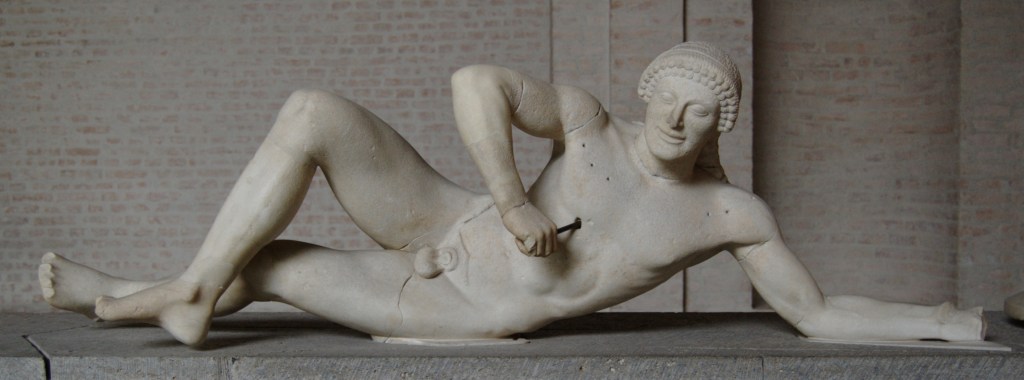
ca. 490 BC, Glyptothek, Munich [source].
Displaying an Archaic style of sculpture, the West pediment was completed ca. 490 BC. The first sculpture that I will be focusing on is the wounded warrior located in this pediment’s right corner (Fig. 1). This warrior has fallen back after being struck by a spear or arrow. Laying on his left hip and elbow, he is awkwardly propped up and presented forward to the audience. His right leg bends over the front of his body while he uses his right arm to pull out the weapon that is killing him. The warrior wears an animated smile typically referred to as an ‘Archaic smile’. In my opinion, this facial expression is an unnerving characteristic of the sculpture and prevents viewers such as myself from emotionally connecting with it. Realistically, a warrior who is dying on the battlefield would not be smiling. Although I believe the artist wants us to perceive the figure as dying in battle, his awkward posture and facial expression detract from the scene’s believability.
This proportional yet unrealistic body is similar to other sculptures of the Archaic period. A marble statue of a kouros youth (ca. 590–580 BC, Fig. 3) also depicts the ideal proportioned human body but lacks a realistic or natural quality. Consisting of a rigid stance with a singular leg pressed forward, “the pose provided a clear, simple formula that was used by Greek sculptors throughout the sixth century BC” (quote after the description at The Metropolitan Museum of Art, see below, Bibliography). Like the West pediment warrior, both sculptures focused on revealing the body rather than a natural human expression. Although rigid and unrealistic, the kouros body and the West pediment warrior are clear examples of the Archaic period.

ca. 480 BC, Aegina island, Glyptothek, Munich [source].
In contrast with the Archaic period, the East pediment displays a Classical style of sculpture and was completed ca. 480 BC. This pediment also includes a reclined warrior (Fig. 2); however, its style makes the narrative more believable. While attempting to push himself off the ground, the warrior maintains a contrapposto pose. Asymmetrical poses, such as that of the Kritios boy (ca. 480) from the Athenian Acropolis (Fig. 4), mark the transition to the Classical period. Because such sculptures utilize asymmetrical body alignment, the figures seem to move more naturally. Returning to the East pediment warrior, the figure attempts to push himself off the ground, twisting his shoulders forward and extending his arm across his torso. He holds a sword in his right hand while his left-hand struggles to remain attached to his shield. Despite having the slightest hint of a smile like Archaic traditions, the warrior’s body language makes it clear that he is in pain. The warrior looks down at the ground below, making eye contact with viewers and connecting with them emotionally. Unlike sculptures on the West pediment that tipped forward to reveal the full body, this warrior holds a realistic pose and was created to focus on the human experience. His muscles flow one into the other. In my view, this develops a real sense of skin and feeling, allowing external viewers to connect with his pain.

Fig. 4 Kritios Boy, ca. 480 BCE, Athenian Acropolis [source].
To properly analyze both pediments and their respective styles, it is necessary to highlight their similarities and differences. Both depict men wounded in battle, interact with other sculptures around them, and are in reclined positions on the outer corners of the pediment triangles. However, this is where a majority of the similarities stop. Although the pediments are thought to have been created within only ten years of one another (scholars suggest a ten year difference between the pediments, but we cannot date them with certainty; the sculptures may also be works from different groups of sculptors), several style changes separate the Archaic West and Classical East pediments. For example, an uncomfortable warrior pose was changed to a more natural and realistic pose. Deep divisions between muscles changed to smooth and complex skin. The tilted presentation of human anatomy changed to a focus on the human experience. Scholars point out such differences, focusing on the Classical period’s representation of human emotion.
Scholars suggest the Classical period produced “figures who we can believe are part of a story. It’s a story that we can begin to feel for them; we can sympathize with them” (Khan Academy, 10:52). While I agree with scholars that emotional complexity deepened in the Classical period, I would argue that such statements fail to acknowledge the other areas of continuity that existed between the Archaic and Classical periods. As previously mentioned, the evolution of art brings about shifts in style over time. While we mark these shifts in time with various period names, it would be naive to think such changes simply happen overnight, or that new periods are always entirely different from their predecessors. In the case of the Archaic period, I do not find it plausible that a style so highly regarded by society for so long could have come to an end so suddenly (see also Morgan 1969, 205: “No style so deeply rooted for so long in the eyes of all Greeks everywhere could have come to an instant and universal end”). Instead, I suggest the period’s ideas were influential to Classical style and were simply expressed in different ways.
In his most influential book, which analyzes the emergence of the Classical style, The Emergence of the Classical Style in Greek Sculpture (2010), Richard Neer focuses on this transition of periods and continuity between ideas. Guy Hedreen’s review of Neer’s book notes that the “Classical style of Greek sculpture does not represent a fundamental break with the values embodied in Archaic sculpture. The development of the Classical style was rather an intensification of the Archaic style in terms of its effects” (Hedreen, 2010: par. 2). In other words, the Classical style and all its physical and emotional changes were not brand-new. Rather, these changes were complex renditions of former Archaic principles. Without the Archaic period, we would not have the Classical period. Therefore, Neer’s conclusions emphasize the value of observing the differences and similarities in style.
Neer’s seminal book also highlights the value of ‘wonder’ across both Archaic and Classical sculpture. Hedreen is right to suggest that if a sculpture possesses wonder, it should seem simultaneously alien and familiar, far and close, inert and alive, absent and present (Hedreen, 2010: par. 2). When looking at the pedimental warriors in the Temple of Aphaia, ‘wonder’ may not seem obvious. Formerly painted in color, the white marble sculptures do not sparkle or catch the viewer’s eye. Despite this, ‘wonder’ can be perceived in the ‘alive’ qualities of the bodies. Their strange poses become understandable. However, the warriors seem bland compared to bodies from the Parthenon (ca. 447 BC). Parthenon sculptures include a more heightened sense of naturalism and wondrous effects. Displaying the Classical style at its best, Neer’s ‘wonder’ may be more easily identified in these later bodies. To reflect on this, I would argue that although major style changes are not immediately obvious between the two pediment warriors, changes in wondrous effects can be observed between the pediments and the art of the Parthenon.
In conclusion, I believe the Archaic and Classical periods maintain a connected and influential relationship – despite their many differences. If viewed in the context of sculptural stone bodies, it is clear that a continuity of ideas exists between both periods. The Temple of Aphaia specifically provides a unique opportunity to compare two similar sculptural scenes. Reportedly created only ten years apart, the pediments capture a moment of transition between Archaic and Classical sculptural styles. A depiction of two warriors dying in battle, the Archaic body uses proper proportions to present the human anatomy, whereas the Classical body uses complex musculature and expressions to present the human experience. Supported by scholars such as Richard Neer, it is clear that the Archaic and Classical periods depend on one another. Amidst all of these conclusions, there is something to be appreciated in both styles of sculptural bodies. Their wondrous effects allow present-day viewers a glimpse into the past.
Bibliography
Fendt, Astrid, “The Sculptures of the Temple of Aphaia on Aegina in their Contemporary Context”, in Olga Palagia and Elisavet P. Sioumpara, eds., From Hippias to Kallias: Greek Art in Athens and Beyond 527–449 BC, Athens: Acropolis Museum Editions, 2019, 193–204.
Hedreen, Guy, “Richard Neer, The Emergence of the Classical Style in Greek Sculpture”, Bryn Mawr Classical Review, Chicago–London: University of Chicago Press, 2010, https://bmcr.brynmawr.edu/2011/2011.07.42 (accessed July 5, 2024).
Khan Academy (Beth Harris and Steven Zucker), “East and West Pediments, Temple of Aphaia, Aegina” (video), Khan Academy, https://www.khanacademy.org/humanities/ancient-art-civilizations/greek-art/earlyclassical/v/east-and-west-pediments-from-the-temple-of-aphaia-aegina-c-490-480-b-ce (accessed February 26, 2024).
The Metropolitan Museum of Art, New York, Marble Statue of a kouros (youth), ca. 590–580 BCE, https://www.metmuseum.org/en/art/collection/search/253370 (accessed July 5, 2024).
Morgan, Charles H., “The End of the Archaic Style”, Hesperia: The Journal of the American School of Classical Studies at Athens 38.2 (1969), 205–212.
Neer, Richard, The Emergence of the Classical Style in Greek Sculpture, Chicago–London: University of Chicago Press, 2010.
Post by Lauren Husz, placed by Olga Strycharczyk













 Our Mythical Childhood Blog
-19.jpg)


