Teaching Ancient Greece: Lesson Plans, Animations, and Resources, ed. by Sonya Nevin

We are delighted to celebrate the publication of Teaching Ancient Greece: Lesson Plans, Animations, and Resources, the most recent result of the European Research Council (ERC) Consolidator Grant project Our Mythical Childhood… The Reception of Classical Antiquity in Children’s and Young Adults’ Culture in Response to Regional and Global Challenges. Teachers and other educators will find this open access volume a treasure trove of material for teaching and learning about ancient world topics, from pottery itself, through sacrifice, music, museums, poetry, drama, marriage, hunting, war and more.

The book Teaching Ancient Greece, edited by Dr Sonya Nevin is available in Open Access.

Teaching Ancient Greece was edited by Sonya Nevin, Assistant Professor at the University of Warsaw’s Faculty of “Artes Liberaes”. Dr Nevin works with animator Steve K. Simons on the Panoply Vase Animation Project, making short educational animations from real ancient artefacts. Where an ancient amphora shows the hero Heracles holding a boar, the animation shows him capturing it; where another vase shows the rainbow goddess Iris, the animation shows her flying, leaving rainbows streaking behind her. Five vase animations and four short documentaries were created for the Our Mythical Childhood project. They are based on five Greek vases from the collection of the National Museum in Warsaw. Now the animations and documentaries have been joined by Teaching Ancient Greece which transforms watching into a multitude of activities.

Dr Sonya Nevin with her book and the famous Sappho vase (no. 142333) in the National Museum of Warsaw.

Teaching Ancient Greece contains activity sheets, including ones for learning the Greek alphabet, matching gods to their symbols, and for colouring in vases and creating new vase designs. These are joined by a set of ready-to-use lesson plans for teaching about the ancient world. Created by experienced educators all over the world, each lesson plan contains an introduction, a lesson including one of the animations, and an exciting activity to extend the learning experience. The target audience is secondary school pupils, but the lessons can all be adapted for older or younger groups.
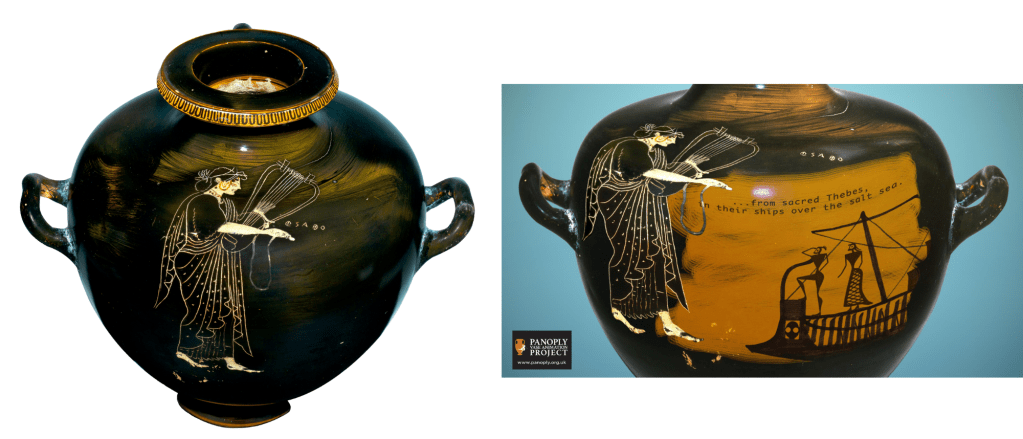
Left, an ancient Athenian vase depicting the poet, Sappho, and (right) a screenshot from the animation created from that vase.

Igor Cardoso in Brazil created a lesson about the poet Sappho, with writing activities about facing difficult situations. Ancient music specialist Aliki Markantonatou in Greece brings us a lesson on composing lyric poetry. This complements her recording of a unique version of one of Sappho’s poems, based on the music that the ancient poem would have been sung to. Ron Hancock-Jones in the UK used the Sappho animation to develop a lesson on marriage and relationships in ancient Greece. Chester Mbangchia in Cameroon created a lesson that introduces the god of drama, wine, and transformation – Dionysus. Theatre facilitator Olivia Gillman in the UK used the Dionysus animation as the basis for a drama class. Barbara Strycharczyk of “Strumienie” High School in Poland established a project for pupils in multiple years of the school who each worked towards an exhibition about the hero Heracles. Jessica Otto, in Germany, used the Heracles animation to show how stories can be represented and decoded through visual clues. Sonya Nevin offers several lessons on learning to “read” the images in Greek pottery, including one on the Libation animation, which shows the gods Zeus and Athena performing a libation sacrifice. Michael Stierstorfer in Germany used the same animation in a lesson about sacrifice in ancient Greece: what was done, how, and what it all meant. As for Iris, Dean Nevin in Switzerland brings us a writing challenge – messages for the rainbow messenger goddess to carry. Terri Kay Brown in New Zealand (Aotearoa) created an introduction to anthropology – a chance to compare different cultures’ myths about the rainbow and to consider what is indicated by the differences and similarities between them.

Right, a vase made in Athens in around 450 BCE, depicting the rainbow goddess Iris (no. 142289), and left, a creative version of the vase made by Temperance, aged 7, Ireland, using an activity sheet from the book.

Other lessons explore the world of museums themselves. Museum educator Jennie Thornber in the UK offers a lesson for exploring museums in person or online and taking on the role of a curator. A PowerPoint on the Panoply site is one of several providing extra support for these activities. Louise Maguire in Ireland set an alternative curator’s challenge, asking learners to consider factors such as planning, budget, and accessibility in planning exhibitions.
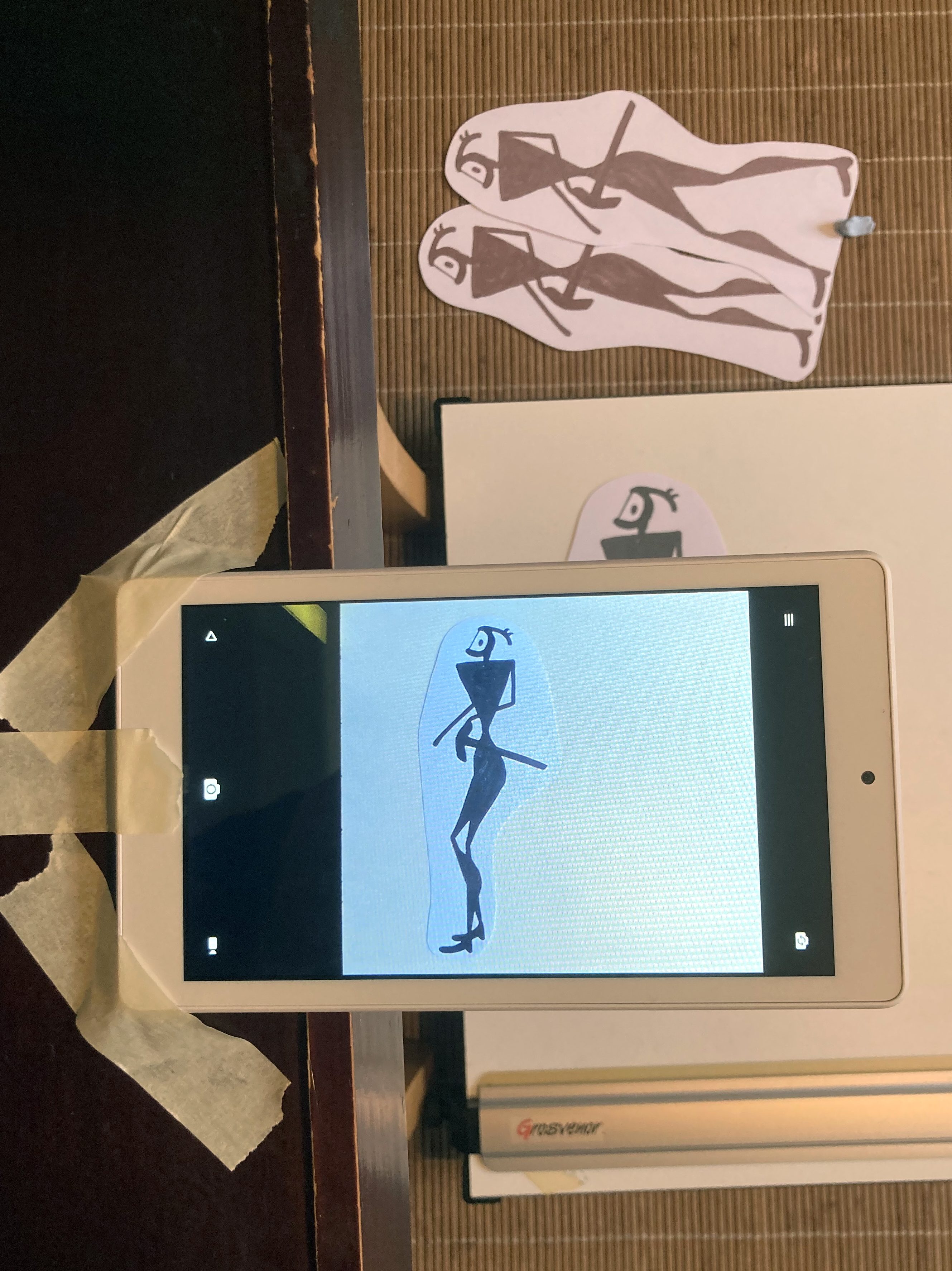
The book includes a detailed guide to making stop motions.
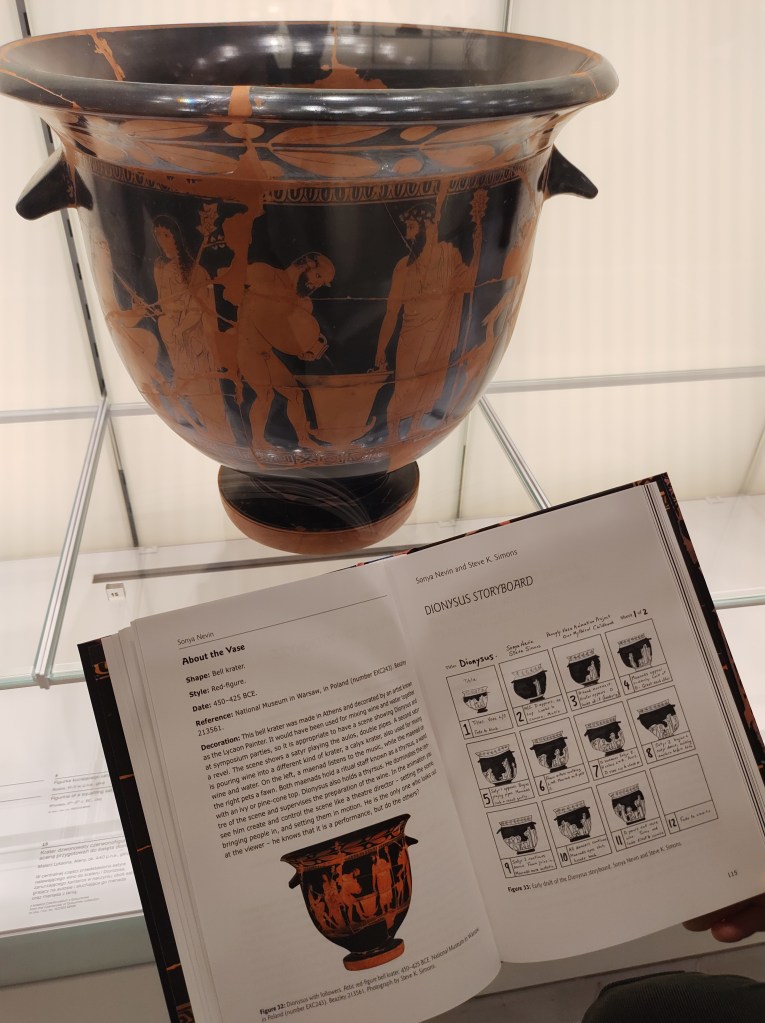
The vase (no. EXC243) used in the Dionysus animation and the storyboard used to plan it. Storyboarding is a great way for students to revisit what they have learned in a creative way.

Perhaps all this talk of animation makes you feel like having a go at making your own stop-motion animation. Christina DePian, a museum educator based in Greece, provides a detailed and accessible guide to making stop motions. Accompanied by a set of animation resources, this guide makes it easy for anyone from 5 to 105 to try animation and create their own version of antiquity.

Teaching Ancient Greece is an action-packed set of resources to make learning enjoyable, challenging, and memorable. Download your free copy here:
https://www.wuw.pl/product-eng-19615-Teaching-Ancient-Greece-Lesson-Plans-Vase-Animations-and-Resources-PDF.html

Post by the OMC Team, placed by Olga Strycharczyk.

***

Our Mythical Childhood website (ERC Consolidator Grant): http://omc.obta.al.uw.edu.pl/

The Modern Argonauts website (ERC Proof of Concept Grant): https://modernargonauts.al.uw.edu.pl/

The Public Reading of Aristophanes’ “Assemblywomen”, by Elena Mignani

Once again this year, the customary Public Reading of the Classics was held in collaboration with the Festival Européen Latin Grec and coordinated by Valentina Garulli, Professor of Greek Language and Literature at the University of Bologna. On 15 March 2024, at the Enzo Biagi auditorium of Bologna’s municipal library, “Salaborsa”, students from the city’s two classical high schools, Marco Minghetti and Luigi Galvani, presented a reading of passages from the Ekklesiazuse, or Assemblywomen by Aristophanes, a text selected by the Festival for this edition. You can see a short reportage about the project here:

In Preparation for the Reading: The Introductory Lectures
The public reading of the text, the final event of the project, was preceded as usual by four introductory lectures given by university professors in the previous weeks. The guests invited this year addressed the play from various perspectives, including that of the political utopia of women governing Athens  (Prof. Vinicio Tammaro, University of Bologna), and how the new laws promoted by this revolutionary government curiously seem to be found in much the same form in the ideal city theorised by Plato in the Republic (Prof. Andrea Capra, University of Milan). This mundus inversus was analysed by Prof. Markus Janka (Ludwig-Maximilians Universität) in its grotesque component, seen as a field of experimentation and a deforming mirror of social antinomies, also looking at the more modern reception of the work. The lecture by Prof. Pietro Totaro (University of Bari), examined in detail some of the final iambic scenes of the play, such as the one in which two old women vie for the company of a young man, by focusing in particular on some textual problems and the comic ideology that can be derived from them.

Third introductory lecture, by Prof. Pietro Totaro. Phot. Mattia Belletti.

Around the Reading: How to Bring Aristophanes Back on Stage
The choice of Assemblywomen was decidedly unexpected, but it was widely appreciated by both professors and students, who had the opportunity to experiment with new ways of translating and disseminating a classic text. Indeed, the first challenge began precisely when it came to choosing how to successfully translate an ancient work and, secondly, how to represent it in front of a contemporary audience. How can one gloss over the various unfamiliar proper names of politicians, strategoi, common citizens, that characterise the Aristophanic play and which, unfortunately, make it so inaccessible? How can one understand the historical context in which it was staged and at the same time equate a theatrical experience with a simple reading of the text?

Translation workshop. Phot. Mattia Belletti.

To achieve this goal, part of the project was dedicated to translation workshops run by master graduate students, in which high school students were able to test their translation skills, devising a translation that was not purely made for school but that was suitable for a public reading. The reading was also accompanied by photographic and musical aids that gave a clear picture of the scene being read and the actors involved. The participation of the students was essential also in these occasions: they contributed their musical and theatrical skills to the background music, to the two introductory and conclusive videos and some pictures, used during the reading itself. “A fruitful interweaving”, commented Domenico Alfano, an undergraduate student at the University of Bologna, which “significantly enhanced the visual experience of the spectator”.

Musical workshop. Phot. Mattia Belletti.

The Scenic and Visual Framework
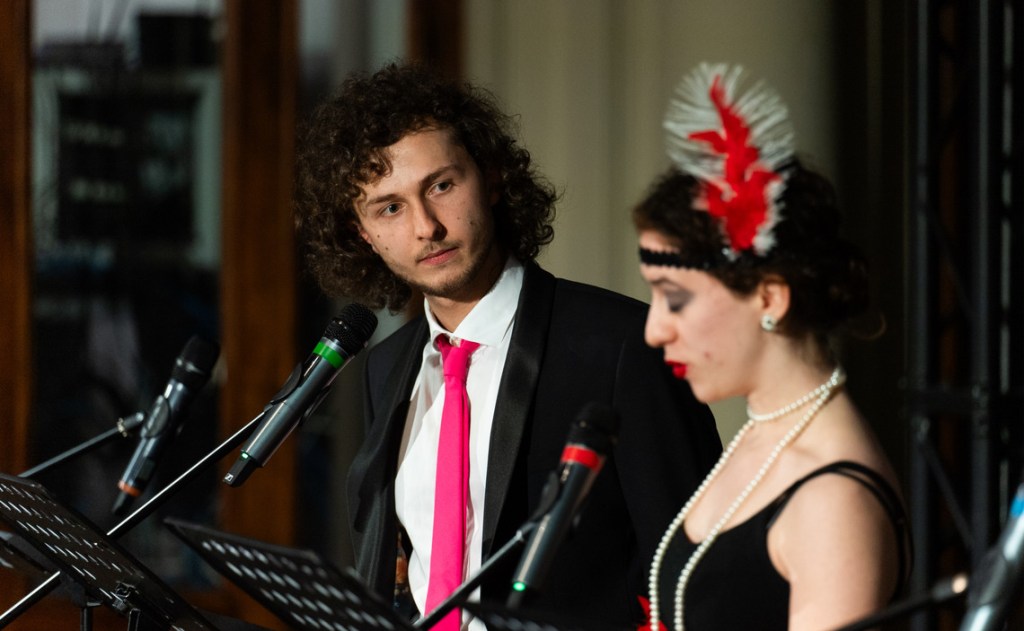
“They tell me to retire, that I am to be scrapped […]”. This is how the narrative framework chosen to accompany the comic text begins. Here, an old Aristophanes, played by Francesco Faccioli, and the Muse of the tragedy Thalìa, Noemi Coppola, discuss the possible plot of a play that was written after the decline of Athenian power in 392/1 BCE, Assemblywomen. The narrative frame perfectly introduces the play to the audience by setting it in its historical context. It also serves as a running thread that coherently connects the various textual sections chosen for reading. “A real added value to the reading”, commented Professor Sonia Stelluto of Luigi Galvani classical high school, “that helped to make the reading clearer and more accessible to a wider audience”.

Scenic Framework: Aristophanes and Thalia discussing about the plot of the play. Phot. Mattia Belletti.

And, while Aristophanes and Thalia imagine the plot of the future play in front of the audience, several Praxagora and Blepiros (the protagonists of the play) take turns on stage while being shown pictures that reflect the salient scenes read by the students.

Images of the reading: scene of Praxagora and Belpiros arguing. Phot. Mattia Belletti.

They are snapshots of a performance that is actually never performed but only imagined: in the introductory video (made by high school and university students coordinated by Mattia Belletti), under the notes of the can-can, the actors hurry to rehearse for the last time before the debut, while in the conclusive video the performance is already over, the audience applauds the actors and the musicians slowly prepare to leave the theatre. All we see on stage, however, are nothing more than the ideas of the playwright and the Muse taking shape and voice in the verses read by the students.

The Students’ Point of View: What Did It Mean for You to Participate?
At the end of the reading, the high school and university students who participated or only attended the reading were asked for their opinion on the project. For the high school students, the value of a project such as the public reading lies very much in the impact it can have on their approach to the classics: “I believe that participation in projects of this kind is fundamental in order not to reduce classicism to a static and distant, and merely scholastic, dimension. We students, as readers, were given the opportunity to revitalise the words of Aristophanes and in doing so we understood the choral nature of the theatrical process, as well as experiencing the emotions” (Letizia Cela, student at Liceo Classico Marco Minghetti, translator and reader).

Equally significant was this initiative to a more specialised audience such as university students.
How do you consider this experience from the point of view of a university student?
“For a university student, the experience is instructive and formative for at least two further reasons: it brings the conscience of the ancients back to the centre of public attention and guides us, thanks to the young and attentive eye of the students at Bologna’s classical high schools, to a new and intriguing way of interpreting and rereading Aristophanes” (Domenico Alfano, undergraduate student of Classics at the University of Bologna).

What do you think about the participation of high school students in a university project?
“I think that the involvement of high school students is praiseworthy: the opportunity to engage in translation work, to personally confront the works, also in terms of their updating, are all elements that I think can really make us reflect on the value of the classics even in today’s world” (Beatrice Bonazza, graduate student in Classics at the University of Bologna).

Hopes and Resolutions for the Upcoming Year
This year’s reading, which was able to involve and entertain such a diverse audience, including high school and university teachers, students and a general audience, was therefore a great success that allowed, in the words of Domenico Alfano (undergraduate student), to “rediscover the beauty of going to the theatre: to purify oneself and reshape one’s spirit according to what one sees on stage”. Among the many goals for the next edition, which will have Seneca’s Medea as its text, there is certainly that of making the initiative accessible to an ever-wider audience so that, in the words of Beatrice Bonazza (master’s student), “the words of the classics and the reflections we can still draw from them reach more and more people”.

Link for the Reading:

Post by Elena Mignani, placed by Olga Strycharczyk