Blog for the international research project "Our Mythical Childhood… The Reception of Classical Antiquity in Children’s and Young Adults’ Culture in Response to Regional and Global Challenges", financed by the ERC Consolidator Grant led by Prof. Katarzyna Marciniak, Faculty of "Artes Liberales" of the University of Warsaw. Team members: Prof. Susan Deacy and Steve K. Simons, University of Roehampton; Prof. Elizabeth Hale and Dr Miriam Riverlea, University of New England; Prof. Lisa Maurice and Dr Ayelet Peer, Bar-Ilan University; Prof. Daniel A. Nkemleke, Dr Divine Che Neba and Dr Eleanor A. Dasi, University of Yaoundé I; Dr Elżbieta Olechowska, Dr Hanna Paulouskaya, Dr Sonya Nevin, Dott. Edoardo Pecchini, Marta Pszczolińska, Angelina Gerus and the Project Officers: Magdalena Andersen, Maria Makarewicz, and Olga Strycharczyk from the Faculty of "Artes Liberales" UW.
The project seminar on making Booktubes at the Benedictine secondary school in Schäftlarn near Munich, led by Dr Michael Stierstorfer, cooperation partner of the Our Mythical Childhood project, has been nominated for the German Reading Prize, which is endowed with several thousand euros. This is awarded in several categories to people who have made a special contribution to promoting and motivating reading.
Dr Michael Stierstorfer with the students from the P-Seminar Booktubes, phot. Otto Heitzer.
Together with his students, Dr Stierstorfer has also published book reviews focusing on Greek and Roman mythology in this context. The focus was on works from current children’s and youth literature. The students of the course are very pleased and are already very excited about the announcement of the prizes. The mythical short videos can be found under the following links on the Youtube channel GBS Booktubes:
Press articles on the nomination can be found here:
Schäftlarner Booktuber für den Deutschen Lesepreis nominiert
Das Projekt-Seminar zum Drehen von Booktubes des Gymnasiums der Benediktiner Schäftlarn bei München unter der Leitung von Dr. Michael Stierstorfer, Kooperationspartner des Projekts Our Mythical Childhood, wurde für den mit mehreren Tausend Euro dotierten deutschen Lesepreis nominiert. Dieser wird Personen, die sich besonders um die Leseförderung und Lesemotivation verdient gemacht haben, in mehreren Kategorien verliehen.
Dr. Michael Stierstorfer mit den Schülerinnen vom P-Seminar Booktubes, phot. Otto Heitzer.
Zusammen mit seinen Schülerinnen hat Stierstorfer in diesem Kontext auch Buchbesprechungen mit dem Fokus auf die griechisch-römische Mythologie veröffentlicht. Hierbei standen Werke aus der aktuellen Kinder- und Jugendliteratur im Vordergrund. Die Schülerinnen des Kurses freuen sich sehr und sind schon sehr nervös mit Blick auf die Bekanntgabe der Preise. Die mythischen Kurzvideos sind unter den folgendes Links auf dem Youtube-Channel GBS Booktubes zu finden:
Elena Mignani (b. 2000) graduated in Classical Studies at the University of Bologna, she attended the first year of Master in Classics at Bologna and will move to Oxford University to conclude her studies. She took part in the public reading of Aristophanes, organized by Prof. Valentina Garulli, and in the translation workshop curated by Prof. Garulli with Davide Lamandini (Master student at the University of Bologna).
Once again this year, the customary Public Reading of the Classics was held in collaboration with the Festival Européen Latin Grec and coordinated by Valentina Garulli, Professor of Greek Language and Literature at the University of Bologna. On 15 March 2024, at the Enzo Biagi auditorium of Bologna’s municipal library, “Salaborsa”, students from the city’s two classical high schools, Marco Minghetti and Luigi Galvani, presented a reading of passages from the Ekklesiazuse, or Assemblywomenby Aristophanes, a text selected by the Festival for this edition. You can see a short reportage about the project here:
In Preparation for the Reading: The Introductory Lectures The public reading of the text, the final event of the project, was preceded as usual by four introductory lectures given by university professors in the previous weeks. The guests invited this year addressed the play from various perspectives, including that of the political utopia of women governing Athens (Prof. Vinicio Tammaro, University of Bologna), and how the new laws promoted by this revolutionary government curiously seem to be found in much the same form in the ideal city theorised by Plato in the Republic (Prof. Andrea Capra, University of Milan). This mundus inversus was analysed by Prof. Markus Janka (Ludwig-Maximilians Universität) in its grotesque component, seen as a field of experimentation and a deforming mirror of social antinomies, also looking at the more modern reception of the work. The lecture by Prof. Pietro Totaro (University of Bari), examined in detail some of the final iambic scenes of the play, such as the one in which two old women vie for the company of a young man, by focusing in particular on some textual problems and the comic ideology that can be derived from them.
Third introductory lecture, by Prof. Pietro Totaro. Phot. Mattia Belletti.
Around the Reading: How to Bring Aristophanes Back on Stage The choice of Assemblywomen was decidedly unexpected, but it was widely appreciated by both professors and students, who had the opportunity to experiment with new ways of translating and disseminating a classic text. Indeed, the first challenge began precisely when it came to choosing how to successfully translate an ancient work and, secondly, how to represent it in front of a contemporary audience. How can one gloss over the various unfamiliar proper names of politicians, strategoi, common citizens, that characterise the Aristophanic play and which, unfortunately, make it so inaccessible? How can one understand the historical context in which it was staged and at the same time equate a theatrical experience with a simple reading of the text?
Translation workshop. Phot. Mattia Belletti.
To achieve this goal, part of the project was dedicated to translation workshops run by master graduate students, in which high school students were able to test their translation skills, devising a translation that was not purely made for school but that was suitable for a public reading. The reading was also accompanied by photographic and musical aids that gave a clear picture of the scene being read and the actors involved. The participation of the students was essential also in these occasions: they contributed their musical and theatrical skills to the background music, to the two introductory and conclusive videos and some pictures, used during the reading itself. “A fruitful interweaving”, commented Domenico Alfano, an undergraduate student at the University of Bologna, which “significantly enhanced the visual experience of the spectator”.
Musical workshop. Phot. Mattia Belletti.
The Scenic and Visual Framework “They tell me to retire, that I am to be scrapped […]”. This is how the narrative framework chosen to accompany the comic text begins. Here, an old Aristophanes, played by Francesco Faccioli, and the Muse of the tragedy Thalìa, Noemi Coppola, discuss the possible plot of a play that was written after the decline of Athenian power in 392/1 BCE, Assemblywomen. The narrative frame perfectly introduces the play to the audience by setting it in its historical context. It also serves as a running thread that coherently connects the various textual sections chosen for reading. “A real added value to the reading”, commented Professor Sonia Stelluto of Luigi Galvani classical high school, “that helped to make the reading clearer and more accessible to a wider audience”.
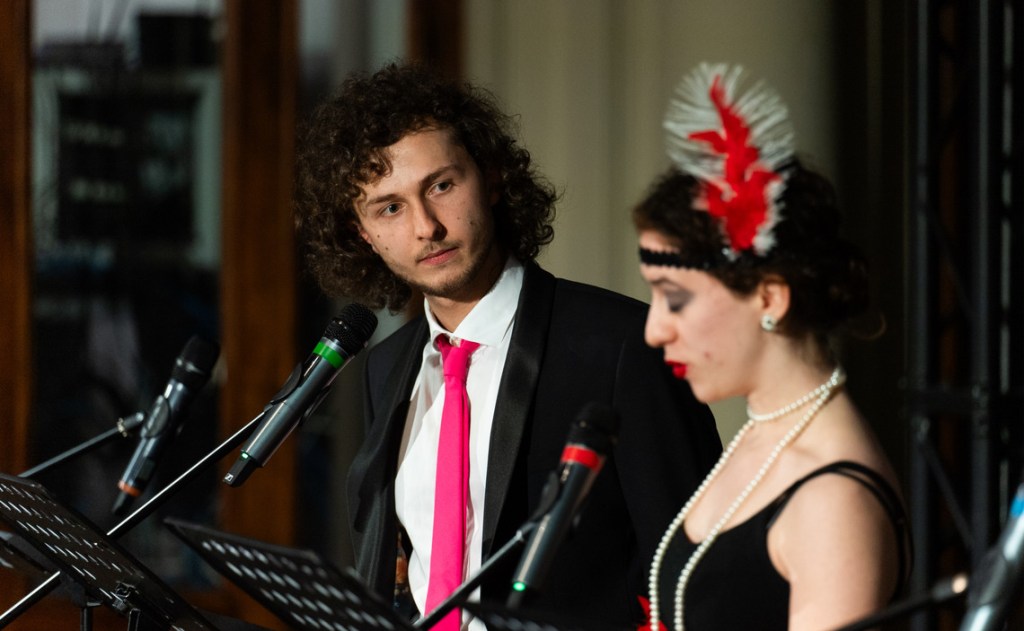
Scenic Framework: Aristophanes and Thalia discussing about the plot of the play. Phot. Mattia Belletti.
And, while Aristophanes and Thalia imagine the plot of the future play in front of the audience, several Praxagora and Blepiros (the protagonists of the play) take turns on stage while being shown pictures that reflect the salient scenes read by the students.
Images of the reading: scene of Praxagora and Belpiros arguing. Phot. Mattia Belletti.
They are snapshots of a performance that is actually never performed but only imagined: in the introductory video (made by high school and university students coordinated by Mattia Belletti), under the notes of the can-can, the actors hurry to rehearse for the last time before the debut, while in the conclusive video the performance is already over, the audience applauds the actors and the musicians slowly prepare to leave the theatre. All we see on stage, however, are nothing more than the ideas of the playwright and the Muse taking shape and voice in the verses read by the students.
The Students’ Point of View: What Did It Mean for You to Participate? At the end of the reading, the high school and university students who participated or only attended the reading were asked for their opinion on the project. For the high school students, the value of a project such as the public reading lies very much in the impact it can have on their approach to the classics: “I believe that participation in projects of this kind is fundamental in order not to reduce classicism to a static and distant, and merely scholastic, dimension. We students, as readers, were given the opportunity to revitalise the words of Aristophanes and in doing so we understood the choral nature of the theatrical process, as well as experiencing the emotions” (Letizia Cela, student at Liceo Classico Marco Minghetti, translator and reader).
Equally significant was this initiative to a more specialised audience such as university students. How do you consider this experience from the point of view of a university student? “For a university student, the experience is instructive and formative for at least two further reasons: it brings the conscience of the ancients back to the centre of public attention and guides us, thanks to the young and attentive eye of the students at Bologna’s classical high schools, to a new and intriguing way of interpreting and rereading Aristophanes” (Domenico Alfano, undergraduate student of Classics at the University of Bologna).
What do you think about the participation of high school students in a university project? “I think that the involvement of high school students is praiseworthy: the opportunity to engage in translation work, to personally confront the works, also in terms of their updating, are all elements that I think can really make us reflect on the value of the classics even in today’s world” (Beatrice Bonazza, graduate student in Classics at the University of Bologna).
Hopes and Resolutions for the Upcoming Year This year’s reading, which was able to involve and entertain such a diverse audience, including high school and university teachers, students and a general audience, was therefore a great success that allowed, in the words of Domenico Alfano (undergraduate student), to “rediscover the beauty of going to the theatre: to purify oneself and reshape one’s spirit according to what one sees on stage”. Among the many goals for the next edition, which will have Seneca’s Medea as its text, there is certainly that of making the initiative accessible to an ever-wider audience so that, in the words of Beatrice Bonazza (master’s student), “the words of the classics and the reflections we can still draw from them reach more and more people”.
Link for the Reading:
Post by Elena Mignani, placed by Olga Strycharczyk



 Our Mythical Childhood Blog