Art & Life in the Ancient World: Winckelmann’s Ideas about Beauty vs. Small and Portable Functional Objects from Classical Antiquity, by Alexandria Kilmartin

Acknowledgements
We are most grateful to Professor Katarzyna Marciniak and her team at the University of Warsaw for this opportunity to publish coursework by University of Roehampton Study Abroad. Below statement and essay by international student Alexandria Kilmartin who joined us at Roehampton all the way from Australia.

***

My name is Alexandria Kilmartin, but I go by Alex, and I am a study abroad student at the University of Roehampton. When not abroad, I study at Macquarie University, in Sydney, Australia, where I am completing a double degree of a Bachelor of Arts, majoring in Ancient History and a Bachelor of Linguistics and Language Sciences. I am a first-generation University student in my family and when I complete my undergraduate studies, I am aiming towards completing a masters in either speech pathology or furthering my historical research studies. Personally, and in my leisure time, I enjoy reading novels, I love the beach and going on long walks and getting coffees with my friends. I decided to select the Art & Life in the Ancient World course at Roehampton because I have always loved and appreciated art, and I was intrigued in developing deeper ideas surrounding art in Antiquity. The course connected with my purpose and decision to select the University of Roehampton and its specific location in proximity to the British Museum, as it has been a dream of mine to visit.

The Art & Life in the Ancient World module has significantly impacted how I view, interpret and interact with ancient art and has helped me develop ideas and evolve concepts in my academic work. Winklemann’s ideas originally interested me because of his perception of aesthetic and beauty standards. His ideas are incredibly evident in society today and, drawing from personal experiences as a young woman, I feel the connection between beauty and (face) value. Many ideas that are elaborated on in my essay I personally resonate with and that is why I was and am so passionate about this topic. I wanted to acknowledge that ideas of beauty are multifaceted and that beauty is in the eye of the beholder. Having the opportunity to be able to publish my work is an incredible opportunity and I am honoured to have been considered for this. I believe that this opportunity will significantly help my career in an overwhelmingly positive way and help me take a step closer to achieving my academic goals of completing a masters, furthering my education and deeper understanding of the world.

To what extent can we apply Winckelmann’s ideas about beauty to small and portable functional objects from Classical Antiquity? Discuss with reference to at least two objects.

Johann Joachim Winckelmann (1717–1768) has provided valuable ideas and perspectives on aesthetic, beauty, knowledge and understanding in his 1764 publication History of the Art of Antiquity (Geschichte der Kunst des Alterthums, 1764).[1] Winckelmann has significantly contributed and inspired the classical archaeology discipline and study of neoclassical art. This essay will elaborate on how Winckelmann’s ideas about beauty can be successfully placed on humble, portable and functional objects. The pieces under discussion are a “Bronze Mirror with a support in the form of a draped woman” (mid-5th century BCE)[2] and secondly a “clay lekythos” (1st quarter of 5th century BCE) attributed to the Manner of the Haimon Painter.[3]

These functional objects are kept in the Metropolitan Museum of Art in New York and the study of these humble objects with reference to Winckelmann’s ideas can significantly contribute to an understanding of the importance of beauty juxtaposed to functionality, and if these concepts are exclusive. I will argue that Winckelmann’s ideas of subjective aesthetics can be used as a foundational assessment in attributing beauty and overall purpose. Specifically, that a more nuanced and less context-specific approach is required in assessing beauty and that functionality is more significant and equally as beautiful. There is scope for a more in-depth study of small finds in museum collections for a broader appreciation of ancient art and life.

Figure 1 Anton Raphael Mengs, Johann Joachim Winckelmann (1717–1768), ca. 1777, The Metropolitan Museum of Art, no. 48.141, Public Domain [source].

Winckelmann is commonly attributed as “a source of inspiration for neo-classical art in the late eighteenth and early nineteenth century” and is seen as the father of the classical archaeology discipline.[4] His History of the Art of Antiquity became a foundational text in neoclassical thought, shaping ideas about specific aesthetics and the idealized European body. Winckelmann believed that Greek art was the epitome of artistic creation and the experience of viewing it provoked joy. Based primarily on sculpture of the human physique, Winckelmann’s ideas are characterized by an unrealistic physical representation of the most elite and sophisticated Greek aesthetics. Winckelmann’s ideas assessed aesthetics in a philosophical and context specific manner that inspired subsequent generations of historians, artists and museum professionals. His publications encouraged enlightened intellectual inquiry on art history and philosophical aesthetics in eighteenth-century Germany. Classical scholar Katherine Harloe, for example, explores how Winckelmann’s ideas impacted German classicists from the 1840s.[5]

In my view, Winckelmann’s ideas provoke thoughtful discussions about ancient objects, their representations, and their surrounding context. The objects selected have been chosen because of their interaction with and representation of the human body, as well as their functional incorporation of movement. A key idea of Winckelmann’s “Rules of perspective” is that “[a]ll the arts have a double goal: they should give pleasure and at the same time instruct”.[6] This highlights that Winckelmann believed that something should be learnt from art. Thus, the objects under discussion are significant and I believe that the basic principles of Winckelmann’s ideas can be applied. Arguably, the rich historical, social and human interactions with functional material culture and the aesthetics of daily life are all ultimately beautiful and educational.
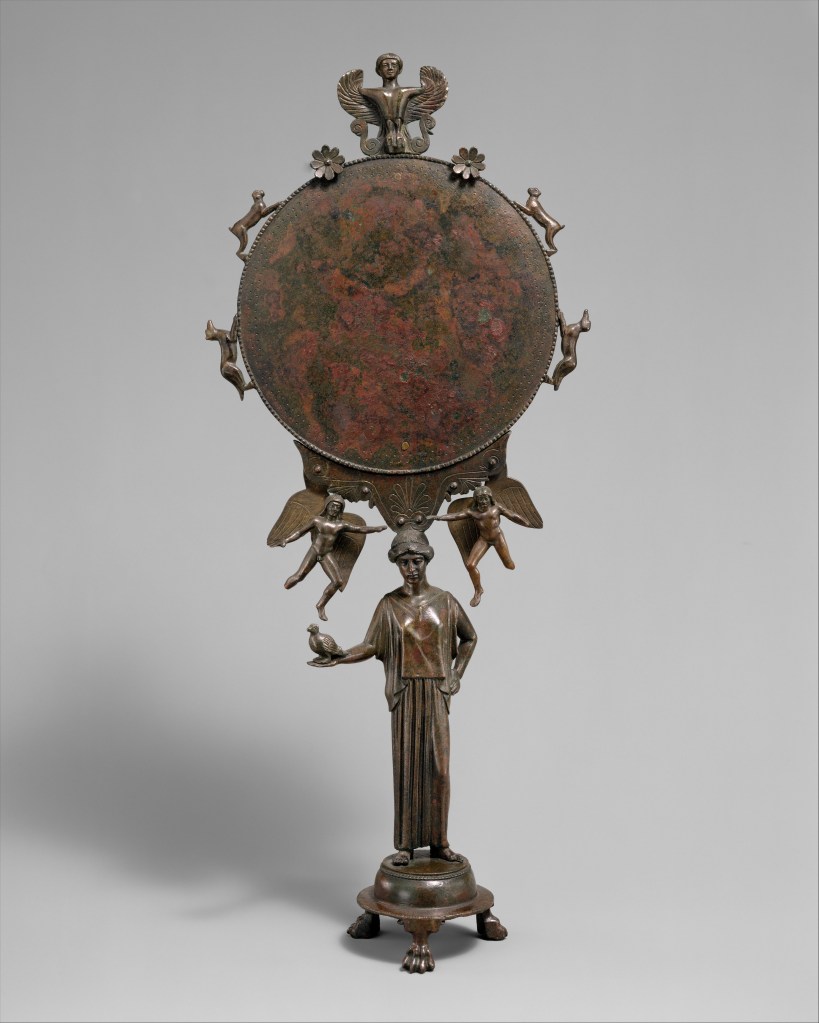
Figure 2 Greek, Argive bronze mirror with a support in the form of a draped woman, mid-5th century BCE, The Metropolitan Museum of Art (number 1972.118.78) [source].

The first object under analysis is a finely crafted bronze mirror from the mid-5th century BCE (Figure 2). The mirror incorporates a statuette of a three-dimensional female figure as a base that supports the mirror. The design of a statuette figure in a functional object is a “hallmark of Greek art”[7], thus I believe that this particular representation of the human body would be an object that Winckelmann’s ideas can be applied to. The mirror features a collection of lively elements such as a human figure as well as animal and mythological creatures. Winged Erotes fly above the female statue’s head. Surrounding the mirrored disk are symmetrical pairs of hounds chasing hares, leading to the top of the mirror where a part bird, part woman siren is perched. Made out of a bronze, approximately 40,4 cm heigh and weighing 0,9 kg, the mirror was found in an Argive grave. The object relates to the human body by sensory, visual and physical touch experiences and displays visual aspects that reflect the classical period and context in which it was made.

The imagery and simplistic action of the woman ultimately holding up the mirrored disk contributes to a deeper metaphor and symbolism of beauty and connects to Winckelmann’s ideas about aesthetics. The stance and posture of the female statuette supports the mirror, simultaneously supporting the female or user of the mirror in their quest for beauty and their interaction with their appearance. “Her serious expression and quiet stance are typical of the retrained early Classical statues that were created from about 480 to 450 BC”, according to the MET online entry.[8] This mirror preserves and perpetuates symbolism of an idea of beauty that must be obtained, societal standards and epitome of beauty and self image. The entirety of the object includes symbolic motifs of beauty and subconscious undertones of elements of feminity. The object itself serves a functional purpose of providing a reflection. The statuette that supports the mirror is beautiful and delicate as it does reflect and reminds the viewer of monumental statues in stone, such as marble statues of Archaic korai dedicated on the Athenian Acropolis. Although the statuette aesthetically contributes to the overall beauty of the mirror, ultimately the most beautiful person is the user of the mirror and the human whose reflection is present. The functionality of the mirror provides a valuable and non-context specific idea of beauty that can be related to any human who uses the mirror.

Figure 3 Attributed to the manner of the Haimon Painter, Greek, Attic lekythos, 1st quarter of 5th century BCE, The Metropolitan Museum of Art (number 41.162.226) [source].

The second object chosen for discussion in reference to Winckelmann’s ideas is a cursorily decorated oil flask, a lekythos from ca. 480 BCE (Figure 3). The lekythos depicts a four-horse chariot, a charioteer and a warrior. Originating from the late Archaic period the medium used is terracotta and the technique is black figure. This is a small container of oil that measures approximately 18 cm. The lekythos is connected to Athens’ international trade and to how “between ca. 500 to 450 BCE Mediterranean markets were flooded with low grade products in black figure”.[9] The lekythos depicts the Apobates Race, in which a fully armed warrior, the apobates, jumped off a four-horse chariot, ran alongside it, and mounted the charion again. The image is symbolic of athletic achievement and victory at the Panathenaia, Athens’ most celebrated religious festival. Thus, the iconography is connected with Winckelmann’s ideas about the human body and its capabilities. Unlike the finely crafted and detailed sculptures in which Winckelmann’s views are mostly applied to, the lekythos lacks detail and refinement in its decoration. Nonetheless, it depicts a most significant Athenian cultural event and that is what makes it culturally important and pleasing to the eye.

Although Winckelmann’s ideas may have only specifically been intended for sculpture and the human body, particular ideas about beauty can be reimagined also in the context of humble and everyday functional objects. Ultimately, these objects immortalize beauty and remind us that beauty is in the eye of the beholder. Aesthetically, the mirror statuette is more beautiful than the sketchy drawing on the oil flask. The human figures on the lekythos lack any anatomical details. Winckelmann does state that “[t]he most beautiful human body in our world would probably not resemble the most beautiful Greek body”[10] and argues that the idealistic bodies sculpted were acquired through their lifestyle. To me, this signals an elite culture of training in the gymnasium and enjoying healthy food ways. Both objects, the mirror and the lekythos, require functional and bodily interactions when placed in the hands of ancient participants. More importantly perhaps, both objects related to ancient beautification and body care. A woman presumably saw her reflection in the mirror. Another person probably used the olive oil in the lekythos to spice food and/or for skin care after exercising. The mirror signals a pleasing appearance where one acts and sculpts one’s appearance to fit the cultural context of beauty, presumably as in monumental religious objects such as the Acropolis korai. Similarly, the lekythos depicts a male in his prime physical fitness who is able to run besides horses. The lekythos also incorporates the action of achievement and greatness which embodies accomplishment, the human spirit and its idealism.

Winckelmann’s formulations encompass multiple imaginary ideas about perfection and the capabilities of the (male) human body. They may apply to a beautifully crafted mirror handle and a drawing of a warrior-athlete, even when both these representations of the human form are small scale and entangled with the function of their respective objects. Surely, Winckelmann’s ideas are rigid and context-specific. Nonetheless, they hold merit and can be applied to small and portable functional objects from ancient art and life. Although these objects are not grand and fine artistic creations, they represent how functionality and beauty need not be mutually exclusive. Winckelmann’s ideas can serve as a platform to nuance the study of daily-life objects from the ancient world, beyond monumental sculpture and architecture that tend to receive masses of scholarly attention.


[1] Johann Joachim Winckelmann, “History of the Art of Antiquity”, in: Johann Joachim Winckelmann and David Carter, Johann Joachim Winckelmann on Art, Architecture, and Archaeology, trans., introduction and notes by David Carter, Rochester (NY): Camden House, 2013, pp. 32–55, 127–128.

[2] “Bronze mirror with a support in the form of a draped woman”, The Metropolitan Museum of Art, https://www.metmuseum.org/art/collection/search/255391 (accessed 3 November 2025).

[3] “Lekythos”, The Metropolitan Museum of Art, https://www.metmuseum.org/art/collection/search/254397 (accessed 3 November 2025).

[4] Amy C. Smith, “Winckelmann, Greek Masterpieces, and Architectural Sculpture. Prolegomena to a History of Classical Archaeology in Museums”, in: Achim Lichtenberger and Rubina Raja, eds., The Diversity of Classical Archaeology, “Studies in Classical Archaeology” 1, Turnhout: Brepols, 2017, pp. 1–33, via Central Archive at the University of Reading, https://centaur.reading.ac.uk/70169/1/Smith2018_preprint.pdf (accessed 3 November 2025).

[5] Eric M. Moormann, “[Review of] Winckelmann and Curiosity in the 18th-Century Gentleman’s Library: Christ Church Upper Library, 29 June – 26 October 2018 by Cristina Neagu, Katherine Harloe, and Amy Claire Smith”, Bryn Mawr Classical Review (2019) 2019.02.20, https://bmcr.brynmawr.edu/2019/2019.02.20 (accessed 3 November 2025).

[6] Johann Joachim Winckelmann, “History of the Art of Antiquity”.

[7] “Bronze mirror with a support in the form of a draped woman”, The Metropolitan Museum of Art.

[8] Ibidem.

[9] Jenifer Neils and Peter Schultz. “Erechtheus and the Apobates Race on the Parthenon Frieze (North XI–XII)”, American Journal of Archaeology, vol. 116, no. 2, 2012, pp. 195–200, DOI: 10.3764/aja.116.2.0195 (accessed 3 November 2025).

[10] Johann Joachim Winckelmann, “History of the Art of Antiquity”.


Bibliography

“Bronze mirror with a support in the form of a draped woman”, The Metropolitan Museum of Art, https://www.metmuseum.org/art/collection/search/255391 (accessed 3 November 2025).

“Johann Joachim Winckelmann (1717–1768)”, The Metropolitan Museum of Art, https://www.metmuseum.org/art/collection/search/437067 (accessed 3 November 2025).

“Lekythos”, The Metropolitan Museum of Art, https://www.metmuseum.org/art/collection/search/254397 (accessed 3 November 2025).

Moormann, Eric M. “[Review of] Winckelmann and Curiosity in the 18th-Century Gentleman’s Library: Christ Church Upper Library, 29 June – 26 October 2018 by Cristina Neagu, Katherine Harloe, and Amy Claire Smith”, Bryn Mawr Classical Review (2019) 2019.02.20, https://bmcr.brynmawr.edu/2019/2019.02.20 (accessed 3 November 2025).

Neils, Jenifer and Peter Schultz. “Erechtheus and the Apobates Race on the Parthenon Frieze (North XI–XII)”, American Journal of Archaeology, vol. 116, no. 2, 2012, pp. 195–200, DOI: 10.3764/aja.116.2.0195 (accessed 3 November 2025).

Orrells, Daniel “[Review of] Winckelmann and the Invention of Antiquity: History and Aesthetics in the Age of Altertumswissenschaft. Classical presences by Katherine Harloe”, Bryn Mawr Classical Review (2014) 2014.12.06, https://bmcr.brynmawr.edu/2014/2014.12.06 (accessed 3 November 2025).

Smith, Amy C. “Winckelmann, Greek Masterpieces, and Architectural Sculpture. Prolegomena to a History of Classical Archaeology in Museums”, in: Achim Lichtenberger and Rubina Raja, eds., The Diversity of Classical Archaeology, “Studies in Classical Archaeology” 1, Turnhout: Brepols, 2017, pp. 1–33, via Central Archive at the University of Reading, https://centaur.reading.ac.uk/70169/1/Smith2018_preprint.pdf (accessed 3 November 2025).

Winckelmann, Johann Joachim “History of the Art of Antiquity”, in: Johann Joachim Winckelmann and David Carter, Johann Joachim Winckelmann on Art, Architecture, and Archaeology, trans., introduction and notes by David Carter, Rochester (NY): Camden House, 2013, pp. 32–55, 127–128.

Post by Alexandria Kilmartin, prepared under tutorship by Dr Katerina Volioti, placed by Olga Strycharczyk
Schäftlarn Students on the Big Screen at the Brandenburg Gate at the Teacher Award Ceremony – An Amazing Ceremony and Honour for Our School [ENG/GERMAN]

The day of the award ceremony was very eventful; instead of a quiet breakfast, interviews with countless Bavarian radio stations began at 8 a.m. Then, a brisk sprint to the futuristically designed Axica Hall in Berlin, situated between the venerable Hotel Adlon and the Brandenburg Gate, was followed by the beginning of the ceremony. After a cool performance by poetry slammer and cabaret artist Lars Ruppel, the first certificates were presented by Jurors renowned in the field of education. The board of the Heraeus Educational Foundation and the German Philologists’ Association then offered their warm congratulations to the teachers.

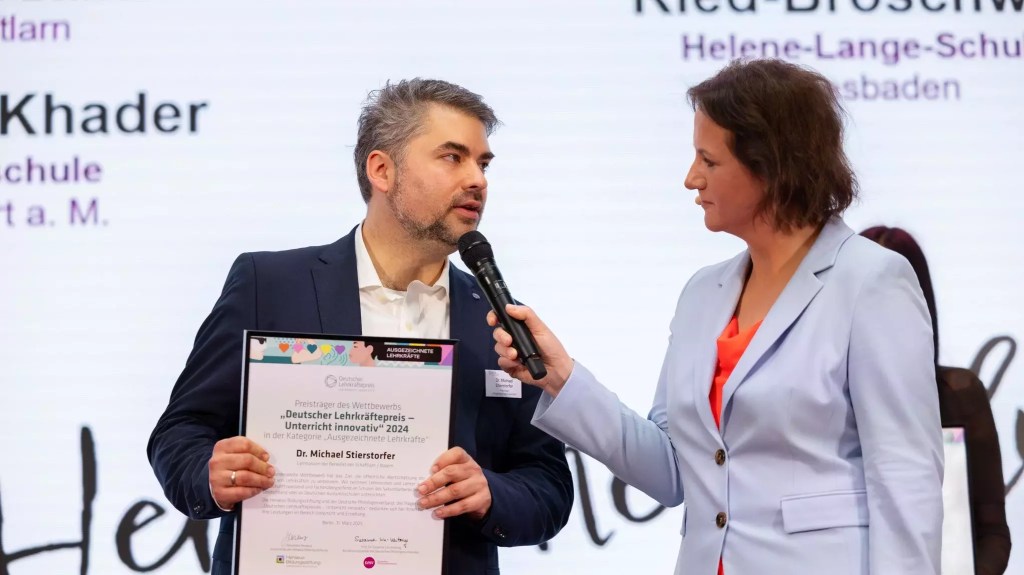
Dr Michael Stierstorfer receveing the German Teacher Award in the “Outstanding Educators” category – phot. Lehrkräftepreis [source].

In conversation, the very charming host, Alexandra Heraeus, told me that she also lives in Bavaria (Germany) near the school of Schäftlarn. What a small world. An invitation to the monastery was immediately extended. Next, our upper school students appeared on the big screen and explained to the experts what, in their view, constitutes outstanding teaching and what makes an exceptional teacher.

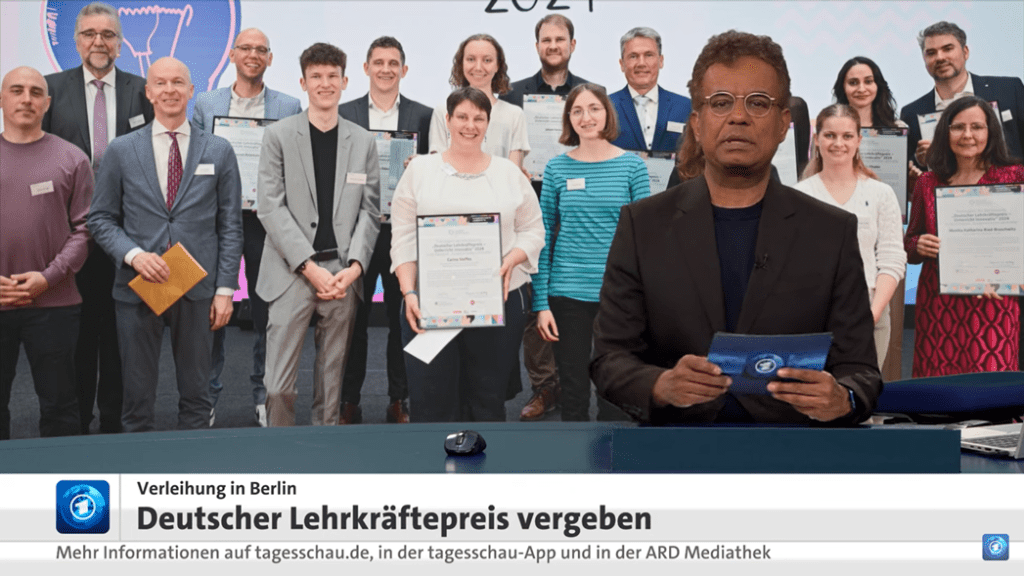
Laureates of the German Teacher Award for “Outstanding Educators”, for innovative teaching methods and exemplary school management – phot. Tagesschau [source].

After a performance by education influencer Emily Hornbach, the other prizes in categories such as “Innovative Teaching”, “Cultural Education”, and “Environment and Sustainability” were awarded. At the end of this brilliant ceremony, numerous interviews followed with BR, ZDF-Phoenix, and other audiovisual media. After this press marathon, delicious snacks were served to restore everyone’s strength, which rounded off the event perfectly. Here are excerpts from the Jury’s reasoning for my award:
Special qualities according to the students include creative, innovative, and future-oriented teaching, enthusiasm, extensive use of modern media and techniques, integration of external experts into lessons, strong commitment, and the incorporation of the students’ own world into the classroom.
(German Teacher Award – Innovative Teaching)

A reportage by the SAT.1 Bayern TV.

Quotations from students’ assessment:
Overall, in our opinion, Mr. Stierstorfer is the most innovative teacher in the country – after all, which other teacher has their own YouTube channel?

Mr. Stierstorfer inspires us with enthusiasm and motivation because he is cheerful when he comes to class every day, always gives appropriate feedback, and his enthusiasm is contagious, as he wants to bring out the best in each of us.

In Mr. Stierstorfer’s classes, everyone can be themselves because he gives feedback at eye level and, through his joyous and strongly optimistic manner, also supports students who are average or weaker.

Moreover, Mr. Stierstorfer consistently stands up for his democratic and humanistic values, which are also reflected in the topics of our “Booktubes”, ranging from political issues to inclusion.

He is the creative “super teacher” at our school and a genuinely great character!

He always tries, by all means, to make something special possible for his students something that will remain in our life memories.

Mr. Stierstorfer fulfills all the criteria you have mentioned outstandingly.

Mr. Stierstorfer is truly a teacher with heart and soul and a considerable portion of humorous creativity, which for us students is the absolute non plus ultra. That’s why many grades always hope to have him as their teacher.

[…] In this context, he also created an innovative learning circle, which we found very enriching for our lessons because it contained great visuals along with vocabulary and grammar aids. This circle focuses on the popular topic of the reception of Ovid’s Metamorphoses.

Interview for the Science Blog of the University of Regensburg:
https://blog.uni-regensburg.de/bildung-mit-wirkung

An interview by Susanne Brückner for the 95.5 Charivari Radio.

Post by Michael Stierstorfer (based on https://www.abtei-schaeftlarn.de/gymnasium-internat/aktuelles), placed by Olga Strycharczyk.


Schäftlarner Schüler auf Großleinwand am Brandenburger Tor beim Lehrkräftepreis – Eine unglaubliche Verleihung und Ehre für unsere Schule

Der Tag der Verleihung war sehr ereignisreich, anstatt eines ruhigen Frühstücks standen ab 8 Uhr Interviews mit unzähligen bayerischen Radiosendern an. Dann ging die Verleihung nach einem sportlichen Sprint zur futuristisch designten Axica-Halle in Berlin, die zwischen dem altehrwürdigen Hotel Adlon und dem Brandenburger Tor gelegen ist, die Verleihung los. Nach einer coolen Poetry-Slammer Performance von Kabarettist Lars Ruppel, wurden die ersten Urkunden von den namhaften Jurorinnen und Juroren aus der Bildungsszene vergeben: Der Vorstand der Heraeus Bildungsstiftung und der des Deutschen Philologenverbands gratulierten sodann uns Lehrkräften sehr herzlich.

Dr. Michael Stierstorfer bei der Verleihung des Deutschen Lehrkräftepreises in der Kategorie „herausragende Lehrkräfte“ – Foto: Lehrkräftepreis [source].

Im Gespräch verriet mir die sehr sympathische Gastgeberin Alexandra Heraeus, dass sie ebenso im Bundesland Bayern (Deutschland) und sogar ganz in der Nähe des Klosters Schäftlarn wohne. So klein ist die Welt. Eine Einladung ins Kloster wurde sogleich ausgesprochen. Als Nächstes erschienen unsere Oberstufenschülerinnen und Schüler auf Großleinwand und erklärten den Experten, was in ihren Augen herausragender Unterricht sei und was eine besondere Lehrkraft ausmache.

Die Preisträgerinnen und Preisträger des Deutschen Lehrkräftepreises in den Kategorien „herausragende Lehrkräfte“, „Unterricht innovativ“ und „vorbildliche Schulleitung“ – Foto: Tagesschau [source].

Nach einem Auftritt der Bildungsinfluencerin Emily Hornbach wurden noch die  anderen Preise der anderen Kategorien wie Unterricht Innovativ, Kulturelle Bildung oder Umwelt und Nachhaltigkeit verliehen. Am Ende dieser genialen Verleihung folgten noch zahlreiche Interviews mit dem BR,  ZDF-Phoenix und anderen audiovisuellen Medien. Nach diesem Presse-Marathon gab es zur Stärkung des leiblichen Wohls sehr leckere Häppchen, wodurch die Veranstaltung passend abgerundet wurde. Auszüge aus der Jury-Begründung für meinen Preis finden sich hier:
Besondere Eigenschaften laut Schülerinnen und Schülern: Kreativer, innovativer und zukunftsorientierter Unterricht, Begeisterungsfähigkeit, umfangreicher Einsatz moderner Medien und Techniken, Einbindung externer Experten in den Unterricht, hohes Engagement, Integration der Lebenswelt der Schülerinnen und Schüler in den Unterricht. (Deutsche Lehrkräftepreis – Unterricht innovativ)

Eine Fernseh-Reportage von Sat. 1 Bayern.

Direktes Lob von Schülerinnen und Schülern:
Insgesamt ist Herr Stierstorfer – also unserer Meinung nach – der innovativste Lehrer im Land, oder welche Lehrkraft hat schon seinen eigenen Youtube-Channel?

Herr Stierstorfer steckt uns dadurch mit Begeisterung und Motivation an, dass er jeden Tag gut gelaunt ist, stets passendes Feedback gibt und sein Enthusiasmus auf uns überspringt, weil er aus jedem von uns das Beste herausholen will.

Im Unterricht von Herrn Stierstorfer kann jeder er selbst sein, weil er den Schülern das Feedback auf Augenhöhe gibt und auch mittlere und schlechtere Schüler durch seine positive und stark optimistische Art mitzieht.

Zuletzt steht Herr Stierstorfer stets für seine demokratischen und humanistischen Werte ein und dies zeigen auch die Themenfelder unserer Booktubes, die von politischen Aspekten bis hin zu Inklusion reichen.

Er der kreativköpfige Superlehrer unserer Schule und ein super Charakter!

Er versucht immer mit allen Mitteln seinen Schülerinnen und Schülern etwas Besonderes zu ermöglichen, was uns fürs Leben im Gedächtnis bleiben soll.

Herr Stierstorfer erfüllt all die von Ihnen genannten Kriterien in herausragender Weise.

Herr Stierstorfer ist wirklich Lehrer mit Leib und Seele und einer riesigen Portion lustiger Kreativität, das ist für uns Schüler das non plus ultra. Daher wünschen sich viele Klassen stets ihn als Lehrer.

[…] In diesem Kontext hat er auch einen innovativen Lernzirkel erstellt, den wir für den Unterricht sehr bereichernd fanden, weil darin tolle Bilder mit Vokabel- und Grammatikhilfen sind.

Interview für den Science Blog der Universität Regensburg:
https://blog.uni-regensburg.de/bildung-mit-wirkung

Ein Interview von Susanne Brückner für 95.5 Charivari Radio.

Post von Michael Stierstorfer (auf Basis von https://www.abtei-schaeftlarn.de/gymnasium-internat/aktuelles), eingetragen von Olga Strycharczyk.

The Portland Vase, by Rachel Rajamoney

Acknowledgements
We are extremely grateful to Professor Katarzyna Marciniak for enabling, once again this year, the publication of student work in the blog of international research project Our Mythical Childhood. International collaborations mean a lot to the Study Abroad Team of the University of Roehampton, and to me personally, Katerina Volioti, as teacher and facilitator of multidisciplinary modules in practical Humanities.

***

My name is Rachel Rajamoney, and I’m currently pursuing a B.S. in Data Science with a minor in Mathematics at Texas Christian University, where I’m also a member of the John V. Roach Honors College. I’m studying abroad this term (Spring 2025) at the University of Roehampton in London, which has given me the opportunity to engage deeply with interdisciplinary perspectives, particularly through the Art & Life module. This class challenged me to look beyond data and code and consider the cultural and embodied dimensions of ancient artifacts.

Through this assignment, I’ve not only developed stronger research and analytical skills, but also advanced my abilities in public speaking, visual communication, and critical storytelling – skills that are essential both in academic and professional environments. My academic background in artificial intelligence and data science shaped how I approached the digital museum critique, especially in recognizing the missed potential for immersive and interactive technologies like VR, haptics, and AI-driven storytelling to restore context and meaning to historical objects.

As someone aspiring to a career that bridges quantitative analysis and strategic decision-making, whether in capital markets, technology, or cultural analytics, this experience reminded me that data is not just numerical. It is narrative. Digital humanities and AI can play a powerful role in revitalizing our relationship with the ancient world, not by replacing human interpretation, but by expanding access, interactivity, and imagination in how we engage with the past.

Before I begin, I’d like to acknowledge the remarkable efforts of curators and museum professionals who care for ancient objects like the Portland Vase. While my presentation offers a critique of certain curatorial approaches, it is not intended to diminish their work. Rather, I approach this as an engaged member of the public – someone with a strong interest in both material culture and digital innovation. I hope to contribute constructively to ongoing conversations about how museums might experiment with new tools that enhance public understanding, especially through sensory engagement and storytelling. This presentation is offered in the spirit of shared curiosity and collaborative improvement.

The Portland Vase, Roman cameo-glass amphora, ca. 1–25, The British Museum, no. 1945,0927.1 [source], © The Trustees of The British Museum. Shared under a Creative Commons Attribution-NonCommercial-ShareAlike 4.0 International (CC BY-NC-SA 4.0) licence.
Today, we’ll discuss the Portland Vase, a Roman cameo-glass masterpiece, dating broadly to 1–25 CE.[1] Named after the Duke of Portland, one of its former owners, the vase is renowned for its unique layered glass decoration, likely imitating monumental sculpture, making it unparalleled in Classical Antiquity. But it was never meant to be a museum artifact. I’ll unravel how people engage bodily with this wine jar as an embodied object, arguing that its museum afterlife renders it disembodied.

A close-up of vase-carvings, Roman banquet [source], © The Trustees of The British Museum. Shared under a Creative Commons Attribution-NonCommercial-ShareAlike 4.0 International (CC BY-NC-SA 4.0) licence.

In elite Roman symposia, the Portland Vase was no passive ornament but an active participant in wine service and hospitality. While other Roman glass vessels existed, none matched the Portland Vase’s technical sophistication or narrative complexity, it remains unparalleled. William Gudenrath, Kenneth Painter, and David Whitehouse’s technical analysis reveals the vase was blown and cased with opaque white over deep blue glass, then meticulously carved, a process requiring such precision that modern reproductions often fail.[2] Maude Haywood notes, in The Decorator and Furnisher, that even Wedgwood’s famed reproductions couldn’t replicate its layered glass technique.[3] This confirms its status as a masterwork of Roman glass technology. When handled during symposia, its mythological scenes – such as that of Peleus and Thetis – provoked philosophical discourse about desire and restraint. The vase became an item of otium, with its luxurious materiality reflecting the elite’s leisure while its myths exposed their vulnerability. Servants transported it between triclinia with ritual care, its fragility underscoring its status, until ultimately accompanying its owner as a funerary object, completing what Newby calls the performance cycle of Roman identity.[4]

A quote from Ian Hodder, Entangled: An Archaeology of the Relationships Between Humans and Things (2012).

This vase acted on people: its beauty commanded reverence, its myths provoked intellectual discourse about morality and human nature. It was multisensory: seen, held, and debated. This was bodily entanglement: the vase mediated social bonds, much as Ian Hodder describes in Entangled: An Archaeology of the Relationships Between Humans and Things – objects act on us as we act with them.[5] Its myths weren’t mere decoration. They sparked sophisticated debates about power and desire, reflecting the owner’s paideia (education) and otium (elite leisure, opposite of negotium, referring to business and political activity). Buried with elites, it transitioned from status symbol to funerary companion, reflecting what Zahra Newby calls identity curation through Greek myths.[6] The vase was a conversation piece in the deepest sense: literally passed around, critically examined, and interpreted through learned discussion.

But this entanglement required intimacy: the warmth of hands and the sound of thoughtful voices.[7] How does that translate today?

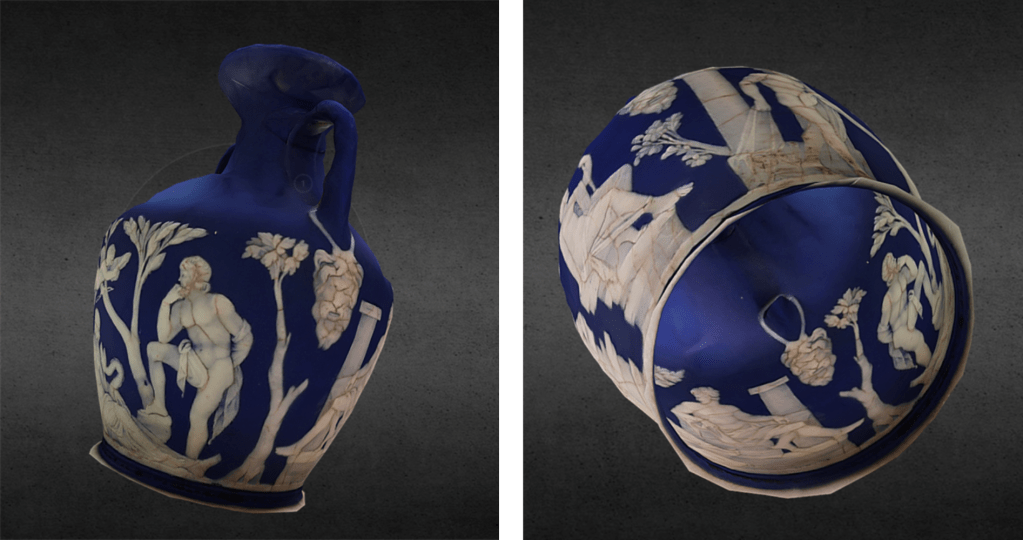
Copy of the Portland Vase, 3D model [source].

Today, the Portland Vase is preserved behind glass in a climate-controlled case in Gallery 70. At present, the British Museum does not offer a three-dimensional (3D) model of the vase. The online platform Sketchfab, however, features a 3D model.[8] However, while helpful, these features only partially convey the object’s materiality. The 3D model allows for rotation, but it lacks cues for scale or sensory context – what American Journal of Archaeology (AJA) reviewers criticize as “decontextualized beauty”. As the AJA’s review “Online Encounters with Museum Antiquities” notes, museums remain primary sites of exchange yet often provide only partial digital access.[9] As Romina Delia writes in “Performances. Contemporary Encounters in Historic Spaces” in The Contemporary Museum: Shaping Museums for the Global Now, museums risk becoming “stages without actors” when they overlook storytelling.[10] Here, the vase remains a silent actor. The vase’s potential for theatrical digital storytelling, such as VR experiences simulating symposia or interactive touch replicas, remains largely untapped.

This is not to criticize but to imagine what might be possible. A more immersive and interpretive approach could enrich the museum’s educational mission by reviving the vase’s embodied social life. While the entry documents materials and style, it could build on that foundation with richer contextual experiences – an exciting opportunity for deeper engagement.

MET Museum’s Boscoreale Villa Recreation, ca. 50–40 BCE, The Metropolitan Museum, no. 03.14.13a–g [source].

Compare this to the Metropolitan Museum’s Boscoreale Villa recreation, where visitors virtually enter a complete Roman dining room that mirrors the original context of vessels like the Portland Vase. Other museums, like the Digital Museum of the Acropolis Museum in Athens, also offer innovative ways to contextualize artifacts through virtual environments. For the Portland Vase, similar tools could simulate handling, letting users feel its weight or pour virtual wine while immersed in its proper architectural setting. The MET’s approach aligns with the International Council of Museums (ICOM), which calls for museums to foster dialogue, not merely display. According to ICOM, A museum is a not-for-profit, permanent institution in the service of society that researches, collects, conserves, interprets and exhibits tangible and intangible heritage. Open to the public, accessible and inclusive, museums foster diversity and sustainability. They operate and communicate ethically, professionally and with the participation of communities, offering varied experiences for education, enjoyment, reflection and knowledge sharing”.[11]

While the British Museum emphasizes global dialogue, the Portland Vase is presented as a timeless relic. Even the lighting in displays, whether in person or online, can sterilize objects, removing shadows and tactile cues. The vase becomes art, not a lived object. As Hodder argues in Entangled: An Archaeology of the Relationships Between Humans and Things, entanglement is multisensory. To fully activate the museum’s educational potential, institutions might explore new digital strategies such as VR recreations of Roman villas or curated digital symposia. As Mary W. Hudson notes in the Fine Arts Journal, the vase’s modest 25 cm scale belies its artistic and social significance.[12] The current dissonance between ancient use and modern presentation signals a compelling opportunity for digital storytelling – not as criticism, but as collaborative imagination.

The BM’s online entry could also benefit from curator voices and layered interpretations – what Cintia Velázquez Marroni calls “expert dialogues” in the “Pasts. Authoring National Histories in the Contemporary City” in The Contemporary Museum: Shaping Museums for the Global Now.[13] Why not a digital symposium or interactive educational module as seen with other Roman objects? These suggestions aim to support, not replace, existing efforts by highlighting ways to expand the museum’s digital reach.

The Portland Vase [source].

The vase’s itinerary, from tactile Roman rituals to pixelated isolation, reveals a choice. While common Roman glassware existed, the Portland Vase’s uniqueness demands exceptional care in its digital presentation. Institutions could look to models like the Vatican’s embodied digital strategies, such as their virtual Sistine Chapel tour, to inspire similar efforts for ancient artifacts.[14] These strategies could allow viewers to engage with the vase through sound, movement, and storytelling. While the British Museum’s online entry provides scholarly data, it strips away the object’s ancient social and sensory entanglements. For the vase to remain culturally alive, museums may need to work harder to bridge the gap between artifact and audience, transforming static displays into dynamic encounters. True preservation means reviving an object’s relationships, not just conserving its form.

In closing, I want to emphasize that my critique arises from deep admiration for the Portland Vase and the institutions that care for it, including the British Museum and others. The British Museum has preserved this masterpiece for future generations, and its online access is an important step. My hope is that this presentation contributes to a wider conversation about how we might build on such foundations, by experimenting with more immersive storytelling, multi-sensory experiences, and interactive formats. These are exciting opportunities for museums to expand their already valuable educational role.


[1] “amphora; vessel (closed); cameo [The Portland Vase]”, The British Museum, https://www.britishmuseum.org/collection/object/G_1945-0927-1 (accessed 4 March 2025).

[2] William Gudenrath, Kenneth Painter, and David Whitehouse, “The Portland Vase”, Journal of Glass Studies 32 (1990), 14, https://www.jstor.org/stable/24188029 (accessed 29 July 2025).

[3] Maude Haywood, “The Portland Vase”, The Decorator and Furnisher 14.1 (Apr. 1889), 25, https://www.jstor.org/stable/25585785 (accessed 29 July 2025).

[4] Zahra Newby, Greek Myths in Roman Art and Culture: Imagery, Values and Identity in Italy, 50 BC–AD 250, Cambridge: Cambridge University Press, 2016, 1–31.

[5] Ian Hodder, Entangled: An Archaeology of the Relationships Between Humans and Things, Oxford: Wiley–Blackwell, 2012, 89.

[6] Zahra Newby, ibidem.

[7] Jesús Muñoz Morcillo, “[Review of] The Embodied Object in Classical Antiquity by Milette Gaifman, Verity Platt, and Michael Squire”, Bryn Mawr Classical Review (2019), 2019.05.52, https://bmcr.brynmawr.edu/2019/2019.05.52 (accessed 4 August 2025).

[8] “Copy of the Portland Vase, 3D model”, Sketchfab, 2022.04.07, https://sketchfab.com/3d-models/copy-of-the-portland-vase-667c25404a074d6389da9a6207098d7f (accessed 29 July 2025).

[9] Caitlin Chien Clerkin and Bradley L. Taylor, “Online Encounters with Museum Antiquities”, American Journal of Archaeology 125.1 (January 2021), 173, https://ajaonline.org/museum-review/4249 (accessed 4 March 2025).

[10] Romina Delia, “Performances. Contemporary encounters in historic spaces” in Simon Knell, ed., The Contemporary Museum: Shaping Museums for the Global Now, London: Routledge, 2018, 128–129.

[11] “Museum Definition”, International Council of Museums, https://icom.museum/en/resources/standards-guidelines/museum-definition (accessed 4 March 2025).

[12] Mary W. Hudson, “The Portland Vase”, Fine Arts Journal 30.1 (1914), 48–49, https://www.jstor.org/stable/25587222 (accessed 29 July 2025).

[13] Cintia Velázquez Marroni, “Pasts. Authoring national histories in the contemporary city”, in Simon Knell, ed., The Contemporary Museum: Shaping Museums for the Global Now, London: Routledge, 2018, 152–153.

[14] “Sistine Chapel”, The Holy See, http://www.vatican.va/various/cappelle/sistina_vr/index.html (accessed 4 March 2025).


Bibliography

“amphora; vessel (closed); cameo [The Portland Vase]”, The British Museum, https://www.britishmuseum.org/collection/object/G_1945-0927-1 (accessed 4 March 2025).

“Copy of the Portland Vase, 3D model”, Sketchfab, 2022.04.07, https://sketchfab.com/3d-models/copy-of-the-portland-vase-667c25404a074d6389da9a6207098d7f (accessed 29 July 2025).

“Cubiculum (bedroom) from the Villa of P. Fannius Synistor at Boscoreale”, The Metropolitan Museum of Art, https://www.metmuseum.org/art/collection/search/247017 (accessed 4 March 2025).

“Museum Definition”, International Council of Museums, https://icom.museum/en/resources/standards-guidelines/museum-definition (accessed 4 March 2025).

“Sistine Chapel”, The Holy See, http://www.vatican.va/various/cappelle/sistina_vr/index.html (accessed 4 March 2025).

Clerkin, Caitlin Chien and Bradley L. Taylor, “Online Encounters with Museum Antiquities”, American Journal of Archaeology 125.1 (January 2021), 165–175, https://ajaonline.org/museum-review/4249 (accessed 4 March 2025).

Delia, Romina, “Performances. Contemporary encounters in historic spaces” in Simon Knell, ed., The Contemporary Museum: Shaping Museums for the Global Now, London: Routledge, 2018, 128–141.

Gudenrath, William, Kenneth Painter, and David Whitehouse, “The Portland Vase”, Journal of Glass Studies 32 (1990), 14–23, https://www.jstor.org/stable/24188029 (accessed 29 July 2025).

Haywood, Maude, “The Portland Vase”, The Decorator and Furnisher 14.1 (Apr. 1889), 24–25, https://www.jstor.org/stable/25585785 (accessed 29 July 2025).

Hodder, Ian, Entangled: An Archaeology of the Relationships Between Humans and Things, Oxford: Wiley–Blackwell, 2012.

Hudson, Mary W., “The Portland Vase”, Fine Arts Journal 30.1 (1914), 48–49, https://www.jstor.org/stable/25587222 (accessed 29 July 2025).

Muñoz Morcillo, Jesús, “[Review of] The Embodied Object in Classical Antiquity by Milette Gaifman, Verity Platt, and Michael Squire”, Bryn Mawr Classical Review (2019), 2019.05.52, https://bmcr.brynmawr.edu/2019/2019.05.52 (accessed 4 August 2025).

Newby, Zahra, Greek Myths in Roman Art and Culture: Imagery, Values and Identity in Italy, 50 BC–AD 250, Cambridge: Cambridge University Press, 2016.

Velázquez Marroni, Cintia, “Pasts. Authoring national histories in the contemporary city”, in Simon Knell, ed., The Contemporary Museum: Shaping Museums for the Global Now, London: Routledge, 2018, 152–166.

Post by Rachel Rajamoney, tutored by Katerina Volioti, placed by Olga Strycharczyk

Sketches from Olympus in the University of Warsaw Gallery [ENG/PL/BY]

For Belarusian click here / For Polish click here

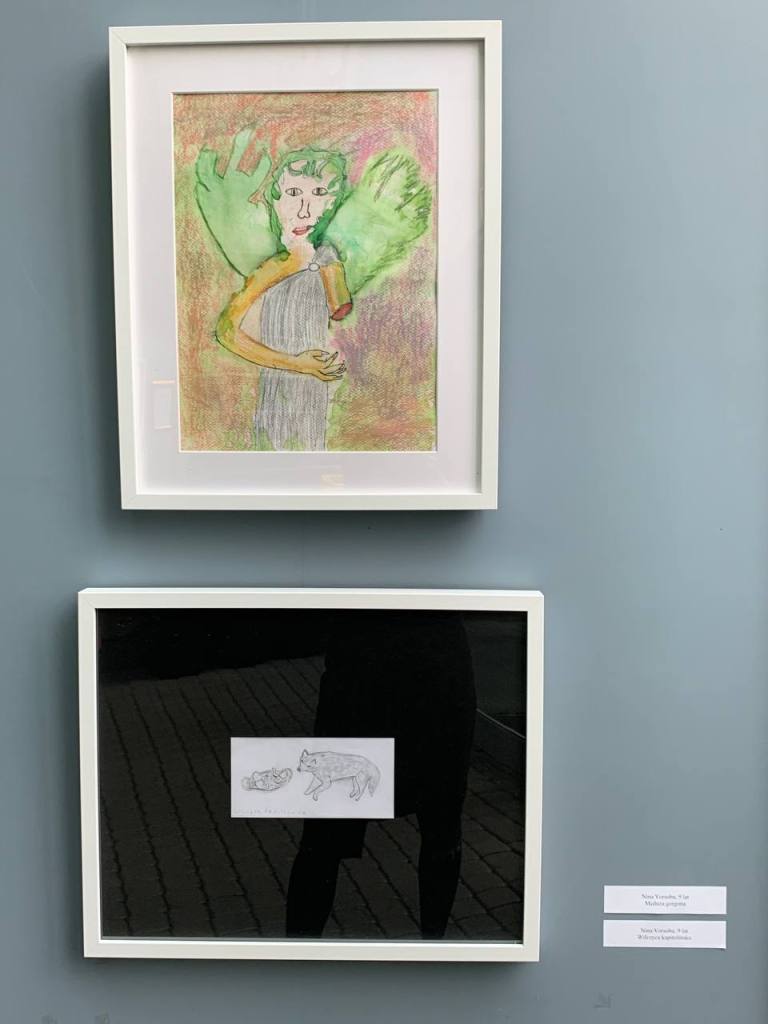
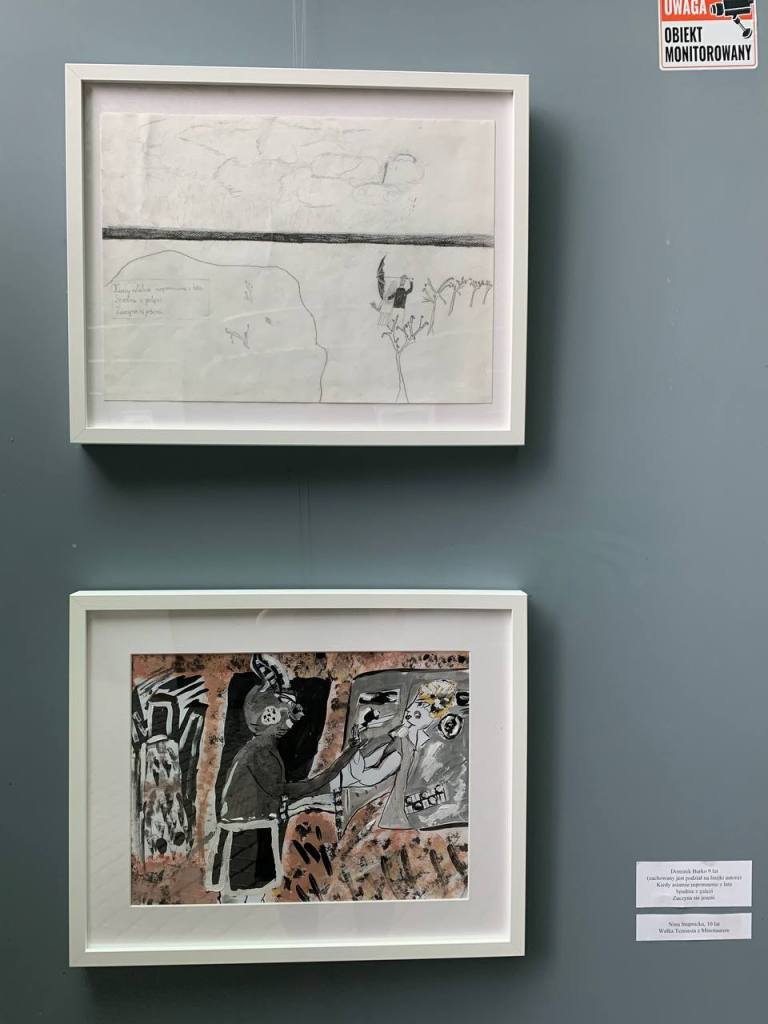
On 29th April the exhibition “Sketching on Olympus” was inaugurated at the University of Warsaw Gallery in the UW Library (BUW). It accompanies the Our Mythical Nature conference within the Our Mythical Childhood… The Reception of Classical Antiquity in Children’s and Young Adults’ Culture in Response to Regional and Global Challenges project at the Faculty of “Artes Liberales” UW. The exhibition presents works by children from Belarus and Ukraine, currently living in Warsaw, on Greek mythology and more. These drawings were created during classes in an art studio for children “Цёплы круг” (The Warm Circle).

Exhibition poster

The studio “The Warm Circle” was founded in September 2020 by two Belarusian artists from Minsk, graduates of the Belarusian Academy of Fine Arts: Tatiana Karpachova and Liza Mikhadziuk. Currently, 13 children aged between 5 and 15 years old attend the studio. The aim of the studio is to teach children the basics of drawing and painting in a comfortable atmosphere of concentration, creative joy, and inner peace. The studio creates the conditions for sharing energy and experience, while at the same time developing the ability to think outside the box and releasing creativity by spending time in an artistic environment.


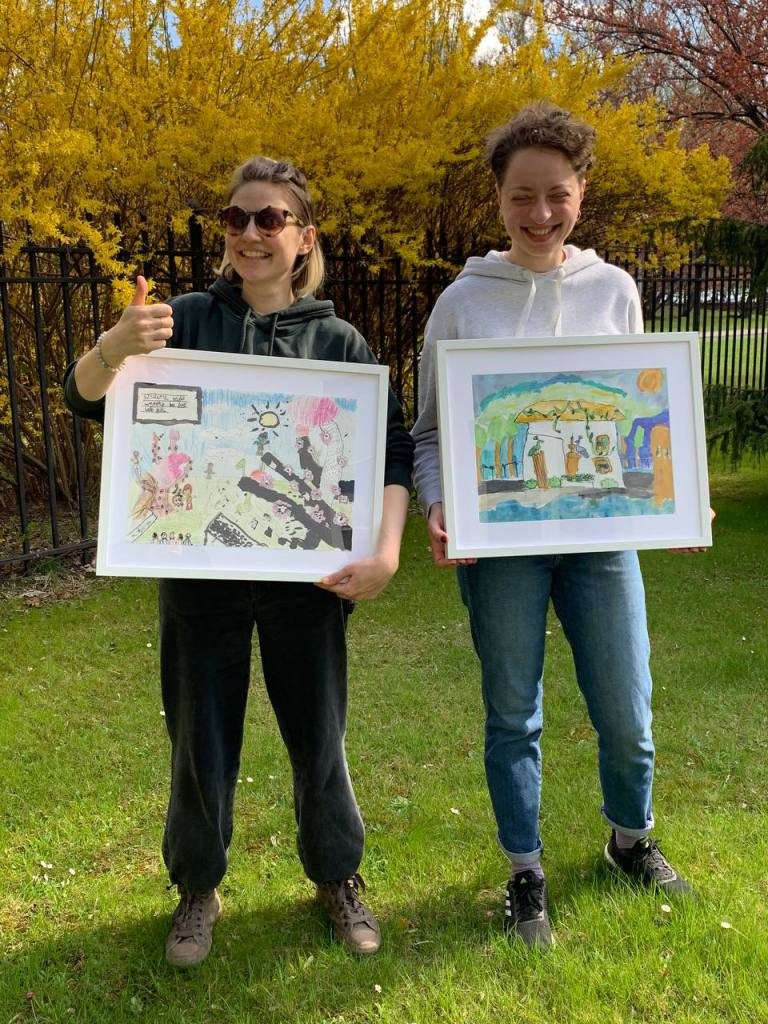
Tatiana Karpachova, Liza Mikhadziuk and Olga Anisko at the exhibition.

All photos have been published with the consent of the project participants (or their parents).
Tatiana Karpachova and Liza Mikhadziuk.
All photos have been published with the consent of the project participants (or their parents).

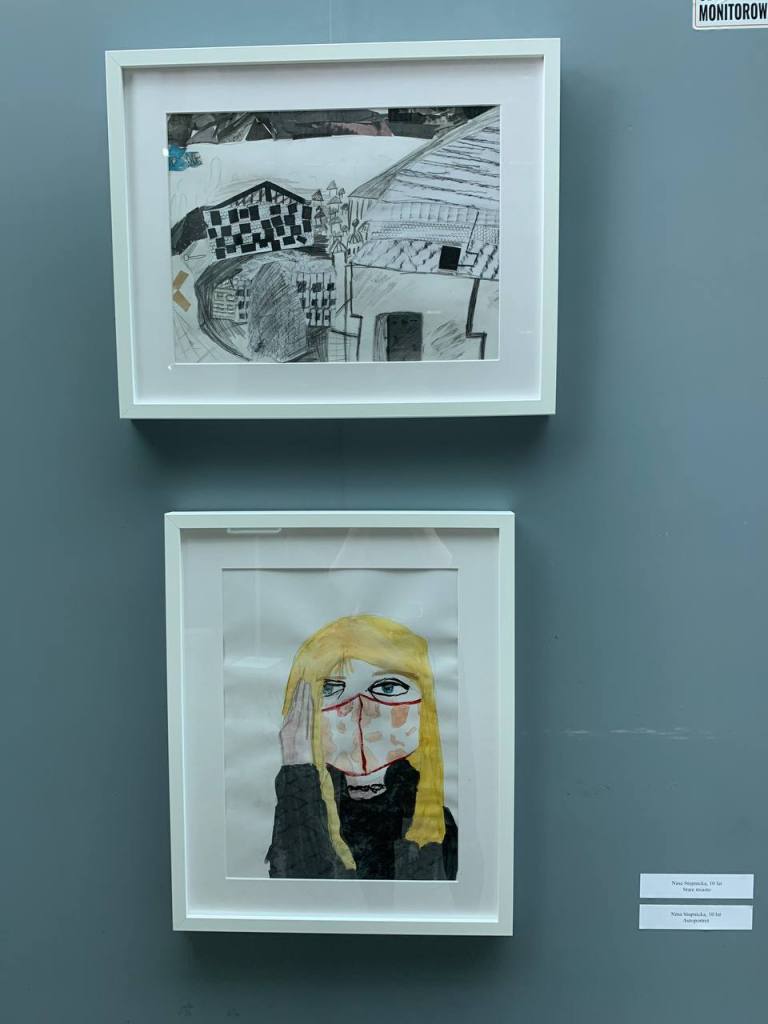
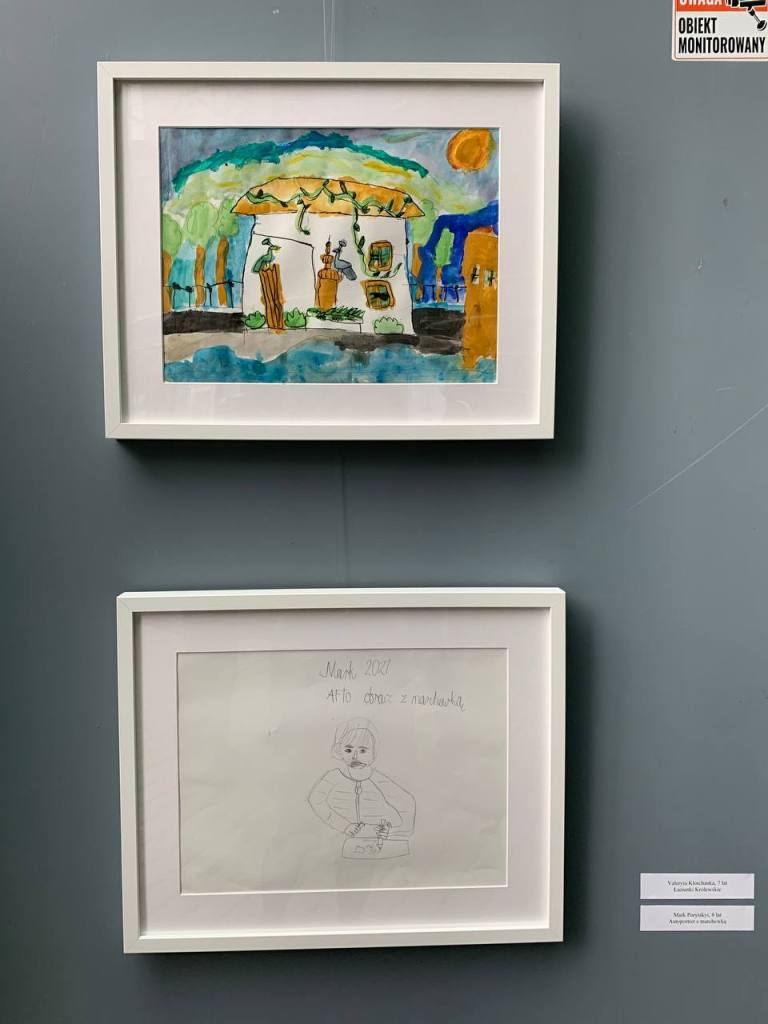
During the classes, the children worked on different themes: “Warsaw”, “Self-portrait”, “Home”, “Hokku”, “Japanese still life”, etc.

In order to create the exhibition “Sketching on Olympus”, the children and their teachers, armed with the necessary equipment: paintbrushes, pencils, paper, and an inexhaustible imagination, spent a month exploring Mount Olympus in order to tell us, the viewers, what “really” happened there. Beforehand, the children listened to the myths and legends of ancient Greece and Rome and familiarized themselves with the works on the subject of the most prominent artists of the world.

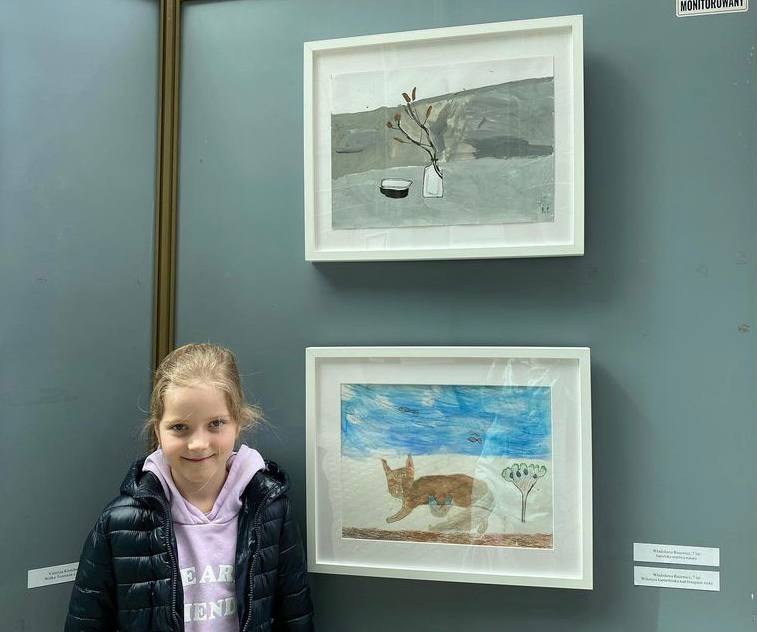
Michał Racewicz and his artwork.
 All photos have been published with the consent of the project participants (or their parents).
Władzisława Racewicz and her artwork.
All photos have been published with the consent of the project participants (or their parents).

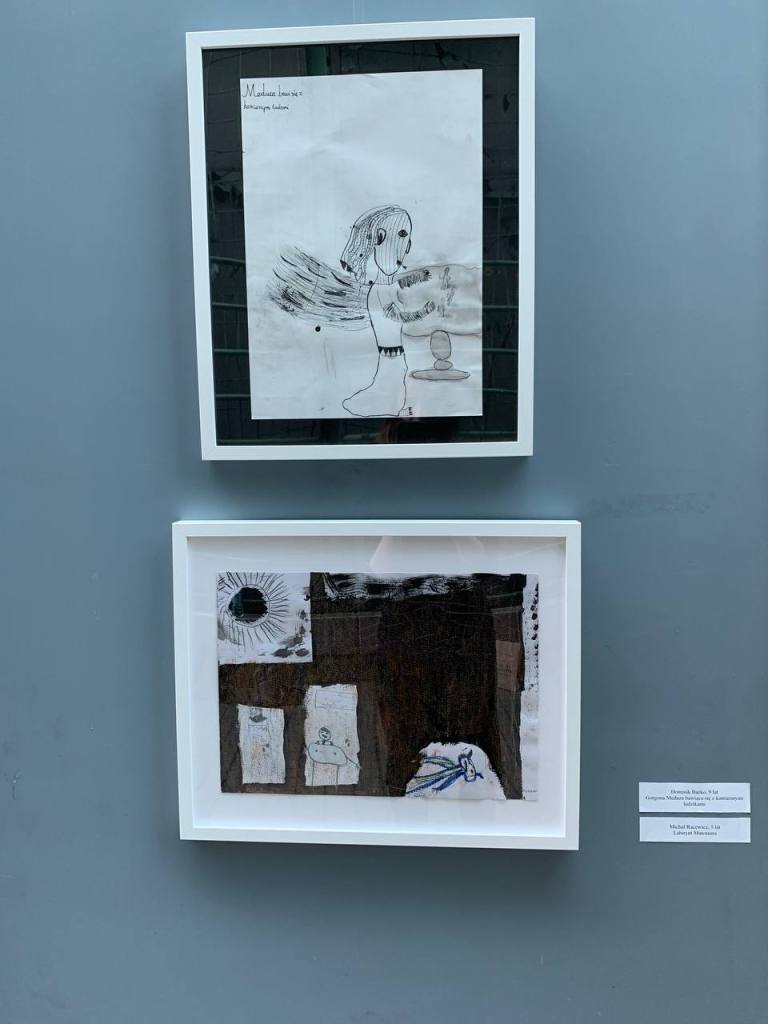
In studying the mythological characters in detail, many difficult questions arose. Could the royal shepherd Faustulus, who raised Romulus and Remus, have had a woollen overcoat? Was Medusa Gorgona’s entire body covered in scales and how long were her nails? If the Minotaur had the head of a bull, was his body hairy? Why did the Minotaur eat so rarely (once in seven years)? Why do all the paintings and sculptures by prominent artists have curly hair?

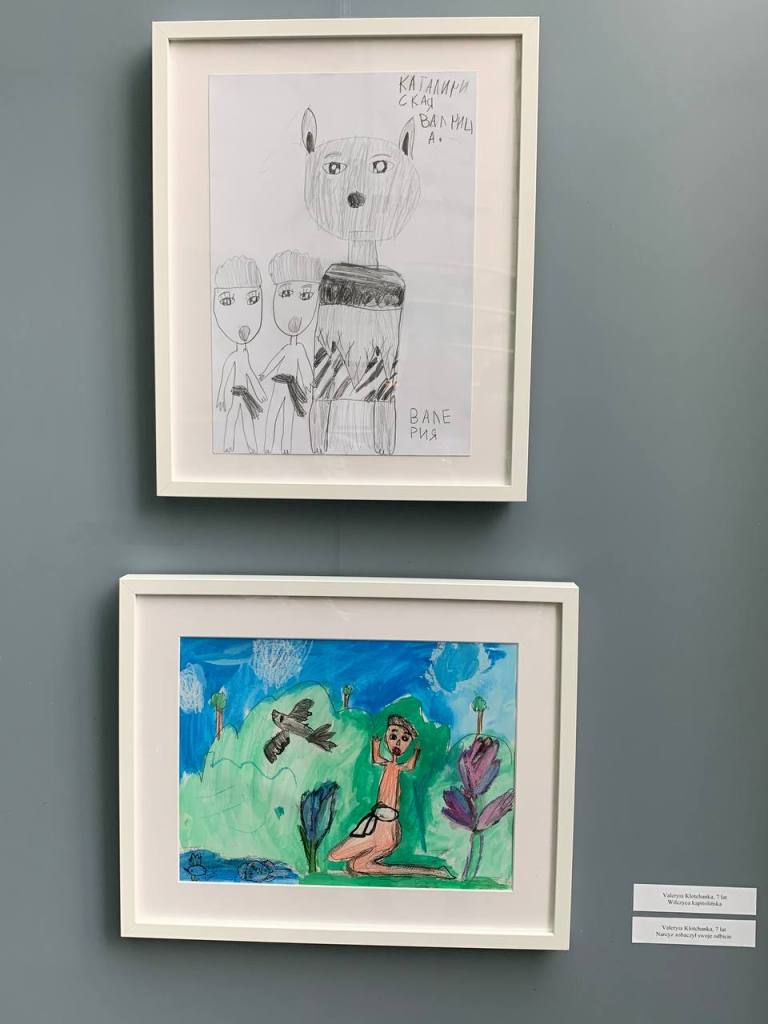
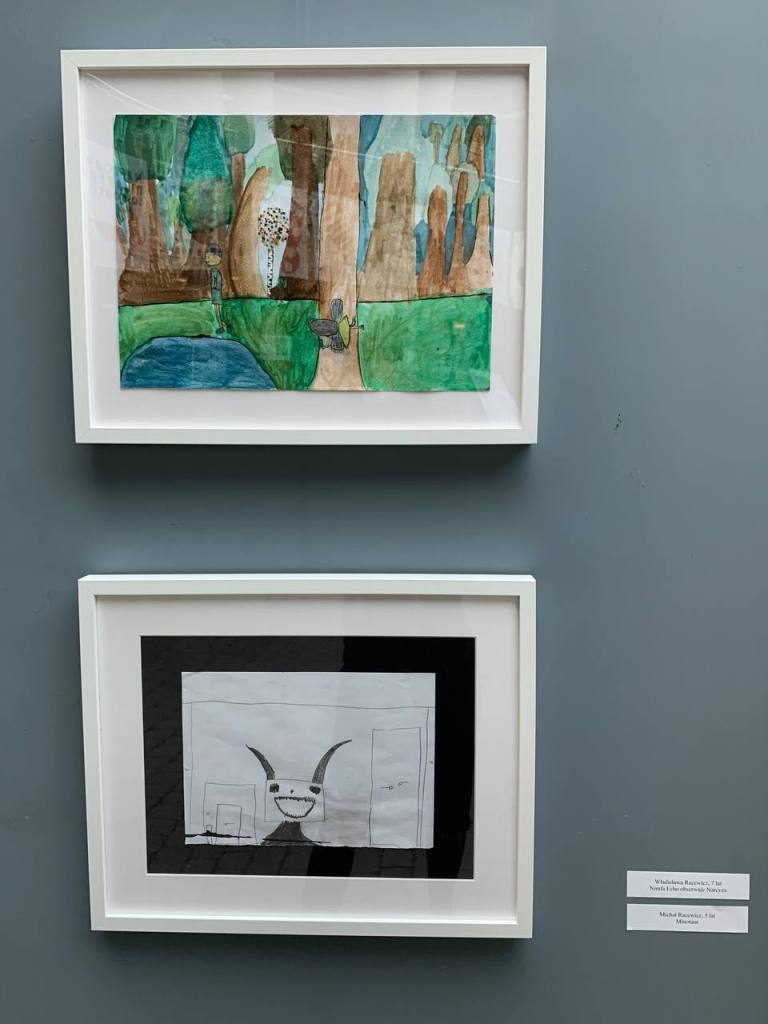
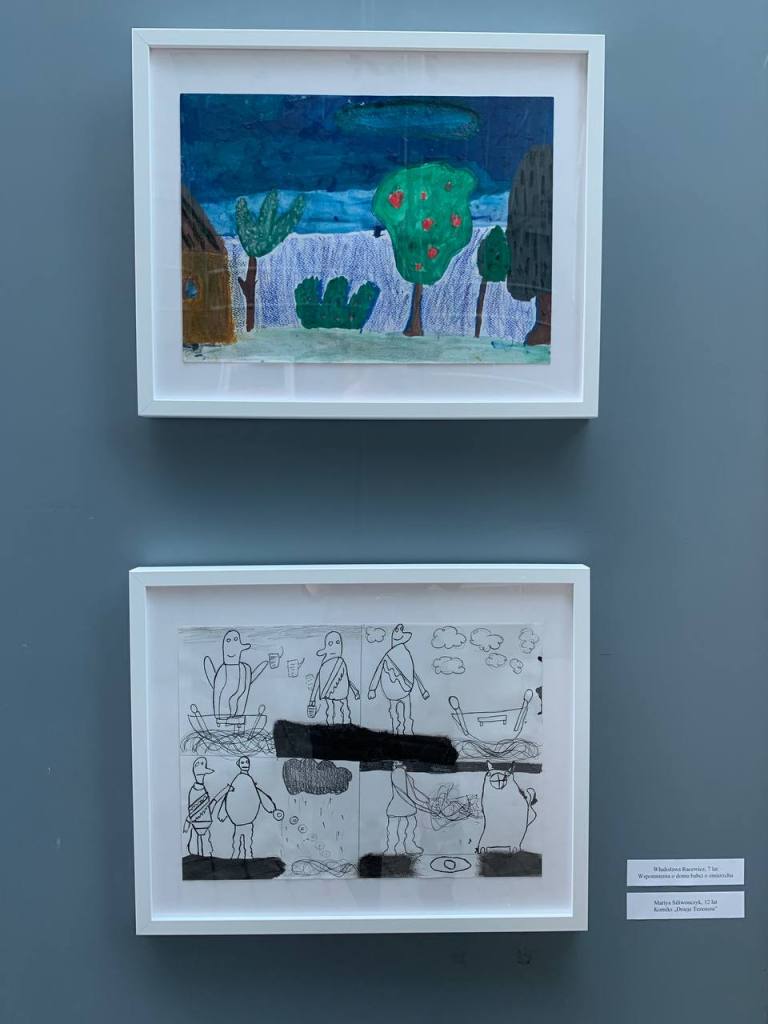
Children’s creativity is full of improvisation and experimentation, hence the Minotaur here does have horns, but his head is square, and the Labyrinth at Knossos is a room with many doors. The comic book which illustrates the journey of Theseus is also worth mentioning – try to find Ariadne in it. In the exhibition we meet Theseus fighting the Minotaur, Medusa playing with stone men, a modern Narcissus wearing a mask but dressed according to 15th-century fashion, and a Narcissus so beautiful that even birds fly away at the sight of him.

The curator of the exhibition is Olga Anisko.

Cooperation with Belarusian scientists, students, and artists has been coordinated for years by Dr Hanna Paulouskaya.

We would like to express our heartfelt thanks to Dr Tomasz Strączek, the Director of the University of Warsaw Gallery, for his invitation, hospitality, and assistance in organizing the exhibition.

We also wish to express our gratitude to the Artes Liberales Institute” Foundation for its financial support which made the exhibition possible.

The exhibition is on display at the University of Warsaw Gallery in the main hall of the University of Warsaw Library (BUW) until June 28, 2021. Here on the blog, we are pleased to share all the works online for all those who are outside of Warsaw or cannot move freely due to the pandemic.


Замалёўкі з Алімпу ў Галерэі Варшаўскага ўніверсітэта

29 красавіка ў Галерэі Варшаўскага ўніверсітэта, якая знаходзіцца ў універсітэцкай бібліятэцы, адбылося адкрыццё выставы “Szkicowanie na Olimpie” (“Замалёўкі на Алімпе”). Выстава прымеркавана да канферэнцыі Our Mythical Nature ў межах праекта Our Mythical Childhood… The Reception of Classical Antiquity in Children’s and Young Adults’ Culture in Response to Regional and Global Challenges, якая праводзіцца факультэтам “Artes Liberales” Варшаўскага ўніверсітэта. На выставе прадстаўлены працы дзяцей з Беларусі і Ўкраіны, якія цяпер жывуць у Варшаве. Гэта малюнкі па матывах грэчаскай міфалогіі, а таксама на іншыя тэмы, якія былі створаны падчас заняткаў мастацкай студыі для дзяцей “Цёплы круг”.

Студыя “Цёплы круг” была арганізавана ў верасні 2020 года двума беларускімі мастачкамі з Мінска, выпускніцамі Беларускай дзяржаўнай акадэміі мастацтваў: Таццянай Карпачовай і Лізаветай Міхадзюк. Зараз у студыі навучаецца 13 дзяцей ва ўзросце ад 5 да 15 гадоў. Мэта студыі – у камфортнай атмасферы сканцэнтраванай працы і настрою творчай радасці і душэўнага спакою перадаць дзецям моцную базу малюнка і жывапісу. Студыя – гэта магчымасць дзяліцца сваёй энергіяй і досведам, адначасова развіваць уменне нестандартна мысліць і раскрываць свой творчы патэнцыял, праводзячы час у мастацкім асяроддзі.

На занятках навучэнцы працавалі над рознымі тэмамі: “Варшава”, “Аўтапартрэт”, “Дом”, “Хоку”, “Японскі нацюрморт” і г.д.

Спецыяльна да выставы “Szkicowanie na Olimpie” дзеці разам са сваімі настаўніцамі, узяўшы з сабою неабходнае абсталяванне: пэндзлікі, алоўкі, паперу і невычэрпнае натхненне, прысвяцілі месяц даследаванню Алімпу, каб расказаць нам, гледачам, як “усё было насамрэч”. А папярэдне дзеці праслухалі міфы і легенды Старажытнай Грэцыі і Рыма і азнаёміліся з працамі выбітных сусветных мастакоў на дадзеную тэматыку.

Падчас падрабязнага знаёмства з міфалагічнымі героямі паўстала мноства сур’ёзных пытанняў. Ці мог каралеўскі пастух Фаўстул, які выхоўваў Ромула і Рэма, мець ваўняны кажух? Ці ўсё цела Медузы Гаргоны было пакрыта луской і якой даўжыні ў яе былі пазногці? Калі ў Мінатаўра была галава быка, то ці было ў яго валасатае тулава? Чаму Мінатаўр так рэдка еў (адзін раз у 7 гадоў)? Чаму на карцінах і скульптурах выбітных мастакоў усе маюць кучаравыя валасы?

Дзіцячая крэатыўнасць напоўнена імправізацыяй і эксперыментамі, таму Мінатаўр тут хоць і з рагамі, але галава ў яго квадратнай формы, а Кноскі Лабірынт – гэта памяшканне з мноствам дзвярэй. Увагі заслугоўвае комікс, які ілюструе падарожжа Тэсея – паспрабуй знайсці ў ім Арыядну. У экспазіцыі сустракаем Тэсея, які змагаецца з Мінатаўрам, Медузу, якая гуляе каменнымі чалавечкамі, сучаснага Нарцыса ў масцы, але апранутага па модзе XV стагоддзя, а таксама Нарцыса, прыгожага настолькі, што ад яго выгляду разлятаюцца нават птушкі.

Куратарка выставы – Вольга Аніська.

Супрацоўніцтва з беларускімі навукоўцамі, студэнтамі і мастакамі каардынуе кандыдат навук Ганна Паўлоўская.

Вялікі дзякуй доктару Томашу Стрончку, дырэктару Галерэі Варшаўскага ўніверсітэта, за запрашэнне, гасціннасць і дапамогу ў арганізацыі выставы.

Мы таксама хацелі б выразіць нашу ўдзячнасць Фундацыі “Інстытут Artes Liberales за фінансавую падтрымку, якая дазволіла ажыццявіць ідэю выставы.

Шчыра запрашаем на выставу, якую можна паглядзець у Галерэі Варшаўскага ўніверсітэта ў галоўным холе Бібліятэцы Варшаўскага ўніверсітэта да 28 чэрвеня 2021 года. Для тых, хто жыве не ў Варшаве, і ўсіх, хто не можа прыехаць з-за пандэміі, публікуем усе працы онлайн.


Szkice z Olimpu do obejrzenia w Galerii UW

29 kwietnia w Galerii UW w BUWie została otwarta wystawa „Szkicowanie na Olimpie”. Towarzyszy ona konferencji Our Mythical Nature w ramach projektu Our Mythical Childhood… The Reception of Classical Antiquity in Children’s and Young Adults’ Culture in Response to Regional and Global Challenges. Wystawa prezentuje prace dzieci z Białorusi oraz Ukrainy, obecnie mieszkających w Warszawie, dotyczące mitologii greckiej i nie tylko. Rysunki te powstały podczas zajęć w pracowni plastycznej dla dzieci „Цёплы круг” (Ciepły krąg).

Pracownia „Ciepły krąg” została założona we wrześniu 2020 roku przez dwie białoruskie artystki z Mińska, absolwentki Białoruskiej Akademii Sztuk Pięknych: Tatianę Karpaczową i Lizę Mikhadziuk. Obecnie do pracowni uczęszcza 13 dzieci w wieku od 5 do 15 lat. Celem pracowni jest w komfortowej atmosferze skupienia oraz nastroju twórczej radości i spokoju wewnętrznego przekazać dzieciom solidne podstawy rysunku i malarstwa. Pracownia stwarza warunki do dzielenia się swoją energią i doświadczeniem, jednocześnie rozwijając umiejętność nieszablonowego myślenia i wyzwalania kreatywności poprzez spędzanie czasu w środowisku artystycznym.

Na zajęciach w pracowni dzieci pracowały nad różnymi tematami: „Warszawa”, „Autoportret”, „Dom”, „Hokku”, „Japońska martwa natura” itd.

Na potrzeby wystawy „Szkicowanie na Olimpie” dzieci wraz z ich nauczycielkami, uzbroiwszy się w niezbędny sprzęt: pędzle, ołówki, papier i niewyczerpaną wyobraźnię, poświęciły miesiąc na badanie Olimpu, aby opowiedzieć nam, widzom, co tak „naprawdę” tam się wydarzyło. Wcześniej zaś dzieci wysłuchały mitów i legend starożytnej Grecji i Rzymu oraz zapoznały się z dziełami wybitnych światowych artystów o danej tematyce.

Przy szczegółowym zapoznawaniu się z mitologicznymi bohaterami zrodziło się wiele trudnych pytań. Czy królewski pasterz Faustulus, który wychował Remulusa i Remusa, mógł mieć wełniany kożuch? Czy całe ciało Meduzy Gorgony było pokryte łuskami i jak długie były jej paznokcie? Jeśli Minotaur miał głowę byka, to czy jego ciało było owłosione? Dlaczego Minotaur jadł tak rzadko (raz na siedem lat)? Dlaczego na obrazach i rzeźbach wybitnych artystów wszyscy mają kręcone włosy?

Dziecięca kreatywność przepełniona jest improwizacją i eksperymentami, stąd Minotaur tutaj wprawdzie posiada rogi, ale za to głowę ma kwadratową, a Labirynt w Knossos jest pomieszczeniem z wieloma drzwiami. Na uwagę zasługuje komiks, który ilustruje podróż Tezeusza – spróbuj odnaleźć w nim Ariadnę. Na wystawie spotkamy Tezeusza walczącego z Minotaurem, Meduzę bawiącą się z kamiennymi ludzikami, współczesnego Narcyza w masce, ale ubranego zgodnie z XV-wieczną modą, oraz Narcyza tak pięknego, że nawet ptaki odlatują na jego widok.

Kuratorką wystawy jest Olga Anisko.

Współpracę z białoruskimi naukowcami, studentami i artystami od lat koordynuje Dr Hanna Paulouskaya.

Z całego serca wyrażamy podziękowania dla Pana Dr Tomasza Strączka, Dyrektora Galerii UW, za zaproszenie, gościnność i pomoc w organizacji wystawy.

Chcielibyśmy również wyrazić wdzięczność Fundacji „Instytut Artes Liberalesza wsparcie finansowe umożliwiające realizację wystawy.

Serdecznie zapraszamy na wystawę, którą można zobaczyć w Galerii UW w głównym holu BUWu do 28 czerwca 2021. Dla osób spoza Warszawy, a także dla wszystkich, którzy nie mogą przemieszczać się z powodu pandemii, zamieszczamy komplet prac online.


Post by Olga Anisko and Hanna Paulouskaya