Blog for the international research project "Our Mythical Childhood… The Reception of Classical Antiquity in Children’s and Young Adults’ Culture in Response to Regional and Global Challenges", financed by the ERC Consolidator Grant led by Prof. Katarzyna Marciniak, Faculty of "Artes Liberales" of the University of Warsaw. Team members: Prof. Susan Deacy and Steve K. Simons, University of Roehampton; Prof. Elizabeth Hale and Dr Miriam Riverlea, University of New England; Prof. Lisa Maurice and Dr Ayelet Peer, Bar-Ilan University; Prof. Daniel A. Nkemleke, Dr Divine Che Neba and Dr Eleanor A. Dasi, University of Yaoundé I; Dr Elżbieta Olechowska, Dr Hanna Paulouskaya, Dr Sonya Nevin, Dott. Edoardo Pecchini, Marta Pszczolińska, Angelina Gerus and the Project Officers: Magdalena Andersen, Maria Makarewicz, and Olga Strycharczyk from the Faculty of "Artes Liberales" UW.
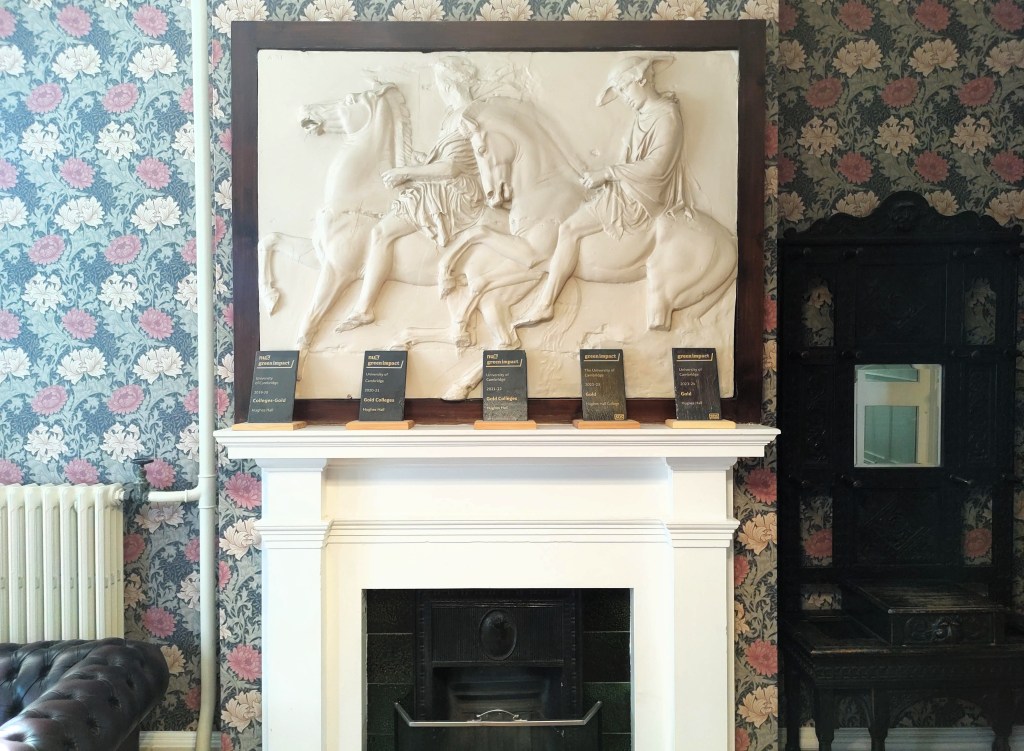
We are most pleased to share the great news. Dr Sonya Nevin has joined Hughes Hall as a by-fellow (a research post). Dr Nevin is also a supervisor (an academic post for small group teaching), and a tutor (a pastoral care role).
Hughes Hall is one of the 31 colleges that belong to the University of Cambridge. It accepts postgraduate and mature undergraduate students, with a very international community. It has a strong showing in education, law, and finance, though it takes students from other subjects too. It prides itself on developing students’ skills and having good contacts with the wider world.
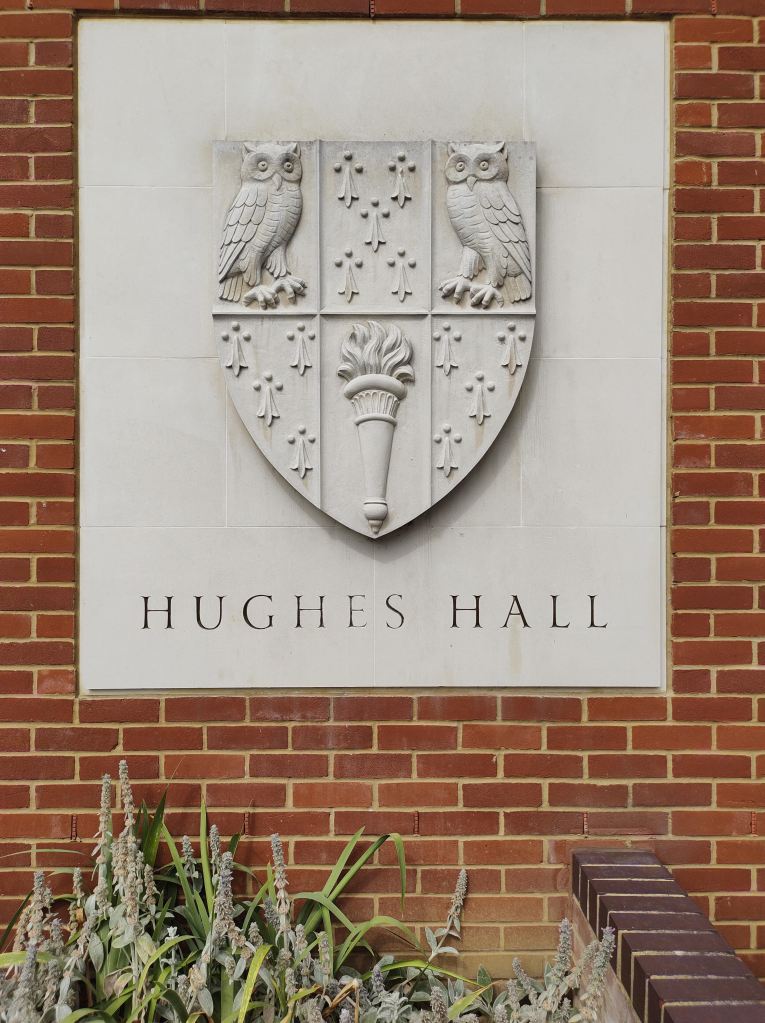
Margaret Wileman Building, the main building of the Hughes Hall, designed by William Fawcett, inaugurated in 1895. Phot. Sonya Nevin.Hughes Hall shield with the owl, symbol of wisdom, and the torch, sign of enlightenment and truth. Phot. Sonya Nevin.
The day of the award ceremony was very eventful; instead of a quiet breakfast, interviews with countless Bavarian radio stations began at 8 a.m. Then, a brisk sprint to the futuristically designed Axica Hall in Berlin, situated between the venerable Hotel Adlon and the Brandenburg Gate, was followed by the beginning of the ceremony. After a cool performance by poetry slammer and cabaret artist Lars Ruppel, the first certificates were presented by Jurors renowned in the field of education. The board of the Heraeus Educational Foundation and the German Philologists’ Association then offered their warm congratulations to the teachers.
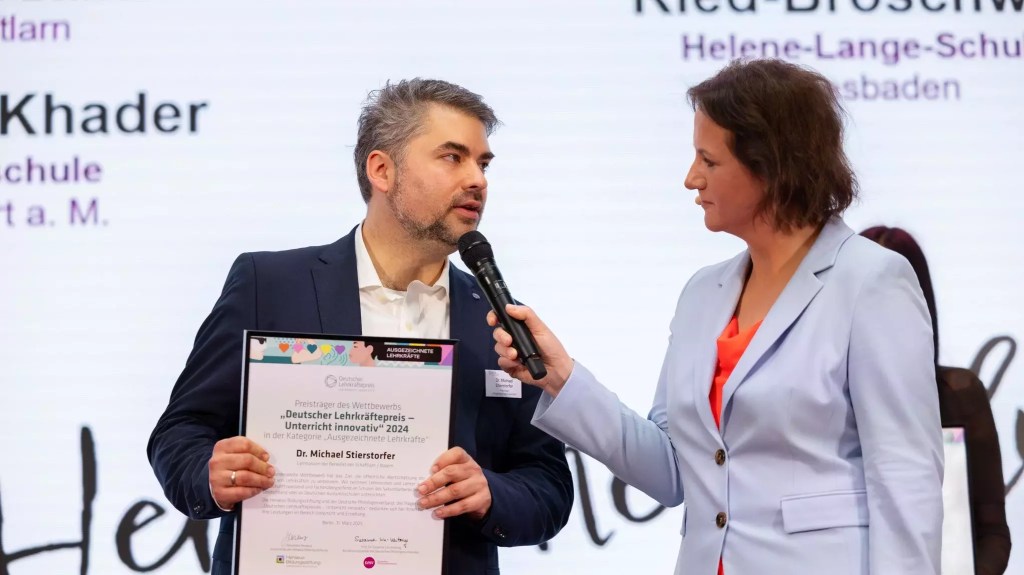
Dr Michael Stierstorfer receveing the German Teacher Award in the “Outstanding Educators” category – phot. Lehrkräftepreis [source].
In conversation, the very charming host, Alexandra Heraeus, told me that she also lives in Bavaria (Germany) near the school of Schäftlarn. What a small world. An invitation to the monastery was immediately extended. Next, our upper school students appeared on the big screen and explained to the experts what, in their view, constitutes outstanding teaching and what makes an exceptional teacher.
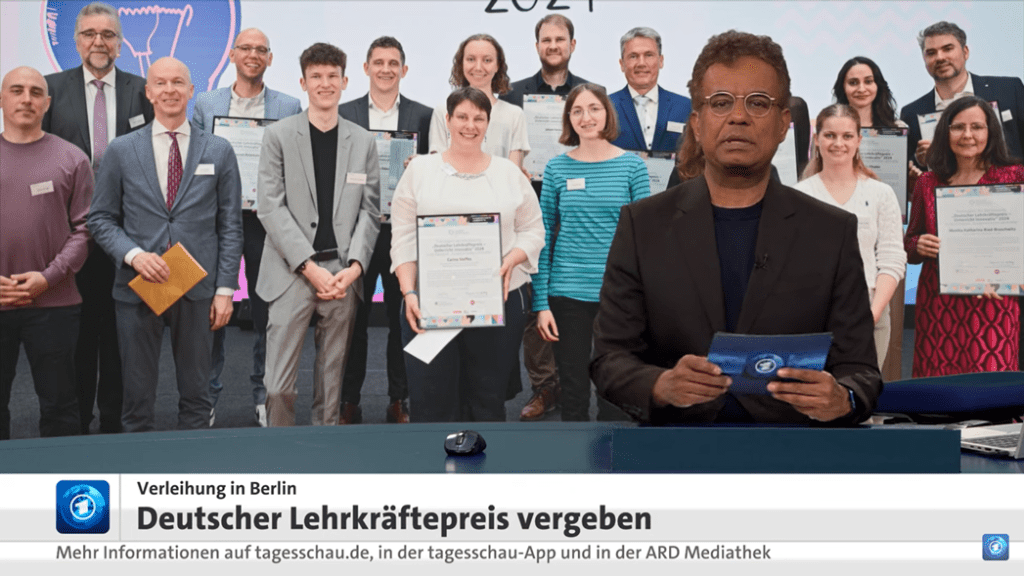
Laureates of the German Teacher Award for “Outstanding Educators”, for innovative teaching methods and exemplary school management – phot. Tagesschau [source].
After a performance by education influencer Emily Hornbach, the other prizes in categories such as “Innovative Teaching”, “Cultural Education”, and “Environment and Sustainability” were awarded. At the end of this brilliant ceremony, numerous interviews followed with BR, ZDF-Phoenix, and other audiovisual media. After this press marathon, delicious snacks were served to restore everyone’s strength, which rounded off the event perfectly. Here are excerpts from the Jury’s reasoning for my award: Special qualities according to the students include creative, innovative, and future-oriented teaching, enthusiasm, extensive use of modern media and techniques, integration of external experts into lessons, strong commitment, and the incorporation of the students’ own world into the classroom. (German Teacher Award – Innovative Teaching)
A reportage by the SAT.1 Bayern TV.
Quotations from students’ assessment: Overall, in our opinion, Mr. Stierstorfer is the most innovative teacher in the country – after all, which other teacher has their own YouTube channel?
Mr. Stierstorfer inspires us with enthusiasm and motivation because he is cheerful when he comes to class every day, always gives appropriate feedback, and his enthusiasm is contagious, as he wants to bring out the best in each of us.
In Mr. Stierstorfer’s classes, everyone can be themselves because he gives feedback at eye level and, through his joyous and strongly optimistic manner, also supports students who are average or weaker.
Moreover, Mr. Stierstorfer consistently stands up for his democratic and humanistic values, which are also reflected in the topics of our “Booktubes”, ranging from political issues to inclusion.
He is the creative “super teacher” at our school and a genuinely great character!
He always tries, by all means, to make something special possible for his students –something that will remain in our life memories.
Mr. Stierstorfer fulfills all the criteria you have mentioned outstandingly.
Mr. Stierstorfer is truly a teacher with heart and soul and a considerable portion of humorous creativity, which for us students is the absolute non plus ultra. That’s why many grades always hope to have him as their teacher.
[…] In this context, he also created an innovative learning circle, which we found very enriching for our lessons because it contained great visuals along with vocabulary and grammar aids. This circle focuses on the popular topic of the reception of Ovid’s Metamorphoses.
Der Tag der Verleihung war sehr ereignisreich, anstatt eines ruhigen Frühstücks standen ab 8 Uhr Interviews mit unzähligen bayerischen Radiosendern an. Dann ging die Verleihung nach einem sportlichen Sprint zur futuristisch designten Axica-Halle in Berlin, die zwischen dem altehrwürdigen Hotel Adlon und dem Brandenburger Tor gelegen ist, die Verleihung los. Nach einer coolen Poetry-Slammer Performance von Kabarettist Lars Ruppel, wurden die ersten Urkunden von den namhaften Jurorinnen und Juroren aus der Bildungsszene vergeben: Der Vorstand der Heraeus Bildungsstiftung und der des Deutschen Philologenverbands gratulierten sodann uns Lehrkräften sehr herzlich.
Dr. Michael Stierstorfer bei der Verleihung des Deutschen Lehrkräftepreises in der Kategorie „herausragende Lehrkräfte“ – Foto: Lehrkräftepreis [source].
Im Gespräch verriet mir die sehr sympathische Gastgeberin Alexandra Heraeus, dass sie ebenso im Bundesland Bayern (Deutschland) und sogar ganz in der Nähe des Klosters Schäftlarn wohne. So klein ist die Welt. Eine Einladung ins Kloster wurde sogleich ausgesprochen. Als Nächstes erschienen unsere Oberstufenschülerinnen und Schüler auf Großleinwand und erklärten den Experten, was in ihren Augen herausragender Unterricht sei und was eine besondere Lehrkraft ausmache.
Die Preisträgerinnen und Preisträger des Deutschen Lehrkräftepreises in den Kategorien „herausragende Lehrkräfte“, „Unterricht innovativ“ und „vorbildliche Schulleitung“ – Foto: Tagesschau [source].
Nach einem Auftritt der Bildungsinfluencerin Emily Hornbach wurden noch die anderen Preise der anderen Kategorien wie „Unterricht Innovativ“, „Kulturelle Bildung“ oder „Umwelt und Nachhaltigkeit“ verliehen. Am Ende dieser genialen Verleihung folgten noch zahlreiche Interviews mit dem BR, ZDF-Phoenix und anderen audiovisuellen Medien. Nach diesem Presse-Marathon gab es zur Stärkung des leiblichen Wohls sehr leckere Häppchen, wodurch die Veranstaltung passend abgerundet wurde. Auszüge aus der Jury-Begründung für meinen Preis finden sich hier: Besondere Eigenschaften laut Schülerinnen und Schülern: Kreativer, innovativer und zukunftsorientierter Unterricht, Begeisterungsfähigkeit, umfangreicher Einsatz moderner Medien und Techniken, Einbindung externer Experten in den Unterricht, hohes Engagement, Integration der Lebenswelt der Schülerinnen und Schüler in den Unterricht. (Deutsche Lehrkräftepreis – Unterricht innovativ)
Eine Fernseh-Reportage von Sat. 1 Bayern.
Direktes Lob von Schülerinnen und Schülern: Insgesamt ist Herr Stierstorfer – also unserer Meinung nach – der innovativste Lehrer im Land, oder welche Lehrkraft hat schon seinen eigenen Youtube-Channel?
Herr Stierstorfer steckt uns dadurch mit Begeisterung und Motivation an, dass er jeden Tag gut gelaunt ist, stets passendes Feedback gibt und sein Enthusiasmus auf uns überspringt, weil er aus jedem von uns das Beste herausholen will.
Im Unterricht von Herrn Stierstorfer kann jeder er selbst sein, weil er den Schülern das Feedback auf Augenhöhe gibt und auch mittlere und schlechtere Schüler durch seine positive und stark optimistische Art mitzieht.
Zuletzt steht Herr Stierstorfer stets für seine demokratischen und humanistischen Werte ein und dies zeigen auch die Themenfelder unserer Booktubes, die von politischen Aspekten bis hin zu Inklusion reichen.
Er der kreativköpfige Superlehrer unserer Schule und ein super Charakter!
Er versucht immer mit allen Mitteln seinen Schülerinnen und Schülern etwas Besonderes zu ermöglichen, was uns fürs Leben im Gedächtnis bleiben soll.
Herr Stierstorfer erfüllt all die von Ihnen genannten Kriterien in herausragender Weise.
Herr Stierstorfer ist wirklich Lehrer mit Leib und Seele und einer riesigen Portion lustiger Kreativität, das ist für uns Schüler das non plus ultra. Daher wünschen sich viele Klassen stets ihn als Lehrer.
[…] In diesem Kontext hat er auch einen innovativen Lernzirkel erstellt, den wir für den Unterricht sehr bereichernd fanden, weil darin tolle Bilder mit Vokabel- und Grammatikhilfen sind.
Natalia Konieczna – Polish language teacher in the Bolesław I the Brave School Complex No. 10 in Koszalin (“Samochodówka” – for motor vehicles). The following text was first published in Polish on the website of the Education Centre in Koszalin in the Database of Best Practices.
In March 2024, together with class 1TB of the Bolesław I the Brave School Complex No. 10 in Koszalin (“Samochodówka” – for motor vehicles), I took part in the programme The Modern Argonauts:A Multicultural Educational Programme Preparing Young People for Contemporary Challenges through an Innovative Use of Classical Mythology. Organised by the Faculty of “Artes Liberales” at the University of Warsaw, the project is addressed to high schools from around the world, therefore our school is taking part along with schools from Italy, Germany, USA, New Zealand, Ukraine, Austria, Great Britain, and Cameroon. The aim of the project is to show to the young adults that Greek and Roman mythology, as part of our cultural heritage, can help coping with challenges of the modern world as varied as, for instance, the use of electronic media or marine pollution. The students had the opportunity to discover the presence of timeless mythological motifs in our everyday life.
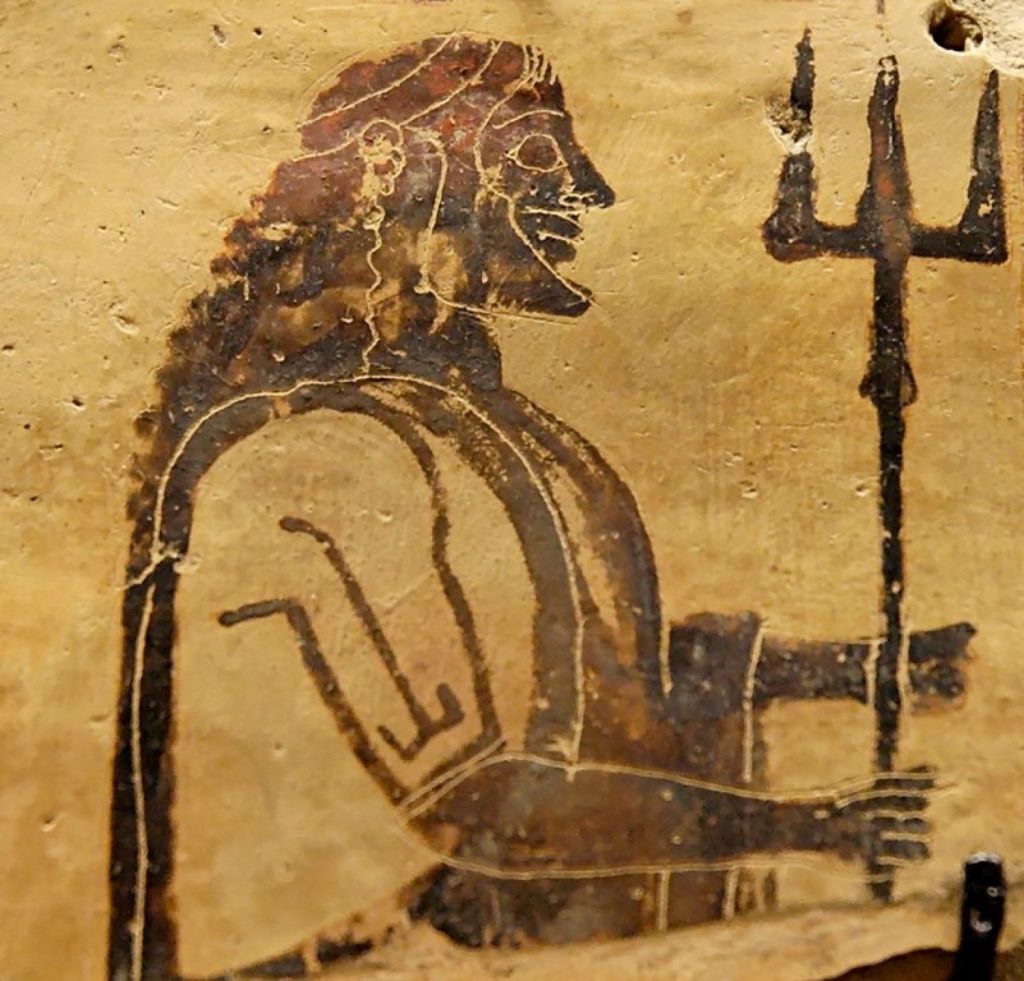
Poseidon and his trident, Corinthian plaque, 550–525 BC from Penteskouphia (a Greek village near the ancient city of Corinth), phot. Jastrow, 9/10/2006, Wikimedia Commons, Public Domain. Illustration used in student presentations (taken from Irene Di Gioia’s lesson).
The project was realized as a lesson based on materials received form the Faculty of “Artes Liberales”. The class 1TB under my guidance tested the lesson about Poseidon (Meet Poseidon), according to the texts, illustrations, and other teaching aids provided by Ms Irene Di Gioia (Universities of Bologna and Göttingen). The purpose of the lesson was to get to learn about the figure of Poseidon and his Roman counterpart Neptune, follow his presence in culture, and at the end of the exercise, prepare a creative task reflecting our concern about restoring nature and counteract marine pollution in the modern world. We concluded the lesson with a test I prepared in the Kahoot app, which allowed the students who completed it to win small gifts bearing mythological names.
In preparing for the 90-minute-long lesson, I decided to share some of the tasks with the students using Ms Di Gioia’s materials as the basis for our discussion about Poseidon. The learning methods I used for this lesson were: – a lecture and a discussion with a multimedia presentation, – tasks divided among groups focusing on a specific topic, – role playing, – production of a movie, – a brainstorming.
The lesson started with a presentation by the teacher – based on available materials: I prepared a Power Point introduction to the lesson including content related to what mythology is, what we need it for, and what influence it has on us. I have also shown what influence – although we often do not see it – ancient culture had on later culture, the surrounding world, and contemporary pop culture (Shakespeare’s plays, The Avengers, the X-Men, certain models of cars).
Statue of Neptune in Bologna by Giambologna, phot. by Monia Mascagni, 2019, Wikimedia Commons, under the Creative Commons Attribution-Share Alike 4.0 License. Photograph used in student presentations, taken from the lesson by Irene Di Gioia.
After my presentation, the students shared the materials they had prepared. One of them played the role of Poseidon and presented this character. Others in the form of presentations introduced: symbology of horses and earthquakes, the image of Poseidon in art and pop culture, the history of Odysseus’ conflict with Polyphemus and the link between this story and the power of Poseidon, the history of the Maserati car brand (its creators – brothers from Bologna who referred to Poseidon). The last activity was the brainstorming, when we were writing down on the board contemporary threats to the seas and reflecting on how we can “help Poseidon” today and protect the cleanliness and good condition of the oceans.
During their work on the tasks, students had to cooperate in order to achieve successful results, especially when making the film based on the myth about Odysseus’ meeting with Polyphemus. Those preparing their presentations had to make a selection among the provided materials, and decide on the optimal graphic form and attractive manner of communication. As it commonly happens in such situations, some students succeeded very well, others limited themselves to an absolute minimum. I supervised the course of the lesson without intervening in the presentations. I noticed that even though the lesson was not open to outside observers and attended only by members of the class, it was still a stressful situation for the students.
Student giving a presentation on Poseidon, from Natalia Konieczna’s archive.
My assessment of the implementation of “The Modern Argonauts” programme is very positive. The students gained from it educationally, but not only – their were motivated by the opportunity to take part in an international project and by the perspective of sharing their impressions as feedback for the handbook including the lesson they implemented, which will be published in Open Access. They also acquired the experience of coping with a public appearance even though on a small scale of performing in front of a small group with which they were already familiar.
As a teacher, I also benefited in many ways from taking part in the project. I realized that combining various methods and mobilizing students impacted their approach to learning; putting an emphasis on their agency and encouraging them to act improves their self-esteem and expectations of success in the area of humanities (beyond mechanics which is the focus of the school). I also saw which aspects I need to work on – mainly those related to improving motivation to act (the entire class could not be successfully mobilized, there were students who did not get involved at all).
Student giving a presentation on Poseidon, from Natalia Konieczna’s archive.
The “Modern Argonauts” project encouraged me to be open to further commitments, and if such opportunities came up, to engage with my students in similar projects. In my opinion, a contemporary school should challenge students in various ways – especially if it is a school like “Samochodówka” [a secondary technical school for motor vehicles]. It is important for education not to be limited to teaching strictly the core curriculum but to engage also in activities going beyond the school’s main obligations (for both students and teaches) and including a broader perspective. At a vocational school, it is easy to neglect or ignore non-core issues; the students many times approach learning with a narrow mind-set focused on “just to get the diploma, just to pass the exams”. Participation in projects like this one introduces a broader perspective and creates motivation to venture into diverse activities, at the same time, building a better relationship between teachers and students.
We are pleased to share the song “The Dream of Ithaca” by Miriana Jędrasik, Hanna Ryznar, and Aleksandra Winiarska – students of the Classical Class at Mikołaj Rej XIHigh School in Warsaw. This Class is under the patronage of the Faculty of “Artes Liberales”, University of Warsaw. Calypso’s song was inspired by a lesson led by Anna Wojciechowska, the teacher of Latin language and ancient culture.This lesson was based on the scenario “Meet Calypso” written by Marta Pszczolińska (Faculty of “Artes Liberales”, University of Warsaw) within “The Modern Argonauts” ERC Proof of Concept Grant project. The scenarios for mythology lessons will be available soon via The Modern Argonauts website (https://modernargonauts.al.uw.edu.pl).
We approached the implementation of the Calypso lesson with great curiosity – the “Modern Argonauts” project is unlike other projects we participated in in previous years. We, therefore, explored the submitted materials, used them in class, and then did one of the creative exercises suggested by the Author of the scenario. The character of Calypso really spoke to us, especially after reading the “Odyssey” and after discussing the female figures created by Homer. Therefore, we decided to re-tell the Calypso story in our own way. One of the created stories is “The Dream of Ithaca”.
Hanna Ryznar: For the purpose of the project, together with Miriana and Ola (Aleksandra) we wrote a song entitled “The Dream of Ithaca”. I wrote the lyrics in Polish, Miriana composed the melody, and Ola designed the cover. The lyrics of the song are a letter from Calypso to Odysseus. The nymph explains in it her longing for the beloved who left her isle of Ogygia to return to his wife waiting for him in Ithaca. Calypso, despite the immense suffering, caused by the departure of her lover, knows that Odysseus must go back home because only there can he be truly happy. I was inspired to write the text by the mythical story of Calypso told by Homer in the “Odyssey”.
Miriana Jędrasik: I intended the melody to resonate with how Calypso must have felt when writing this letter. It is nostalgic, but also emotional and touching.
Aleksandra Winiarska: The inspiration for my illustration was a picture by the famous painter Jules Breton. The woman waiting for Odysseus at home is knitting, trying to keep her thoughts occupied so that she can forget the suffering for a while.
lyrics: Hanna Ryznar music: Miriana Jędrasik cover image: Aleksandra Winiarska
English translation of the lyrics (original text in Polish below):
On Zeus’ orders I had to return your freedom to you, to give up the dream of my own happiness. Your departure hurts me immensely, but only in Ithaca will you find your happiness. I remember many talks about love. How Iwanted you to accept the gift of immortality! To you, Ogygia was never home. Although you slept next to me, you dreamt of Ithaca.
I know that wandering across the seas, you will encounter many difficulties. Always mind the Bear in the sky and call on me when you find yourself in need.
From the beginning of your adventures, you wanted challenges and hardships and despised the fake happiness of the Gods. Ican’t imagine this island without you, but Ihave to forget, go on for myself.
I know that wandering across the seas, you will encounter many difficulties. Always mind the Bear in the sky and call on me when you find yourself in need.
Post by Anna Wojciechowska, Miriana Jędrasik, Hanna Ryznar, and Aleksandra Winiarska, translated and placed by Olga Strycharczyk, proofread by Elżbieta Olechowska
Sen o Itace
Mamy przyjemność podzielić się piosenką „Sen oItace”, przygotowaną przez Mirianę Jędrasik, Hannę Ryznar iAleksandrę Winiarską – uczennice klasy klasycznej XILiceum Ogólnokształcącego im. Mikołaja Reja wWarszawie. Klasa klasyczna jest objęta patronatem Wydziału „Artes Liberales” Uniwersytetu Warszawskiego. Utwór powstał z inspiracji lekcją pod kierunkiem Anny Wojciechowskiej – nauczycielki łaciny ikultury antycznej.Jako podstawę tej lekcji wykorzystano scenariusz „Spotkanie z Kalipso” autorstwa Marty Pszczolińskiej (Wydział „Artes Liberales” UW) napisany w ramach ERC Proof of Concept Grant na projekt „Współcześni Argonauci”. Scenariusze lekcji omitologii będą dostępne wkrótce na stronie The Modern Argonauts (https://modernargonauts.al.uw.edu.pl).
Do realizacji lekcji o Kalipso przystąpiliśmy z wielką ciekawością – „The Modern Argonauts” to projekt odmienny od tych, w których braliśmy udział w poprzednich latach. Zapoznaliśmy się zatem z nadesłanymi materiałami, wykorzystaliśmy je podczas zajęć, a potem wykonaliśmy jedno z ćwiczeń kreatywnych zaproponowanych przez Autorkę lekcji. Postać Kalipso bardzo nam się podobała, zwłaszcza po lekturze „Odysei” i po rozmowach na temat stworzonych przez Homera postaci kobiecych. Postanowiliśmy zatem opowiedzieć historię Kalipso na nowo, na swój sposób. Jedną z powstałych opowieści jest piosenka pt. „Sen o Itace”.
Hanna Ryznar: Na potrzeby projektu razem z Mirianą i Olą stworzyłyśmy piosenkę pod tytułem „Sen o Itace”. Ja napisałam tekst, Miriana skomponowała melodię, a Ola stworzyła projekt okładki. Tekst piosenki to list Kalipso do Odyseusza. Nimfa wyraża w nim swoją tęsknotę za ukochanym, który opuścił jej wyspę Ogygię, aby powrócić do żony, czekającej na niego na Itace. Kalipso, pomimo ogromu cierpienia, jakie sprawiło jej odejście ukochanego, wie, że Odyseusz musi wrócić do domu, ponieważ tylko tam może być prawdziwie szczęśliwy. Do napisania tekstu zainspirowała mnie mityczna historia Kalipso opowiedziana przez Homera w „Odysei”.
Miriana Jędrasik: Chciałam, aby melodia komponowała się z tym, jak musiała czuć się Kalipso, pisząc ten list. Jest nostalgiczna, lecz także emocjonująca i wzruszająca.
Aleksandra Winiarska: Inspiracją dla mojej ilustracji był obraz słynnego malarza Jules’a Bretona. Kobieta, czekając na Odyseusza w domu, zajmuje się robieniem na drutach, stara się zająć własne myśli, aby na chwilę uwolnić się od cierpienia.
tekst: Hanna Ryznar muzyka: Miriana Jędrasik ilustracja na okładce: Aleksandra Winiarska
Z rozkazu Zeusa musiałam wolność Ci zwrócić, marzenia owłasnym szczęściu porzucić. Ogromnie mnie boli to Twoje odejście, lecz tylko wItace odnajdziesz swe szczęście. Pamiętam wiele rozmów omiłości. Jak chciałam, byś przyjął dar nieśmiertelności! Ogygia dla Ciebie nigdy domem nie była, choć spałeś obok mnie, Itaka Ci się śniła.
Wiem, że tułając się po morzach, napotkasz wiele trudności. Zawsze miej Niedźwiedzicę na niebie iprzywołaj mnie, gdy się znajdziesz wpotrzebie.
Od początku przygód, wyzwań itrudów chciałeś isztucznym szczęściem bogów pogardzałeś. Nie umiem wyobrazić sobie tej wyspy bez Ciebie, lecz muszę zapomnieć, iść dalej dla siebie.
Wiem, że tułając się po morzach, napotkasz wiele trudności. Zawsze miej Niedźwiedzicę na niebie iprzywołaj mnie, gdy się znajdziesz wpotrzebie.
Post przygotowany przez Annę Wojciechowską, Mirianę Jędrasik, Hannę Ryznar i Aleksandrę Winiarską, przetłumaczony i zamieszczony przez Olgę Strycharczyk, korekta wersji angielskiej: Elżbieta Olechowska
The project seminar on making Booktubes at the Benedictine secondary school in Schäftlarn near Munich, led by Dr Michael Stierstorfer, cooperation partner of the Our Mythical Childhood project, has been nominated for the German Reading Prize, which is endowed with several thousand euros. This is awarded in several categories to people who have made a special contribution to promoting and motivating reading.
Dr Michael Stierstorfer with the students from the P-Seminar Booktubes, phot. Otto Heitzer.
Together with his students, Dr Stierstorfer has also published book reviews focusing on Greek and Roman mythology in this context. The focus was on works from current children’s and youth literature. The students of the course are very pleased and are already very excited about the announcement of the prizes. The mythical short videos can be found under the following links on the Youtube channel GBS Booktubes:
Press articles on the nomination can be found here:
Schäftlarner Booktuber für den Deutschen Lesepreis nominiert
Das Projekt-Seminar zum Drehen von Booktubes des Gymnasiums der Benediktiner Schäftlarn bei München unter der Leitung von Dr. Michael Stierstorfer, Kooperationspartner des Projekts Our Mythical Childhood, wurde für den mit mehreren Tausend Euro dotierten deutschen Lesepreis nominiert. Dieser wird Personen, die sich besonders um die Leseförderung und Lesemotivation verdient gemacht haben, in mehreren Kategorien verliehen.
Dr. Michael Stierstorfer mit den Schülerinnen vom P-Seminar Booktubes, phot. Otto Heitzer.
Zusammen mit seinen Schülerinnen hat Stierstorfer in diesem Kontext auch Buchbesprechungen mit dem Fokus auf die griechisch-römische Mythologie veröffentlicht. Hierbei standen Werke aus der aktuellen Kinder- und Jugendliteratur im Vordergrund. Die Schülerinnen des Kurses freuen sich sehr und sind schon sehr nervös mit Blick auf die Bekanntgabe der Preise. Die mythischen Kurzvideos sind unter den folgendes Links auf dem Youtube-Channel GBS Booktubes zu finden:
The book Teaching Ancient Greece, edited by Dr Sonya Nevin is available in Open Access.
Teaching Ancient Greece was edited by Sonya Nevin, Assistant Professor at the University of Warsaw’s Faculty of “Artes Liberaes”. Dr Nevin works with animator Steve K. Simons on the Panoply Vase Animation Project, making short educational animations from real ancient artefacts. Where an ancient amphora shows the hero Heracles holding a boar, the animation shows him capturing it; where another vase shows the rainbow goddess Iris, the animation shows her flying, leaving rainbows streaking behind her. Five vase animations and four short documentaries were created for the Our Mythical Childhood project. They are based on five Greek vases from the collection of the National Museum in Warsaw. Now the animations and documentaries have been joined by Teaching Ancient Greece which transforms watching into a multitude of activities.
Dr Sonya Nevin with her book and the famous Sappho vase (no. 142333) in the National Museum of Warsaw.
Teaching Ancient Greece contains activity sheets, including ones for learning the Greek alphabet, matching gods to their symbols, and for colouring in vases and creating new vase designs. These are joined by a set of ready-to-use lesson plans for teaching about the ancient world. Created by experienced educators all over the world, each lesson plan contains an introduction, a lesson including one of the animations, and an exciting activity to extend the learning experience. The target audience is secondary school pupils, but the lessons can all be adapted for older or younger groups.
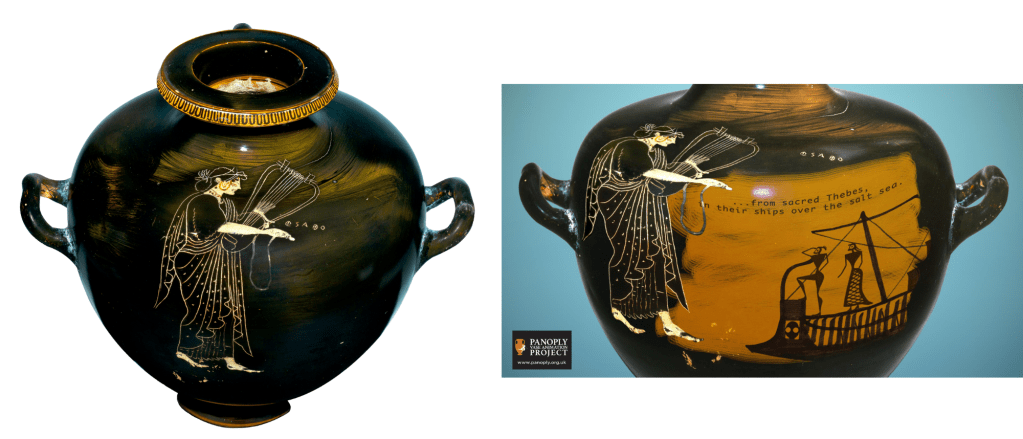
Left, an ancient Athenian vase depicting the poet, Sappho, and (right) a screenshot from the animation created from that vase.
Igor Cardoso in Brazil created a lesson about the poet Sappho, with writing activities about facing difficult situations. Ancient music specialist Aliki Markantonatou in Greece brings us a lesson on composing lyric poetry. This complements her recording of a unique version of one of Sappho’s poems, based on the music that the ancient poem would have been sung to. Ron Hancock-Jones in the UK used the Sappho animation to develop a lesson on marriage and relationships in ancient Greece. Chester Mbangchia in Cameroon created a lesson that introduces the god of drama, wine, and transformation – Dionysus. Theatre facilitator Olivia Gillman in the UK used the Dionysus animation as the basis for a drama class. Barbara Strycharczyk of “Strumienie” High School in Poland established a project for pupils in multiple years of the school who each worked towards an exhibition about the hero Heracles. Jessica Otto, in Germany, used the Heracles animation to show how stories can be represented and decoded through visual clues. Sonya Nevin offers several lessons on learning to “read” the images in Greek pottery, including one on the Libation animation, which shows the gods Zeus and Athena performing a libation sacrifice. Michael Stierstorfer in Germany used the same animation in a lesson about sacrifice in ancient Greece: what was done, how, and what it all meant. As for Iris, Dean Nevin in Switzerland brings us a writing challenge – messages for the rainbow messenger goddess to carry. Terri Kay Brown in New Zealand (Aotearoa) created an introduction to anthropology – a chance to compare different cultures’ myths about the rainbow and to consider what is indicated by the differences and similarities between them.
Right, a vase made in Athens in around 450 BCE, depicting the rainbow goddess Iris (no. 142289), and left, a creative version of the vase made by Temperance, aged 7, Ireland, using an activity sheet from the book.
Other lessons explore the world of museumsthemselves. Museum educator Jennie Thornber in the UK offers a lesson for exploring museums in person or online and taking on the role of a curator. A PowerPoint on the Panoply site is one of several providing extra support for these activities. Louise Maguire in Ireland set an alternative curator’s challenge, asking learners to consider factors such as planning, budget, and accessibility in planning exhibitions.
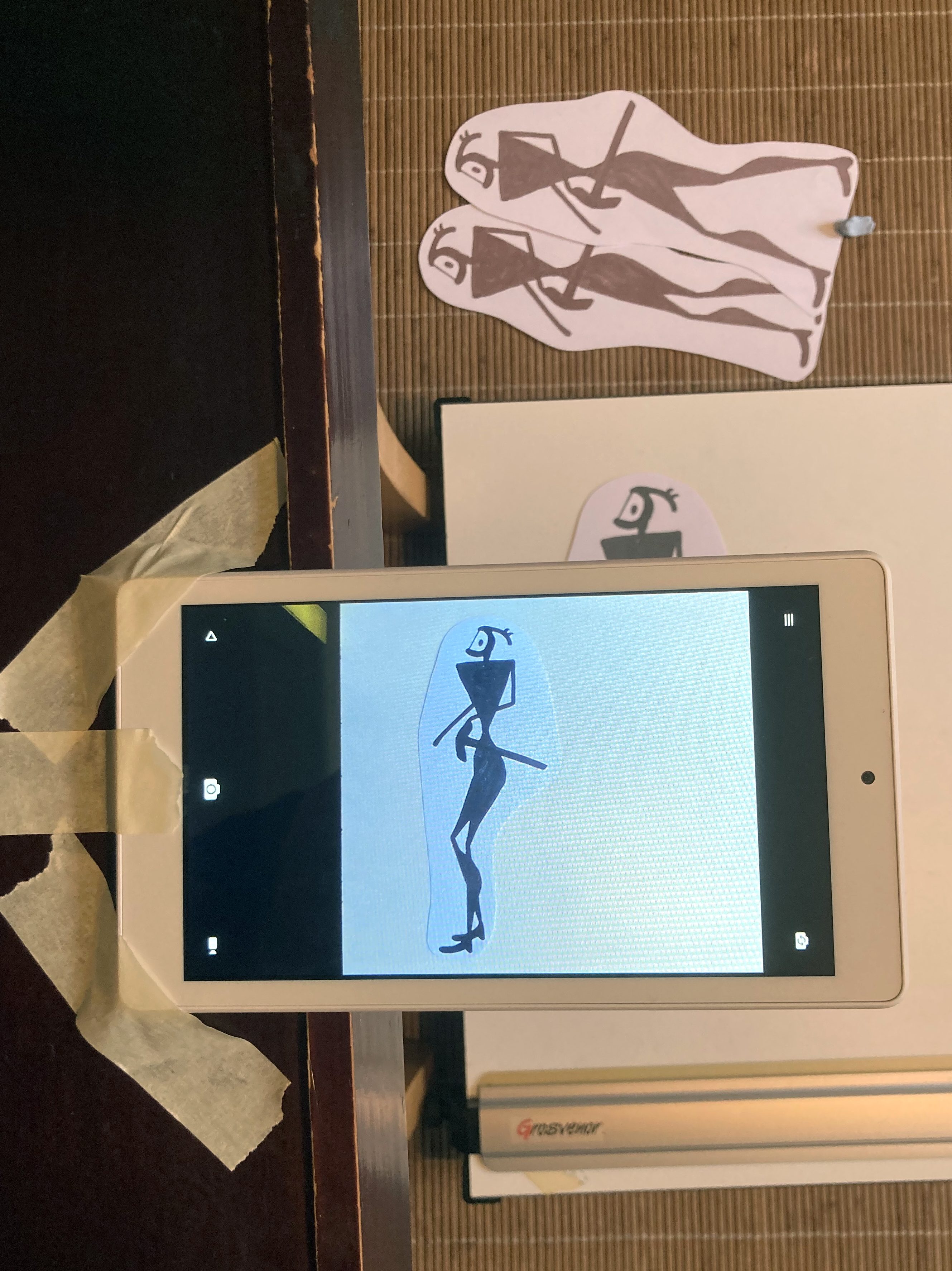
The book includes a detailed guide to making stop motions.
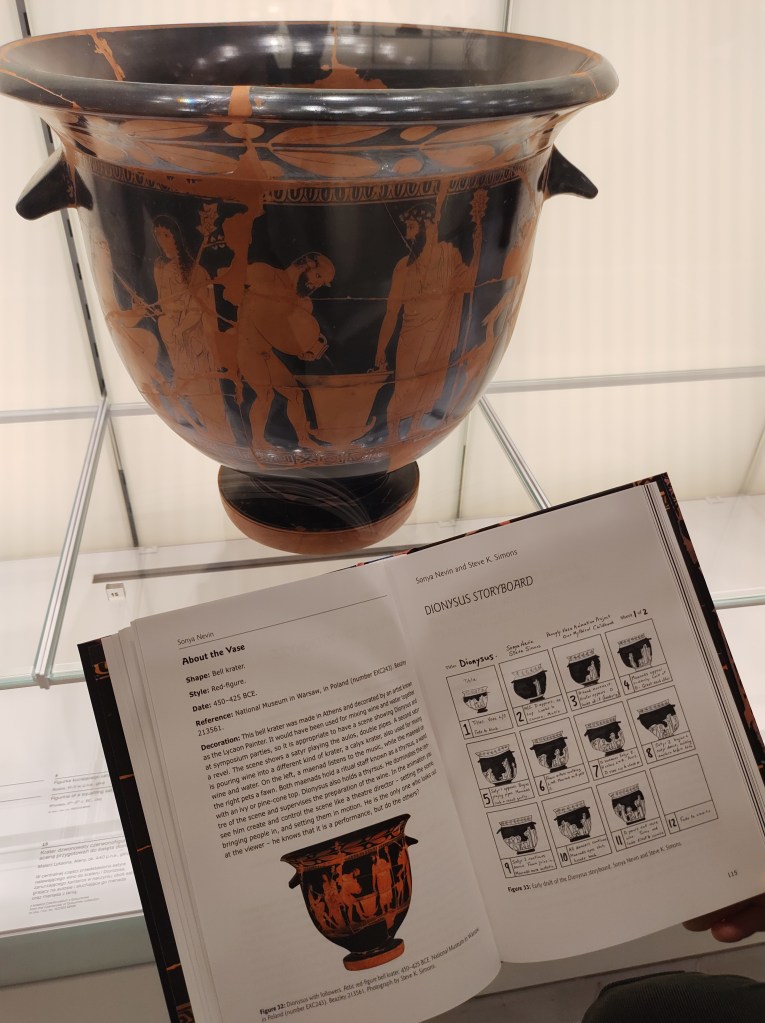
The vase (no. EXC243) used in the Dionysus animation and the storyboard used to plan it. Storyboarding is a great way for students to revisit what they have learned in a creative way.
Perhaps all this talk of animation makes you feel like having a go at making your own stop-motion animation. Christina DePian, a museum educator based in Greece, provides a detailed and accessible guide to making stop motions. Accompanied by a set of animation resources, this guide makes it easy for anyone from 5 to 105 to try animation and create their own version of antiquity.
Elena Mignani (b. 2000) graduated in Classical Studies at the University of Bologna, she attended the first year of Master in Classics at Bologna and will move to Oxford University to conclude her studies. She took part in the public reading of Aristophanes, organized by Prof. Valentina Garulli, and in the translation workshop curated by Prof. Garulli with Davide Lamandini (Master student at the University of Bologna).
Once again this year, the customary Public Reading of the Classics was held in collaboration with the Festival Européen Latin Grec and coordinated by Valentina Garulli, Professor of Greek Language and Literature at the University of Bologna. On 15 March 2024, at the Enzo Biagi auditorium of Bologna’s municipal library, “Salaborsa”, students from the city’s two classical high schools, Marco Minghetti and Luigi Galvani, presented a reading of passages from the Ekklesiazuse, or Assemblywomenby Aristophanes, a text selected by the Festival for this edition. You can see a short reportage about the project here:
In Preparation for the Reading: The Introductory Lectures The public reading of the text, the final event of the project, was preceded as usual by four introductory lectures given by university professors in the previous weeks. The guests invited this year addressed the play from various perspectives, including that of the political utopia of women governing Athens (Prof. Vinicio Tammaro, University of Bologna), and how the new laws promoted by this revolutionary government curiously seem to be found in much the same form in the ideal city theorised by Plato in the Republic (Prof. Andrea Capra, University of Milan). This mundus inversus was analysed by Prof. Markus Janka (Ludwig-Maximilians Universität) in its grotesque component, seen as a field of experimentation and a deforming mirror of social antinomies, also looking at the more modern reception of the work. The lecture by Prof. Pietro Totaro (University of Bari), examined in detail some of the final iambic scenes of the play, such as the one in which two old women vie for the company of a young man, by focusing in particular on some textual problems and the comic ideology that can be derived from them.
Third introductory lecture, by Prof. Pietro Totaro. Phot. Mattia Belletti.
Around the Reading: How to Bring Aristophanes Back on Stage The choice of Assemblywomen was decidedly unexpected, but it was widely appreciated by both professors and students, who had the opportunity to experiment with new ways of translating and disseminating a classic text. Indeed, the first challenge began precisely when it came to choosing how to successfully translate an ancient work and, secondly, how to represent it in front of a contemporary audience. How can one gloss over the various unfamiliar proper names of politicians, strategoi, common citizens, that characterise the Aristophanic play and which, unfortunately, make it so inaccessible? How can one understand the historical context in which it was staged and at the same time equate a theatrical experience with a simple reading of the text?
Translation workshop. Phot. Mattia Belletti.
To achieve this goal, part of the project was dedicated to translation workshops run by master graduate students, in which high school students were able to test their translation skills, devising a translation that was not purely made for school but that was suitable for a public reading. The reading was also accompanied by photographic and musical aids that gave a clear picture of the scene being read and the actors involved. The participation of the students was essential also in these occasions: they contributed their musical and theatrical skills to the background music, to the two introductory and conclusive videos and some pictures, used during the reading itself. “A fruitful interweaving”, commented Domenico Alfano, an undergraduate student at the University of Bologna, which “significantly enhanced the visual experience of the spectator”.
Musical workshop. Phot. Mattia Belletti.
The Scenic and Visual Framework “They tell me to retire, that I am to be scrapped […]”. This is how the narrative framework chosen to accompany the comic text begins. Here, an old Aristophanes, played by Francesco Faccioli, and the Muse of the tragedy Thalìa, Noemi Coppola, discuss the possible plot of a play that was written after the decline of Athenian power in 392/1 BCE, Assemblywomen. The narrative frame perfectly introduces the play to the audience by setting it in its historical context. It also serves as a running thread that coherently connects the various textual sections chosen for reading. “A real added value to the reading”, commented Professor Sonia Stelluto of Luigi Galvani classical high school, “that helped to make the reading clearer and more accessible to a wider audience”.
Scenic Framework: Aristophanes and Thalia discussing about the plot of the play. Phot. Mattia Belletti.
And, while Aristophanes and Thalia imagine the plot of the future play in front of the audience, several Praxagora and Blepiros (the protagonists of the play) take turns on stage while being shown pictures that reflect the salient scenes read by the students.
Images of the reading: scene of Praxagora and Belpiros arguing. Phot. Mattia Belletti.
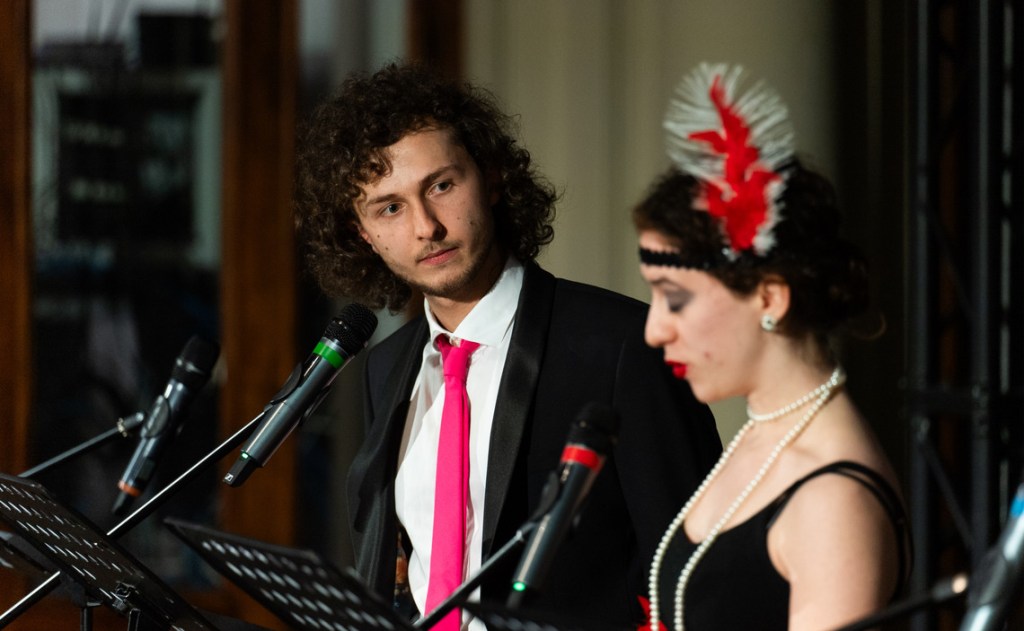
They are snapshots of a performance that is actually never performed but only imagined: in the introductory video (made by high school and university students coordinated by Mattia Belletti), under the notes of the can-can, the actors hurry to rehearse for the last time before the debut, while in the conclusive video the performance is already over, the audience applauds the actors and the musicians slowly prepare to leave the theatre. All we see on stage, however, are nothing more than the ideas of the playwright and the Muse taking shape and voice in the verses read by the students.
The Students’ Point of View: What Did It Mean for You to Participate? At the end of the reading, the high school and university students who participated or only attended the reading were asked for their opinion on the project. For the high school students, the value of a project such as the public reading lies very much in the impact it can have on their approach to the classics: “I believe that participation in projects of this kind is fundamental in order not to reduce classicism to a static and distant, and merely scholastic, dimension. We students, as readers, were given the opportunity to revitalise the words of Aristophanes and in doing so we understood the choral nature of the theatrical process, as well as experiencing the emotions” (Letizia Cela, student at Liceo Classico Marco Minghetti, translator and reader).
Equally significant was this initiative to a more specialised audience such as university students. How do you consider this experience from the point of view of a university student? “For a university student, the experience is instructive and formative for at least two further reasons: it brings the conscience of the ancients back to the centre of public attention and guides us, thanks to the young and attentive eye of the students at Bologna’s classical high schools, to a new and intriguing way of interpreting and rereading Aristophanes” (Domenico Alfano, undergraduate student of Classics at the University of Bologna).
What do you think about the participation of high school students in a university project? “I think that the involvement of high school students is praiseworthy: the opportunity to engage in translation work, to personally confront the works, also in terms of their updating, are all elements that I think can really make us reflect on the value of the classics even in today’s world” (Beatrice Bonazza, graduate student in Classics at the University of Bologna).
Hopes and Resolutions for the Upcoming Year This year’s reading, which was able to involve and entertain such a diverse audience, including high school and university teachers, students and a general audience, was therefore a great success that allowed, in the words of Domenico Alfano (undergraduate student), to “rediscover the beauty of going to the theatre: to purify oneself and reshape one’s spirit according to what one sees on stage”. Among the many goals for the next edition, which will have Seneca’s Medea as its text, there is certainly that of making the initiative accessible to an ever-wider audience so that, in the words of Beatrice Bonazza (master’s student), “the words of the classics and the reflections we can still draw from them reach more and more people”.
Link for the Reading:
Post by Elena Mignani, placed by Olga Strycharczyk









 Our Mythical Childhood Blog