Blog for the international research project "Our Mythical Childhood… The Reception of Classical Antiquity in Children’s and Young Adults’ Culture in Response to Regional and Global Challenges", financed by the ERC Consolidator Grant led by Prof. Katarzyna Marciniak, Faculty of "Artes Liberales" of the University of Warsaw. Team members: Prof. Susan Deacy and Steve K. Simons, University of Roehampton; Prof. Elizabeth Hale and Dr Miriam Riverlea, University of New England; Prof. Lisa Maurice and Dr Ayelet Peer, Bar-Ilan University; Prof. Daniel A. Nkemleke, Dr Divine Che Neba and Dr Eleanor A. Dasi, University of Yaoundé I; Dr Elżbieta Olechowska, Dr Hanna Paulouskaya, Dr Sonya Nevin, Dott. Edoardo Pecchini, Marta Pszczolińska, Angelina Gerus and the Project Officers: Magdalena Andersen, Maria Makarewicz, and Olga Strycharczyk from the Faculty of "Artes Liberales" UW.
We are most pleased to share the great news. Dr Sonya Nevin has joined Hughes Hall as a by-fellow (a research post). Dr Nevin is also a supervisor (an academic post for small group teaching), and a tutor (a pastoral care role).
Hughes Hall is one of the 31 colleges that belong to the University of Cambridge. It accepts postgraduate and mature undergraduate students, with a very international community. It has a strong showing in education, law, and finance, though it takes students from other subjects too. It prides itself on developing students’ skills and having good contacts with the wider world.
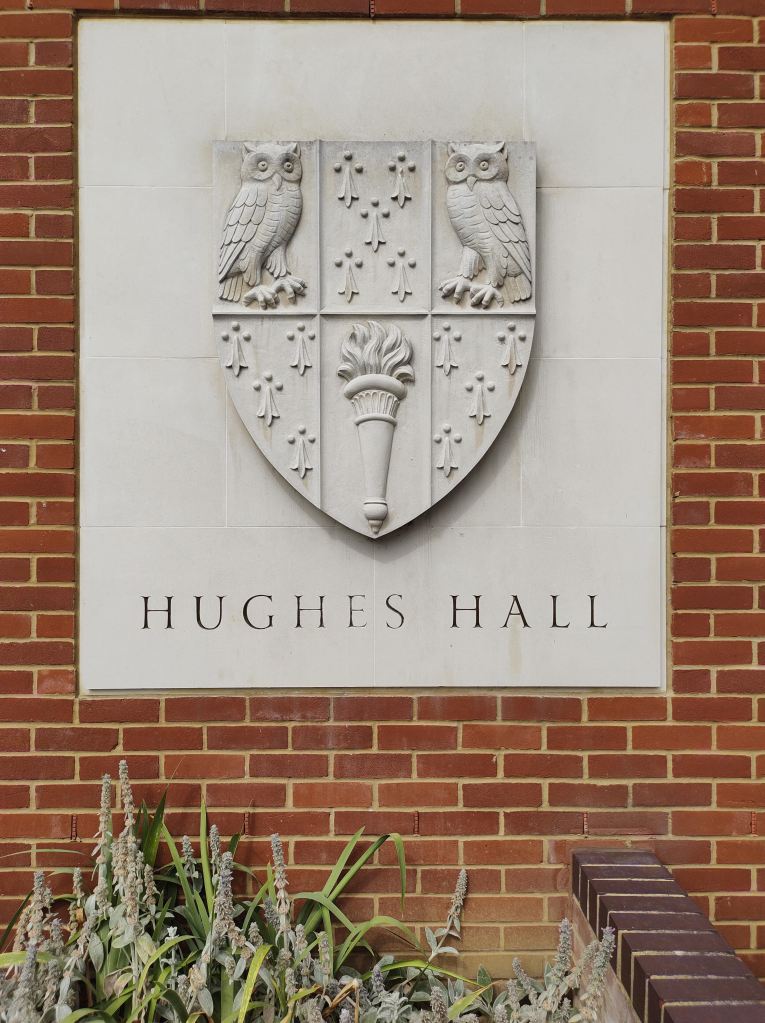
Margaret Wileman Building, the main building of the Hughes Hall, designed by William Fawcett, inaugurated in 1895. Phot. Sonya Nevin.Hughes Hall shield with the owl, symbol of wisdom, and the torch, sign of enlightenment and truth. Phot. Sonya Nevin.
Acknowledgements We are most grateful to Professor Katarzyna Marciniak and her team at the University of Warsaw for this opportunity to publish coursework by University of Roehampton Study Abroad. Below statement and essay by international student Alexandria Kilmartin who joined us at Roehampton all the way from Australia.
***
My name is Alexandria Kilmartin, but I go by Alex, and I am a study abroad student at the University of Roehampton. When not abroad, I study at Macquarie University, in Sydney, Australia, where I am completing a double degree of a Bachelor of Arts, majoring in Ancient History and a Bachelor of Linguistics and Language Sciences. I am a first-generation University student in my family and when I complete my undergraduate studies, I am aiming towards completing a masters in either speech pathology or furthering my historical research studies. Personally, and in my leisure time, I enjoy reading novels, I love the beach and going on long walks and getting coffees with my friends. I decided to select the Art & Life in the Ancient World course at Roehampton because I have always loved and appreciated art, and I was intrigued in developing deeper ideas surrounding art in Antiquity. The course connected with my purpose and decision to select the University of Roehampton and its specific location in proximity to the British Museum, as it has been a dream of mine to visit.
The Art & Life in the Ancient World module has significantly impacted how I view, interpret and interact with ancient art and has helped me develop ideas and evolve concepts in my academic work. Winklemann’s ideas originally interested me because of his perception of aesthetic and beauty standards. His ideas are incredibly evident in society today and, drawing from personal experiences as a young woman, I feel the connection between beauty and (face) value. Many ideas that are elaborated on in my essay I personally resonate with and that is why I was and am so passionate about this topic. I wanted to acknowledge that ideas of beauty are multifaceted and that beauty is in the eye of the beholder. Having the opportunity to be able to publish my work is an incredible opportunity and I am honoured to have been considered for this. I believe that this opportunity will significantly help my career in an overwhelmingly positive way and help me take a step closer to achieving my academic goals of completing a masters, furthering my education and deeper understanding of the world.
To what extent can we apply Winckelmann’s ideas about beauty to small and portable functional objects from Classical Antiquity? Discuss with reference to at least two objects.
Johann Joachim Winckelmann (1717–1768) has provided valuable ideas and perspectives on aesthetic, beauty, knowledge and understanding in his 1764 publication History of the Art of Antiquity (Geschichte der Kunst des Alterthums, 1764).[1] Winckelmann has significantly contributed and inspired the classical archaeology discipline and study of neoclassical art. This essay will elaborate on how Winckelmann’s ideas about beauty can be successfully placed on humble, portable and functional objects. The pieces under discussion are a “Bronze Mirror with a support in the form of a draped woman” (mid-5th century BCE)[2] and secondly a “clay lekythos” (1st quarter of 5th century BCE) attributed to the Manner of the Haimon Painter.[3]
These functional objects are kept in the Metropolitan Museum of Art in New York and the study of these humble objects with reference to Winckelmann’s ideas can significantly contribute to an understanding of the importance of beauty juxtaposed to functionality, and if these concepts are exclusive. I will argue that Winckelmann’s ideas of subjective aesthetics can be used as a foundational assessment in attributing beauty and overall purpose. Specifically, that a more nuanced and less context-specific approach is required in assessing beauty and that functionality is more significant and equally as beautiful. There is scope for a more in-depth study of small finds in museum collections for a broader appreciation of ancient art and life.
Figure 1 Anton Raphael Mengs, Johann Joachim Winckelmann (1717–1768), ca. 1777, The Metropolitan Museum of Art, no. 48.141, Public Domain [source].
Winckelmann is commonly attributed as “a source of inspiration for neo-classical art in the late eighteenth and early nineteenth century” and is seen as the father of the classical archaeology discipline.[4] His History of the Art of Antiquity became a foundational text in neoclassical thought, shaping ideas about specific aesthetics and the idealized European body. Winckelmann believed that Greek art was the epitome of artistic creation and the experience of viewing it provoked joy. Based primarily on sculpture of the human physique, Winckelmann’s ideas are characterized by an unrealistic physical representation of the most elite and sophisticated Greek aesthetics. Winckelmann’s ideas assessed aesthetics in a philosophical and context specific manner that inspired subsequent generations of historians, artists and museum professionals. His publications encouraged enlightened intellectual inquiry on art history and philosophical aesthetics in eighteenth-century Germany. Classical scholar Katherine Harloe, for example, explores how Winckelmann’s ideas impacted German classicists from the 1840s.[5]
In my view, Winckelmann’s ideas provoke thoughtful discussions about ancient objects, their representations, and their surrounding context. The objects selected have been chosen because of their interaction with and representation of the human body, as well as their functional incorporation of movement. A key idea of Winckelmann’s “Rules of perspective” is that “[a]ll the arts have a double goal: they should give pleasure and at the same time instruct”.[6] This highlights that Winckelmann believed that something should be learnt from art. Thus, the objects under discussion are significant and I believe that the basic principles of Winckelmann’s ideas can be applied. Arguably, the rich historical, social and human interactions with functional material culture and the aesthetics of daily life are all ultimately beautiful and educational.
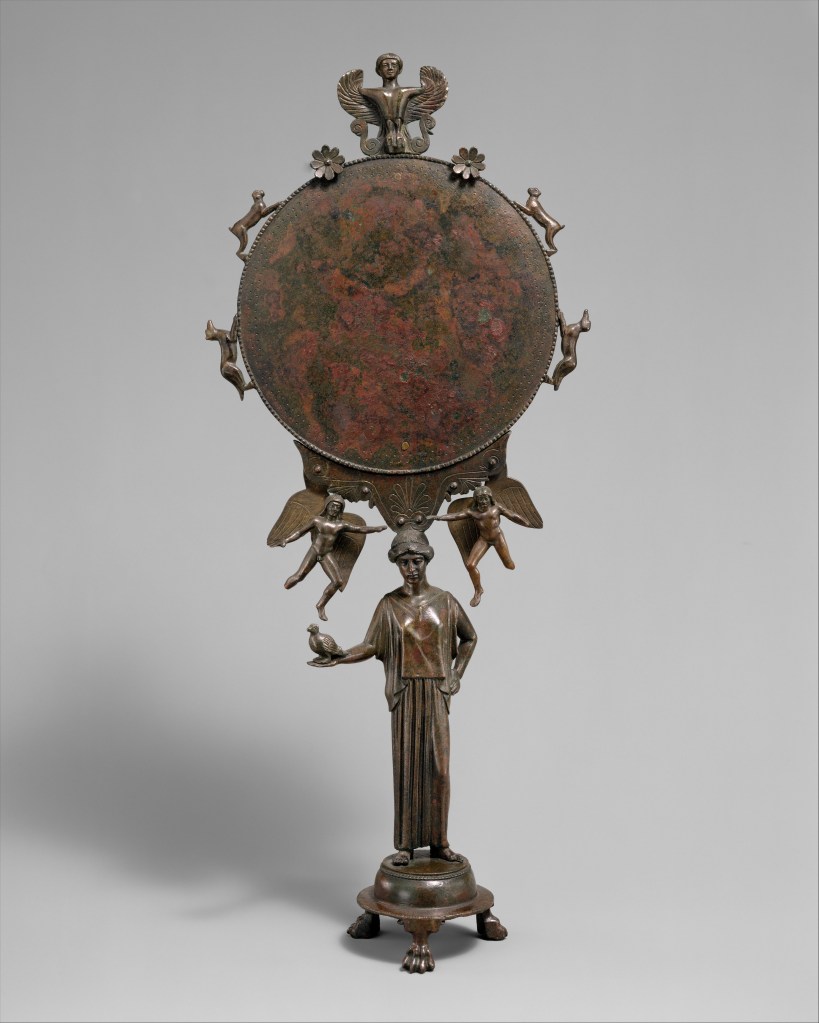
Figure 2 Greek, Argive bronze mirror with a support in the form of a draped woman, mid-5th century BCE, The Metropolitan Museum of Art (number 1972.118.78) [source].
The first object under analysis is a finely crafted bronze mirror from the mid-5th century BCE (Figure 2). The mirror incorporates a statuette of a three-dimensional female figure as a base that supports the mirror. The design of a statuette figure in a functional object is a “hallmark of Greek art”[7], thus I believe that this particular representation of the human body would be an object that Winckelmann’s ideas can be applied to. The mirror features a collection of lively elements such as a human figure as well as animal and mythological creatures. Winged Erotes fly above the female statue’s head. Surrounding the mirrored disk are symmetrical pairs of hounds chasing hares, leading to the top of the mirror where a part bird, part woman siren is perched. Made out of a bronze, approximately 40,4 cm heigh and weighing 0,9 kg, the mirror was found in an Argive grave. The object relates to the human body by sensory, visual and physical touch experiences and displays visual aspects that reflect the classical period and context in which it was made.
The imagery and simplistic action of the woman ultimately holding up the mirrored disk contributes to a deeper metaphor and symbolism of beauty and connects to Winckelmann’s ideas about aesthetics. The stance and posture of the female statuette supports the mirror, simultaneously supporting the female or user of the mirror in their quest for beauty and their interaction with their appearance. “Her serious expression and quiet stance are typical of the retrained early Classical statues that were created from about 480 to 450 BC”, according to the MET online entry.[8] This mirror preserves and perpetuates symbolism of an idea of beauty that must be obtained, societal standards and epitome of beauty and self image. The entirety of the object includes symbolic motifs of beauty and subconscious undertones of elements of feminity. The object itself serves a functional purpose of providing a reflection. The statuette that supports the mirror is beautiful and delicate as it does reflect and reminds the viewer of monumental statues in stone, such as marble statues of Archaic korai dedicated on the Athenian Acropolis. Although the statuette aesthetically contributes to the overall beauty of the mirror, ultimately the most beautiful person is the user of the mirror and the human whose reflection is present. The functionality of the mirror provides a valuable and non-context specific idea of beauty that can be related to any human who uses the mirror.
Figure 3 Attributed to the manner of the Haimon Painter, Greek, Attic lekythos, 1st quarter of 5th century BCE, The Metropolitan Museum of Art (number 41.162.226) [source].
The second object chosen for discussion in reference to Winckelmann’s ideas is a cursorily decorated oil flask, a lekythos from ca. 480 BCE (Figure 3). The lekythos depicts a four-horse chariot, a charioteer and a warrior. Originating from the late Archaic period the medium used is terracotta and the technique is black figure. This is a small container of oil that measures approximately 18 cm. The lekythos is connected to Athens’ international trade and to how “between ca. 500 to 450 BCE Mediterranean markets were flooded with low grade products in black figure”.[9] The lekythos depicts the Apobates Race, in which a fully armed warrior, the apobates, jumped off a four-horse chariot, ran alongside it, and mounted the charion again. The image is symbolic of athletic achievement and victory at the Panathenaia, Athens’ most celebrated religious festival. Thus, the iconography is connected with Winckelmann’s ideas about the human body and its capabilities. Unlike the finely crafted and detailed sculptures in which Winckelmann’s views are mostly applied to, the lekythos lacks detail and refinement in its decoration. Nonetheless, it depicts a most significant Athenian cultural event and that is what makes it culturally important and pleasing to the eye.
Although Winckelmann’s ideas may have only specifically been intended for sculpture and the human body, particular ideas about beauty can be reimagined also in the context of humble and everyday functional objects. Ultimately, these objects immortalize beauty and remind us that beauty is in the eye of the beholder. Aesthetically, the mirror statuette is more beautiful than the sketchy drawing on the oil flask. The human figures on the lekythos lack any anatomical details. Winckelmann does state that “[t]he most beautiful human body in our world would probably not resemble the most beautiful Greek body”[10] and argues that the idealistic bodies sculpted were acquired through their lifestyle. To me, this signals an elite culture of training in the gymnasium and enjoying healthy food ways. Both objects, the mirror and the lekythos, require functional and bodily interactions when placed in the hands of ancient participants. More importantly perhaps, both objects related to ancient beautification and body care. A woman presumably saw her reflection in the mirror. Another person probably used the olive oil in the lekythos to spice food and/or for skin care after exercising. The mirror signals a pleasing appearance where one acts and sculpts one’s appearance to fit the cultural context of beauty, presumably as in monumental religious objects such as the Acropolis korai. Similarly, the lekythos depicts a male in his prime physical fitness who is able to run besides horses. The lekythos also incorporates the action of achievement and greatness which embodies accomplishment, the human spirit and its idealism.
Winckelmann’s formulations encompass multiple imaginary ideas about perfection and the capabilities of the (male) human body. They may apply to a beautifully crafted mirror handle and a drawing of a warrior-athlete, even when both these representations of the human form are small scale and entangled with the function of their respective objects. Surely, Winckelmann’s ideas are rigid and context-specific. Nonetheless, they hold merit and can be applied to small and portable functional objects from ancient art and life. Although these objects are not grand and fine artistic creations, they represent how functionality and beauty need not be mutually exclusive. Winckelmann’s ideas can serve as a platform to nuance the study of daily-life objects from the ancient world, beyond monumental sculpture and architecture that tend to receive masses of scholarly attention.
[1] Johann Joachim Winckelmann, “History of the Art of Antiquity”, in: Johann Joachim Winckelmann and David Carter, Johann Joachim Winckelmann on Art, Architecture, and Archaeology, trans., introduction and notes by David Carter, Rochester (NY): Camden House, 2013, pp. 32–55, 127–128.
[4] Amy C. Smith, “Winckelmann, Greek Masterpieces, and Architectural Sculpture. Prolegomena to a History of Classical Archaeology in Museums”, in: Achim Lichtenberger and Rubina Raja, eds., The Diversity of Classical Archaeology, “Studies in Classical Archaeology” 1, Turnhout: Brepols, 2017, pp. 1–33, via Central Archive at the University of Reading, https://centaur.reading.ac.uk/70169/1/Smith2018_preprint.pdf (accessed 3 November 2025).
[5] Eric M. Moormann, “[Review of] Winckelmann and Curiosity in the 18th-Century Gentleman’s Library: Christ Church Upper Library, 29 June – 26 October 2018 by Cristina Neagu, Katherine Harloe, and Amy Claire Smith”, Bryn Mawr Classical Review (2019) 2019.02.20, https://bmcr.brynmawr.edu/2019/2019.02.20 (accessed 3 November 2025).
[6] Johann Joachim Winckelmann, “History of the Art of Antiquity”.
[7] “Bronze mirror with a support in the form of a draped woman”, The Metropolitan Museum of Art.
[8] Ibidem.
[9] Jenifer Neils and Peter Schultz. “Erechtheus and the Apobates Race on the Parthenon Frieze (North XI–XII)”, American Journal of Archaeology, vol. 116, no. 2, 2012, pp. 195–200, DOI: 10.3764/aja.116.2.0195 (accessed 3 November 2025).
[10] Johann Joachim Winckelmann, “History of the Art of Antiquity”.
Moormann, Eric M. “[Review of] Winckelmann and Curiosity in the 18th-Century Gentleman’s Library: Christ Church Upper Library, 29 June – 26 October 2018 by Cristina Neagu, Katherine Harloe, and Amy Claire Smith”, Bryn Mawr Classical Review (2019) 2019.02.20, https://bmcr.brynmawr.edu/2019/2019.02.20 (accessed 3 November 2025).
Neils, Jenifer and Peter Schultz. “Erechtheus and the Apobates Race on the Parthenon Frieze (North XI–XII)”, American Journal of Archaeology, vol. 116, no. 2, 2012, pp. 195–200, DOI: 10.3764/aja.116.2.0195 (accessed 3 November 2025).
Orrells, Daniel “[Review of] Winckelmann and the Invention of Antiquity: History and Aesthetics in the Age of Altertumswissenschaft. Classical presences by Katherine Harloe”, Bryn Mawr Classical Review (2014) 2014.12.06, https://bmcr.brynmawr.edu/2014/2014.12.06 (accessed 3 November 2025).
Smith, Amy C. “Winckelmann, Greek Masterpieces, and Architectural Sculpture. Prolegomena to a History of Classical Archaeology in Museums”, in: Achim Lichtenberger and Rubina Raja, eds., The Diversity of Classical Archaeology, “Studies in Classical Archaeology” 1, Turnhout: Brepols, 2017, pp. 1–33, via Central Archive at the University of Reading, https://centaur.reading.ac.uk/70169/1/Smith2018_preprint.pdf (accessed 3 November 2025).
Winckelmann, Johann Joachim “History of the Art of Antiquity”, in: Johann Joachim Winckelmann and David Carter, Johann Joachim Winckelmann on Art, Architecture, and Archaeology, trans., introduction and notes by David Carter, Rochester (NY): Camden House, 2013, pp. 32–55, 127–128.
Post by Alexandria Kilmartin, prepared under tutorship by Dr Katerina Volioti, placed by Olga Strycharczyk
Natalia Konieczna – Polish language teacher in the Bolesław I the Brave School Complex No. 10 in Koszalin (“Samochodówka” – for motor vehicles). The following text was first published in Polish on the website of the Education Centre in Koszalin in the Database of Best Practices.
In March 2024, together with class 1TB of the Bolesław I the Brave School Complex No. 10 in Koszalin (“Samochodówka” – for motor vehicles), I took part in the programme The Modern Argonauts:A Multicultural Educational Programme Preparing Young People for Contemporary Challenges through an Innovative Use of Classical Mythology. Organised by the Faculty of “Artes Liberales” at the University of Warsaw, the project is addressed to high schools from around the world, therefore our school is taking part along with schools from Italy, Germany, USA, New Zealand, Ukraine, Austria, Great Britain, and Cameroon. The aim of the project is to show to the young adults that Greek and Roman mythology, as part of our cultural heritage, can help coping with challenges of the modern world as varied as, for instance, the use of electronic media or marine pollution. The students had the opportunity to discover the presence of timeless mythological motifs in our everyday life.
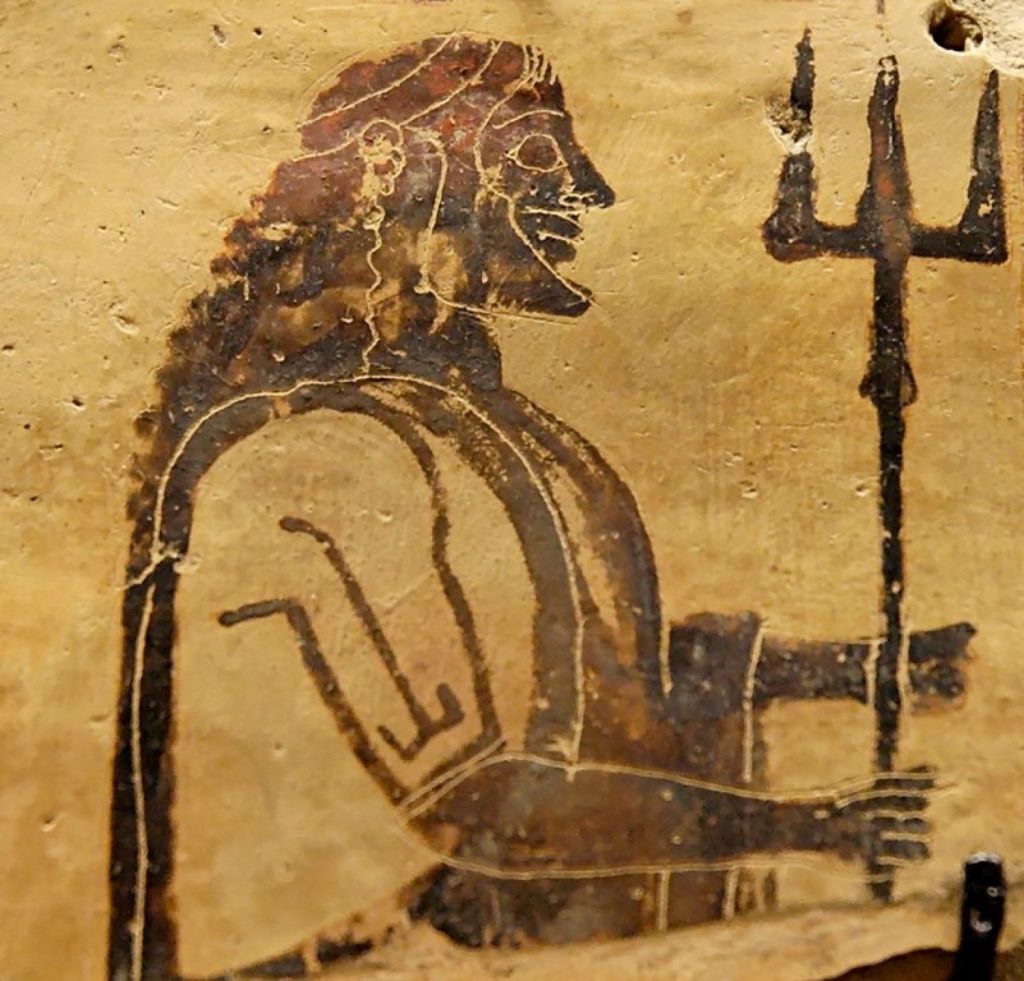
Poseidon and his trident, Corinthian plaque, 550–525 BC from Penteskouphia (a Greek village near the ancient city of Corinth), phot. Jastrow, 9/10/2006, Wikimedia Commons, Public Domain. Illustration used in student presentations (taken from Irene Di Gioia’s lesson).
The project was realized as a lesson based on materials received form the Faculty of “Artes Liberales”. The class 1TB under my guidance tested the lesson about Poseidon (Meet Poseidon), according to the texts, illustrations, and other teaching aids provided by Ms Irene Di Gioia (Universities of Bologna and Göttingen). The purpose of the lesson was to get to learn about the figure of Poseidon and his Roman counterpart Neptune, follow his presence in culture, and at the end of the exercise, prepare a creative task reflecting our concern about restoring nature and counteract marine pollution in the modern world. We concluded the lesson with a test I prepared in the Kahoot app, which allowed the students who completed it to win small gifts bearing mythological names.
In preparing for the 90-minute-long lesson, I decided to share some of the tasks with the students using Ms Di Gioia’s materials as the basis for our discussion about Poseidon. The learning methods I used for this lesson were: – a lecture and a discussion with a multimedia presentation, – tasks divided among groups focusing on a specific topic, – role playing, – production of a movie, – a brainstorming.
The lesson started with a presentation by the teacher – based on available materials: I prepared a Power Point introduction to the lesson including content related to what mythology is, what we need it for, and what influence it has on us. I have also shown what influence – although we often do not see it – ancient culture had on later culture, the surrounding world, and contemporary pop culture (Shakespeare’s plays, The Avengers, the X-Men, certain models of cars).
Statue of Neptune in Bologna by Giambologna, phot. by Monia Mascagni, 2019, Wikimedia Commons, under the Creative Commons Attribution-Share Alike 4.0 License. Photograph used in student presentations, taken from the lesson by Irene Di Gioia.
After my presentation, the students shared the materials they had prepared. One of them played the role of Poseidon and presented this character. Others in the form of presentations introduced: symbology of horses and earthquakes, the image of Poseidon in art and pop culture, the history of Odysseus’ conflict with Polyphemus and the link between this story and the power of Poseidon, the history of the Maserati car brand (its creators – brothers from Bologna who referred to Poseidon). The last activity was the brainstorming, when we were writing down on the board contemporary threats to the seas and reflecting on how we can “help Poseidon” today and protect the cleanliness and good condition of the oceans.
During their work on the tasks, students had to cooperate in order to achieve successful results, especially when making the film based on the myth about Odysseus’ meeting with Polyphemus. Those preparing their presentations had to make a selection among the provided materials, and decide on the optimal graphic form and attractive manner of communication. As it commonly happens in such situations, some students succeeded very well, others limited themselves to an absolute minimum. I supervised the course of the lesson without intervening in the presentations. I noticed that even though the lesson was not open to outside observers and attended only by members of the class, it was still a stressful situation for the students.
Student giving a presentation on Poseidon, from Natalia Konieczna’s archive.
My assessment of the implementation of “The Modern Argonauts” programme is very positive. The students gained from it educationally, but not only – their were motivated by the opportunity to take part in an international project and by the perspective of sharing their impressions as feedback for the handbook including the lesson they implemented, which will be published in Open Access. They also acquired the experience of coping with a public appearance even though on a small scale of performing in front of a small group with which they were already familiar.
As a teacher, I also benefited in many ways from taking part in the project. I realized that combining various methods and mobilizing students impacted their approach to learning; putting an emphasis on their agency and encouraging them to act improves their self-esteem and expectations of success in the area of humanities (beyond mechanics which is the focus of the school). I also saw which aspects I need to work on – mainly those related to improving motivation to act (the entire class could not be successfully mobilized, there were students who did not get involved at all).
Student giving a presentation on Poseidon, from Natalia Konieczna’s archive.
The “Modern Argonauts” project encouraged me to be open to further commitments, and if such opportunities came up, to engage with my students in similar projects. In my opinion, a contemporary school should challenge students in various ways – especially if it is a school like “Samochodówka” [a secondary technical school for motor vehicles]. It is important for education not to be limited to teaching strictly the core curriculum but to engage also in activities going beyond the school’s main obligations (for both students and teaches) and including a broader perspective. At a vocational school, it is easy to neglect or ignore non-core issues; the students many times approach learning with a narrow mind-set focused on “just to get the diploma, just to pass the exams”. Participation in projects like this one introduces a broader perspective and creates motivation to venture into diverse activities, at the same time, building a better relationship between teachers and students.
We are pleased to share the song “The Dream of Ithaca” by Miriana Jędrasik, Hanna Ryznar, and Aleksandra Winiarska – students of the Classical Class at Mikołaj Rej XIHigh School in Warsaw. This Class is under the patronage of the Faculty of “Artes Liberales”, University of Warsaw. Calypso’s song was inspired by a lesson led by Anna Wojciechowska, the teacher of Latin language and ancient culture.This lesson was based on the scenario “Meet Calypso” written by Marta Pszczolińska (Faculty of “Artes Liberales”, University of Warsaw) within “The Modern Argonauts” ERC Proof of Concept Grant project. The scenarios for mythology lessons will be available soon via The Modern Argonauts website (https://modernargonauts.al.uw.edu.pl).
We approached the implementation of the Calypso lesson with great curiosity – the “Modern Argonauts” project is unlike other projects we participated in in previous years. We, therefore, explored the submitted materials, used them in class, and then did one of the creative exercises suggested by the Author of the scenario. The character of Calypso really spoke to us, especially after reading the “Odyssey” and after discussing the female figures created by Homer. Therefore, we decided to re-tell the Calypso story in our own way. One of the created stories is “The Dream of Ithaca”.
Hanna Ryznar: For the purpose of the project, together with Miriana and Ola (Aleksandra) we wrote a song entitled “The Dream of Ithaca”. I wrote the lyrics in Polish, Miriana composed the melody, and Ola designed the cover. The lyrics of the song are a letter from Calypso to Odysseus. The nymph explains in it her longing for the beloved who left her isle of Ogygia to return to his wife waiting for him in Ithaca. Calypso, despite the immense suffering, caused by the departure of her lover, knows that Odysseus must go back home because only there can he be truly happy. I was inspired to write the text by the mythical story of Calypso told by Homer in the “Odyssey”.
Miriana Jędrasik: I intended the melody to resonate with how Calypso must have felt when writing this letter. It is nostalgic, but also emotional and touching.
Aleksandra Winiarska: The inspiration for my illustration was a picture by the famous painter Jules Breton. The woman waiting for Odysseus at home is knitting, trying to keep her thoughts occupied so that she can forget the suffering for a while.
lyrics: Hanna Ryznar music: Miriana Jędrasik cover image: Aleksandra Winiarska
English translation of the lyrics (original text in Polish below):
On Zeus’ orders I had to return your freedom to you, to give up the dream of my own happiness. Your departure hurts me immensely, but only in Ithaca will you find your happiness. I remember many talks about love. How Iwanted you to accept the gift of immortality! To you, Ogygia was never home. Although you slept next to me, you dreamt of Ithaca.
I know that wandering across the seas, you will encounter many difficulties. Always mind the Bear in the sky and call on me when you find yourself in need.
From the beginning of your adventures, you wanted challenges and hardships and despised the fake happiness of the Gods. Ican’t imagine this island without you, but Ihave to forget, go on for myself.
I know that wandering across the seas, you will encounter many difficulties. Always mind the Bear in the sky and call on me when you find yourself in need.
Post by Anna Wojciechowska, Miriana Jędrasik, Hanna Ryznar, and Aleksandra Winiarska, translated and placed by Olga Strycharczyk, proofread by Elżbieta Olechowska
Sen o Itace
Mamy przyjemność podzielić się piosenką „Sen oItace”, przygotowaną przez Mirianę Jędrasik, Hannę Ryznar iAleksandrę Winiarską – uczennice klasy klasycznej XILiceum Ogólnokształcącego im. Mikołaja Reja wWarszawie. Klasa klasyczna jest objęta patronatem Wydziału „Artes Liberales” Uniwersytetu Warszawskiego. Utwór powstał z inspiracji lekcją pod kierunkiem Anny Wojciechowskiej – nauczycielki łaciny ikultury antycznej.Jako podstawę tej lekcji wykorzystano scenariusz „Spotkanie z Kalipso” autorstwa Marty Pszczolińskiej (Wydział „Artes Liberales” UW) napisany w ramach ERC Proof of Concept Grant na projekt „Współcześni Argonauci”. Scenariusze lekcji omitologii będą dostępne wkrótce na stronie The Modern Argonauts (https://modernargonauts.al.uw.edu.pl).
Do realizacji lekcji o Kalipso przystąpiliśmy z wielką ciekawością – „The Modern Argonauts” to projekt odmienny od tych, w których braliśmy udział w poprzednich latach. Zapoznaliśmy się zatem z nadesłanymi materiałami, wykorzystaliśmy je podczas zajęć, a potem wykonaliśmy jedno z ćwiczeń kreatywnych zaproponowanych przez Autorkę lekcji. Postać Kalipso bardzo nam się podobała, zwłaszcza po lekturze „Odysei” i po rozmowach na temat stworzonych przez Homera postaci kobiecych. Postanowiliśmy zatem opowiedzieć historię Kalipso na nowo, na swój sposób. Jedną z powstałych opowieści jest piosenka pt. „Sen o Itace”.
Hanna Ryznar: Na potrzeby projektu razem z Mirianą i Olą stworzyłyśmy piosenkę pod tytułem „Sen o Itace”. Ja napisałam tekst, Miriana skomponowała melodię, a Ola stworzyła projekt okładki. Tekst piosenki to list Kalipso do Odyseusza. Nimfa wyraża w nim swoją tęsknotę za ukochanym, który opuścił jej wyspę Ogygię, aby powrócić do żony, czekającej na niego na Itace. Kalipso, pomimo ogromu cierpienia, jakie sprawiło jej odejście ukochanego, wie, że Odyseusz musi wrócić do domu, ponieważ tylko tam może być prawdziwie szczęśliwy. Do napisania tekstu zainspirowała mnie mityczna historia Kalipso opowiedziana przez Homera w „Odysei”.
Miriana Jędrasik: Chciałam, aby melodia komponowała się z tym, jak musiała czuć się Kalipso, pisząc ten list. Jest nostalgiczna, lecz także emocjonująca i wzruszająca.
Aleksandra Winiarska: Inspiracją dla mojej ilustracji był obraz słynnego malarza Jules’a Bretona. Kobieta, czekając na Odyseusza w domu, zajmuje się robieniem na drutach, stara się zająć własne myśli, aby na chwilę uwolnić się od cierpienia.
tekst: Hanna Ryznar muzyka: Miriana Jędrasik ilustracja na okładce: Aleksandra Winiarska
Z rozkazu Zeusa musiałam wolność Ci zwrócić, marzenia owłasnym szczęściu porzucić. Ogromnie mnie boli to Twoje odejście, lecz tylko wItace odnajdziesz swe szczęście. Pamiętam wiele rozmów omiłości. Jak chciałam, byś przyjął dar nieśmiertelności! Ogygia dla Ciebie nigdy domem nie była, choć spałeś obok mnie, Itaka Ci się śniła.
Wiem, że tułając się po morzach, napotkasz wiele trudności. Zawsze miej Niedźwiedzicę na niebie iprzywołaj mnie, gdy się znajdziesz wpotrzebie.
Od początku przygód, wyzwań itrudów chciałeś isztucznym szczęściem bogów pogardzałeś. Nie umiem wyobrazić sobie tej wyspy bez Ciebie, lecz muszę zapomnieć, iść dalej dla siebie.
Wiem, że tułając się po morzach, napotkasz wiele trudności. Zawsze miej Niedźwiedzicę na niebie iprzywołaj mnie, gdy się znajdziesz wpotrzebie.
Post przygotowany przez Annę Wojciechowską, Mirianę Jędrasik, Hannę Ryznar i Aleksandrę Winiarską, przetłumaczony i zamieszczony przez Olgę Strycharczyk, korekta wersji angielskiej: Elżbieta Olechowska
The project seminar on making Booktubes at the Benedictine secondary school in Schäftlarn near Munich, led by Dr Michael Stierstorfer, cooperation partner of the Our Mythical Childhood project, has been nominated for the German Reading Prize, which is endowed with several thousand euros. This is awarded in several categories to people who have made a special contribution to promoting and motivating reading.
Dr Michael Stierstorfer with the students from the P-Seminar Booktubes, phot. Otto Heitzer.
Together with his students, Dr Stierstorfer has also published book reviews focusing on Greek and Roman mythology in this context. The focus was on works from current children’s and youth literature. The students of the course are very pleased and are already very excited about the announcement of the prizes. The mythical short videos can be found under the following links on the Youtube channel GBS Booktubes:
Press articles on the nomination can be found here:
Schäftlarner Booktuber für den Deutschen Lesepreis nominiert
Das Projekt-Seminar zum Drehen von Booktubes des Gymnasiums der Benediktiner Schäftlarn bei München unter der Leitung von Dr. Michael Stierstorfer, Kooperationspartner des Projekts Our Mythical Childhood, wurde für den mit mehreren Tausend Euro dotierten deutschen Lesepreis nominiert. Dieser wird Personen, die sich besonders um die Leseförderung und Lesemotivation verdient gemacht haben, in mehreren Kategorien verliehen.
Dr. Michael Stierstorfer mit den Schülerinnen vom P-Seminar Booktubes, phot. Otto Heitzer.
Zusammen mit seinen Schülerinnen hat Stierstorfer in diesem Kontext auch Buchbesprechungen mit dem Fokus auf die griechisch-römische Mythologie veröffentlicht. Hierbei standen Werke aus der aktuellen Kinder- und Jugendliteratur im Vordergrund. Die Schülerinnen des Kurses freuen sich sehr und sind schon sehr nervös mit Blick auf die Bekanntgabe der Preise. Die mythischen Kurzvideos sind unter den folgendes Links auf dem Youtube-Channel GBS Booktubes zu finden:
The book Teaching Ancient Greece, edited by Dr Sonya Nevin is available in Open Access.
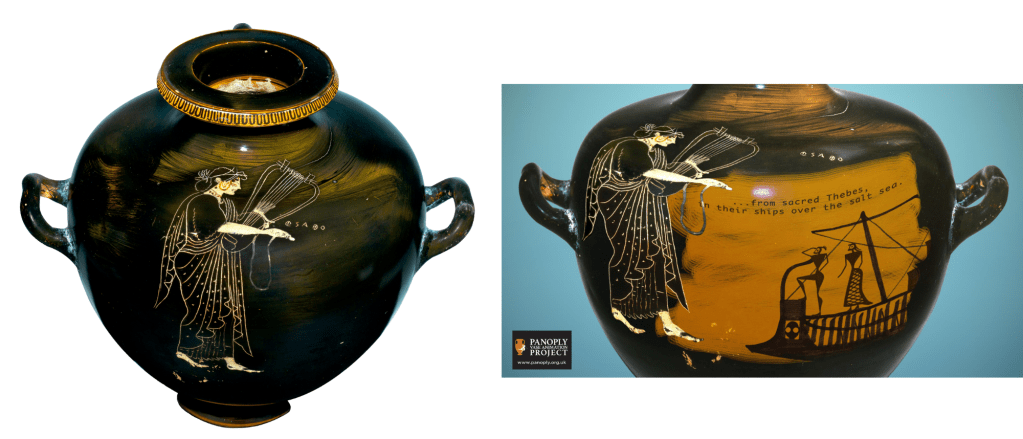
Teaching Ancient Greece was edited by Sonya Nevin, Assistant Professor at the University of Warsaw’s Faculty of “Artes Liberaes”. Dr Nevin works with animator Steve K. Simons on the Panoply Vase Animation Project, making short educational animations from real ancient artefacts. Where an ancient amphora shows the hero Heracles holding a boar, the animation shows him capturing it; where another vase shows the rainbow goddess Iris, the animation shows her flying, leaving rainbows streaking behind her. Five vase animations and four short documentaries were created for the Our Mythical Childhood project. They are based on five Greek vases from the collection of the National Museum in Warsaw. Now the animations and documentaries have been joined by Teaching Ancient Greece which transforms watching into a multitude of activities.
Dr Sonya Nevin with her book and the famous Sappho vase (no. 142333) in the National Museum of Warsaw.
Teaching Ancient Greece contains activity sheets, including ones for learning the Greek alphabet, matching gods to their symbols, and for colouring in vases and creating new vase designs. These are joined by a set of ready-to-use lesson plans for teaching about the ancient world. Created by experienced educators all over the world, each lesson plan contains an introduction, a lesson including one of the animations, and an exciting activity to extend the learning experience. The target audience is secondary school pupils, but the lessons can all be adapted for older or younger groups.
Left, an ancient Athenian vase depicting the poet, Sappho, and (right) a screenshot from the animation created from that vase.
Igor Cardoso in Brazil created a lesson about the poet Sappho, with writing activities about facing difficult situations. Ancient music specialist Aliki Markantonatou in Greece brings us a lesson on composing lyric poetry. This complements her recording of a unique version of one of Sappho’s poems, based on the music that the ancient poem would have been sung to. Ron Hancock-Jones in the UK used the Sappho animation to develop a lesson on marriage and relationships in ancient Greece. Chester Mbangchia in Cameroon created a lesson that introduces the god of drama, wine, and transformation – Dionysus. Theatre facilitator Olivia Gillman in the UK used the Dionysus animation as the basis for a drama class. Barbara Strycharczyk of “Strumienie” High School in Poland established a project for pupils in multiple years of the school who each worked towards an exhibition about the hero Heracles. Jessica Otto, in Germany, used the Heracles animation to show how stories can be represented and decoded through visual clues. Sonya Nevin offers several lessons on learning to “read” the images in Greek pottery, including one on the Libation animation, which shows the gods Zeus and Athena performing a libation sacrifice. Michael Stierstorfer in Germany used the same animation in a lesson about sacrifice in ancient Greece: what was done, how, and what it all meant. As for Iris, Dean Nevin in Switzerland brings us a writing challenge – messages for the rainbow messenger goddess to carry. Terri Kay Brown in New Zealand (Aotearoa) created an introduction to anthropology – a chance to compare different cultures’ myths about the rainbow and to consider what is indicated by the differences and similarities between them.
Right, a vase made in Athens in around 450 BCE, depicting the rainbow goddess Iris (no. 142289), and left, a creative version of the vase made by Temperance, aged 7, Ireland, using an activity sheet from the book.
Other lessons explore the world of museumsthemselves. Museum educator Jennie Thornber in the UK offers a lesson for exploring museums in person or online and taking on the role of a curator. A PowerPoint on the Panoply site is one of several providing extra support for these activities. Louise Maguire in Ireland set an alternative curator’s challenge, asking learners to consider factors such as planning, budget, and accessibility in planning exhibitions.
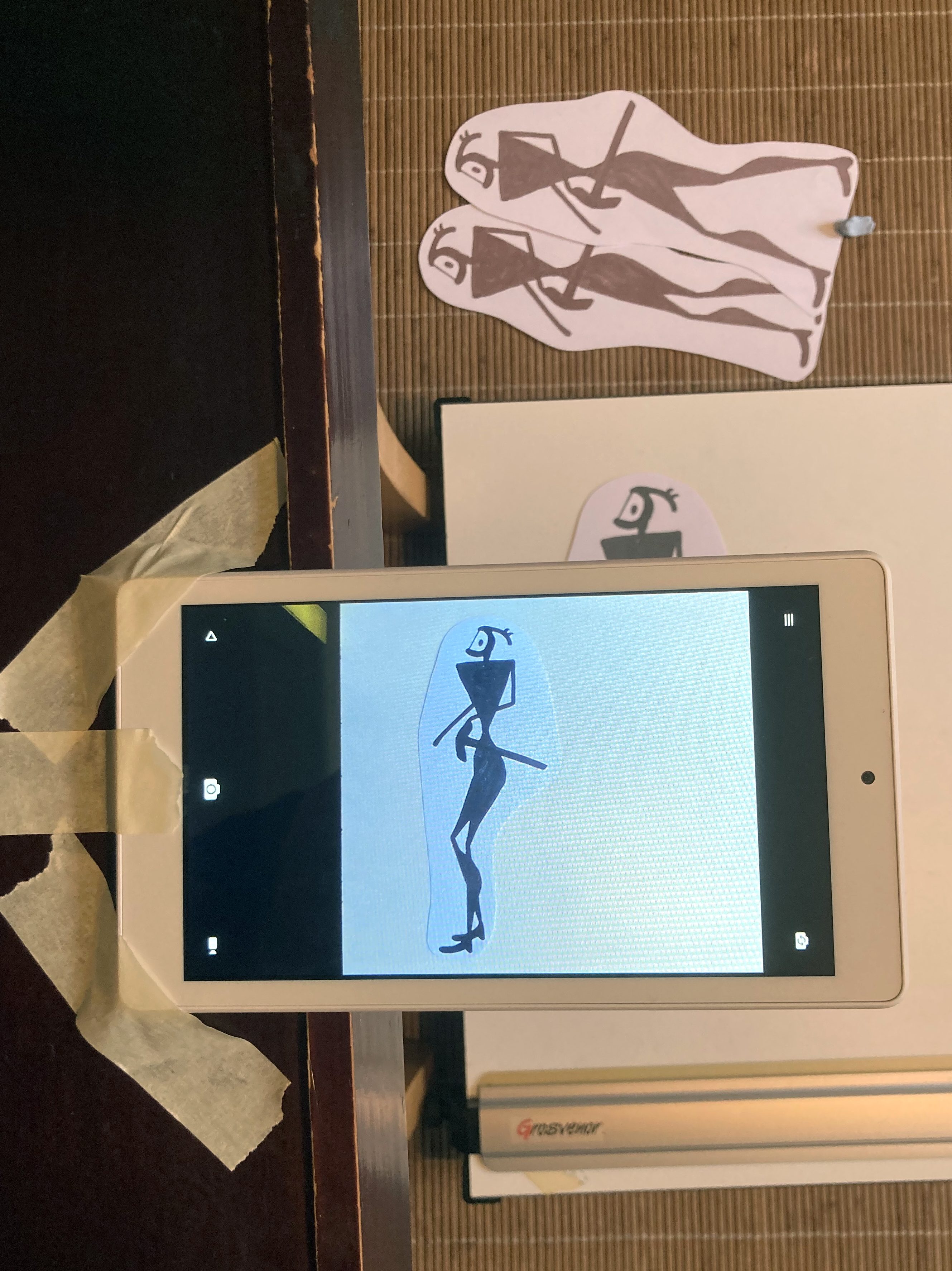
The book includes a detailed guide to making stop motions.
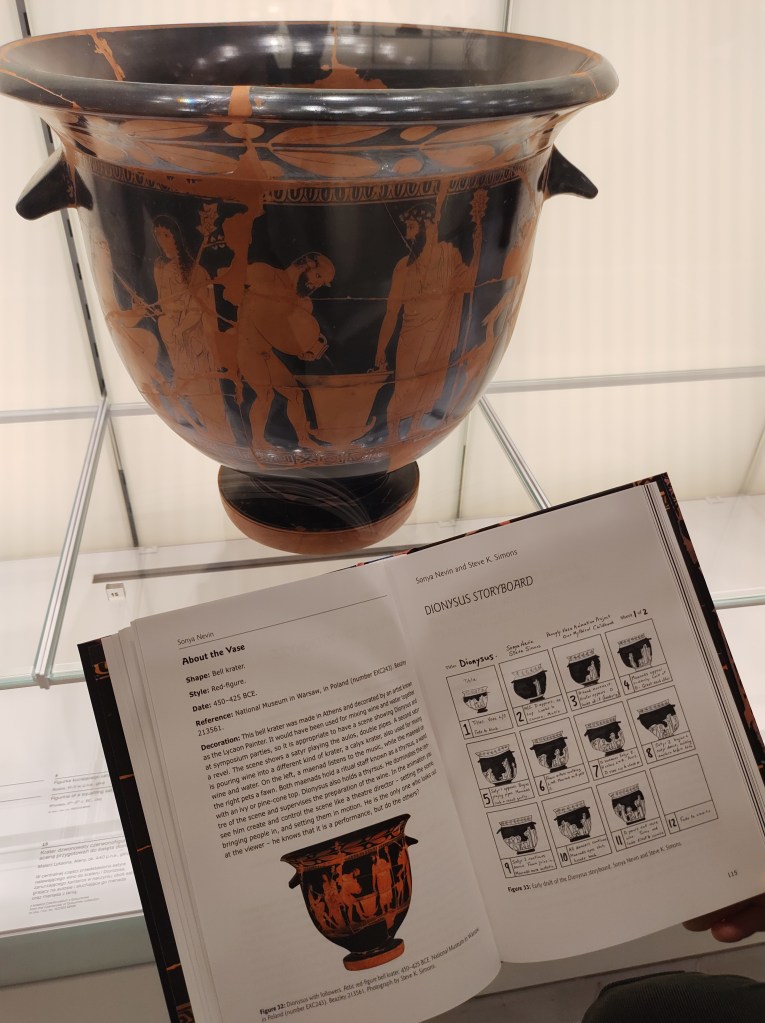
The vase (no. EXC243) used in the Dionysus animation and the storyboard used to plan it. Storyboarding is a great way for students to revisit what they have learned in a creative way.
Perhaps all this talk of animation makes you feel like having a go at making your own stop-motion animation. Christina DePian, a museum educator based in Greece, provides a detailed and accessible guide to making stop motions. Accompanied by a set of animation resources, this guide makes it easy for anyone from 5 to 105 to try animation and create their own version of antiquity.








 Our Mythical Childhood Blog