“Dolls of the World – Princess of Ancient Greece”

This post is an English updated version prepared by Wiktoria Popowicz’s (3rd year of Cultural Studies – Mediterranean Civilization) of her work for the classes “Ancient Greek Art around Us” conducted by Dr Alfred Twardecki at the Faculty of “Artes Liberales” UW in 2019/2020.


The echo of ancient Greek art returns and is still alive nowadays. Elements borrowed from the fragments of culture of the inhabitants of Hellas can be found in all areas. In 1980, the toy company Mattel produced a collector’s series of Barbie dolls “Dolls of the World – The Princess Collection”, which includes representatives of different countries and historical periods. The company has released 91 types of dolls in this series since then. Doll collectors receive a certificate and a passport confirming authenticity. Dolls’ distinguishing features are the costumes that characterize particular culture. Among them, the “Princess of Ancient Greece” from 2003 deserves attention, representing the ancient world that does not exist anymore:
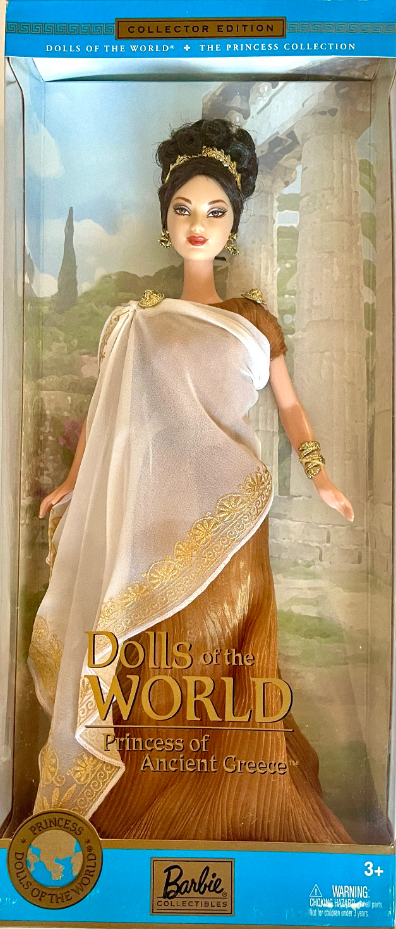
The doll wears a dress stylized as a woman’s garment worn in ancient Greece. Since the original fabrics have not survived to our times, the designers of this toy could only use the available sources (including vase paintings and sculptures) supplemented with imagination.

The dress of the “Princess of Ancient Greece” consists of two elements: a golden-copper, shiny, free-flowing chiton and a white see-through scarf decorated with a golden pattern, called himation. It is tucked under the left shoulder and pinned on the right. You may compare Barbie’s dress with the one worn by Nike depicted in the red-figure oinochoe (illustration 1): the goddess wears a himation, from under which a chiton protrudes similar to the one in which the doll was dressed, made of pleated material that widens slightly at the feet.

Illustration 1: The Nikon Painter, Nike pursuing a bird, red-figured oinochoe, 470-450 BC, The British Museum (E538) [source]

The difference in the approach to ancient patterns is that the doll is made of plastic and synthetic materials, just like her clothes and jewelry. The colors – white and gold-copper metallic shade of the dress – may result from numerous stereotypical “naked” white sculptures devoid of old polychrome and poor colors conveyed by vase painting. The upper scarf is decorated with a golden floral pattern. Similar design motifs can also be found in vase painting. Two clips placed on the arms of the doll are also interesting. They imitate the golden brooches fastening the robe. They are shaped like lion heads. Similar representation can be found on the Greek pendant (illustration 2) and earrings (illustration 3).
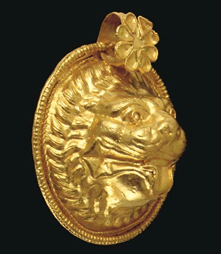
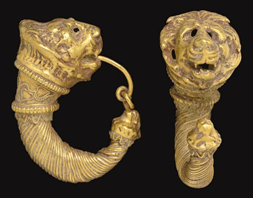
Illustration 2: Pendant in the shape of a lion’s head, Classical period, ca. 5–4th c. BC, Christie’s. [source]
Illustration 3: Greek earrings, Classical to Hellenistic period, ca. 4th c. BC, Christie’s. [source]

Barbie’s “Princess of Ancient Greece” earrings also refer to the jewelry worn by the inhabitants of Hellas. They are large, golden, oval in shape. Archaeological excavations have provided many similar artifacts. The designers of the doll even took care of details such as the bracelet on the wrist. Analogous item (illustration 4) can be seen at the Metropolitan Museum of Arts in New York.
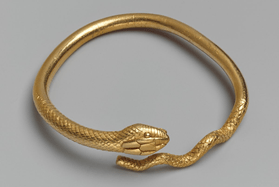
Illustration 4: Gold Greek Bracelet, ca. 300–250 BC, The Metropolitan Museum of Art. [source]

The clothes of the collectible dolls are very well made, but most often they cannot be taken off. The doll’s outfit is complemented by a plastic version of the golden tiara in the form of a laurel crown. Many real decorations have survived to our times (illustration 5), which could be an inspiration for artists.
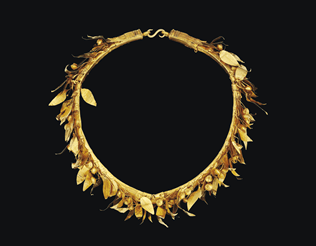
lllustration 5: Golden Greek myrtle crown/wreath. [source]

 In ancient Greece, wreaths were worn in religious ceremonies and were usually presented as prizes in sports and art competitions. The doll’s crown made of golden leaves is attached to lush, dark hair pinned up in a classic, high bun, reminiscent of the goddess Artemis’ hair in a red-figure vase (illustration 6).

lllustration 6: Amphora with the goddess Artemis wearing a thin chiton and himation, ca. 520–510 BC, Louvre. [source]

 The cardboard background behind the doll is also important. There are columns and construction elements suggesting the Doric style of the building. The time-gnawed marble is clearly visible. All this is surrounded by grass, empty spaces, and lush vegetation in the background. A similar sight can be seen, for example, in Athens and Paestum, where the preserved Doric temples are only a shadow, a remnant of the magnificent, colorful buildings from centuries ago, which the packaging designers did not take into account. Paradoxically, the doll was placed in a Greek landscape, but modern to us, full of ruins and white scattered marble. Contemporary reconstructions of Doric buildings (illustration 7) show what the architecture of ancient Greece is supposed to look like.

Illustration 7: Kieran Orrell, A color reconstruction of the Parthenon, 2014. [source]

 The designers probably referred to the image of the Acropolis that we know today (illustration 8), located in the capital of the country, making it the background.
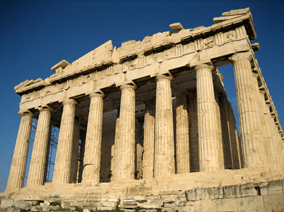
Illustration 8: Parthenon from West, Athens, 5th c. BC, phot. by Mountain, 2006, Wikimedia Commons. [source]

The construction of the Barbie doll, especially the mobility of its joints, resembles the ancient Greek prototypes (illustration 9), whose arms and legs were connected to the body with a string or wire. The “Princess of Ancient Greece” shakes her head, can sit up, and move her legs and arms – similar to ancient Greek dolls, referred to as “neurospaston” (τὸ νευρόσπαστον, from: τὸ νεῦρον – “sinew, cord” and σπάω – “to draw”). Such Greek figurines were not always toys for children. They could have cult functions that would connect them to the adult world – much like the Barbie series of dolls intended for collectors.

Illustration 9: Greek clay doll, 5th c. BC,  Museum of Cycladic Art, Athens. [source]

Ancient Greek art surrounds us, but it is transformed, often difficult to see if we do not know what to look for. The background of the “Princess of Ancient Greece” doll is based on a schematic vision of Greece, with the ancient buildings turned into ruins, stripped of polychrome. It follows the stereotypical pattern, as does the doll’s outfit, which draws a lot from Greek fashion but modifies it quite freely. Nevertheless, some elements have a lot in common with reality, which is especially visible in the hairstyle and intricately made jewelry. Details such as a bracelet, a wreath, and brooches impress with their precision, despite their small size. “Princess of Ancient Greece” is an interesting and well-made example of the presence and use of ancient culture today.

Post written by Wiktoria Popowicz. We wish to ackowledge Dr Alfred Twardecki’s help in preparing the post and we also thank Dr Karolina Kulpa who specializes in Antiquity-inspired toys for her consultation.

Post elaborated by Dorota Rejter


Bibliography and Further Reading

  • Bernhard Maria Ludwika: Ubiory starożytnej Grecji. Warszawa: Muzeum Narodowe w Warszawie, 1956.
  • Papuci-Władyka Ewdoksia: Sztuka starożytnej Grecji. Warszawa: Wydawnictwo Naukowe PWN, 2001.
  • For more information about toys and games in Classical Antiquity, visit the website of the ERC Advanced Grant Project Locus Ludi led by Prof. Véronique Dasen at the University of Fribourg: https://locusludi.ch/.
  • Currently, Prof. Dasen leads also the project focused on the ancient dolls, “Poupées articulées grecques et romaines” (see http://p3.snf.ch/project-192197).

Websites


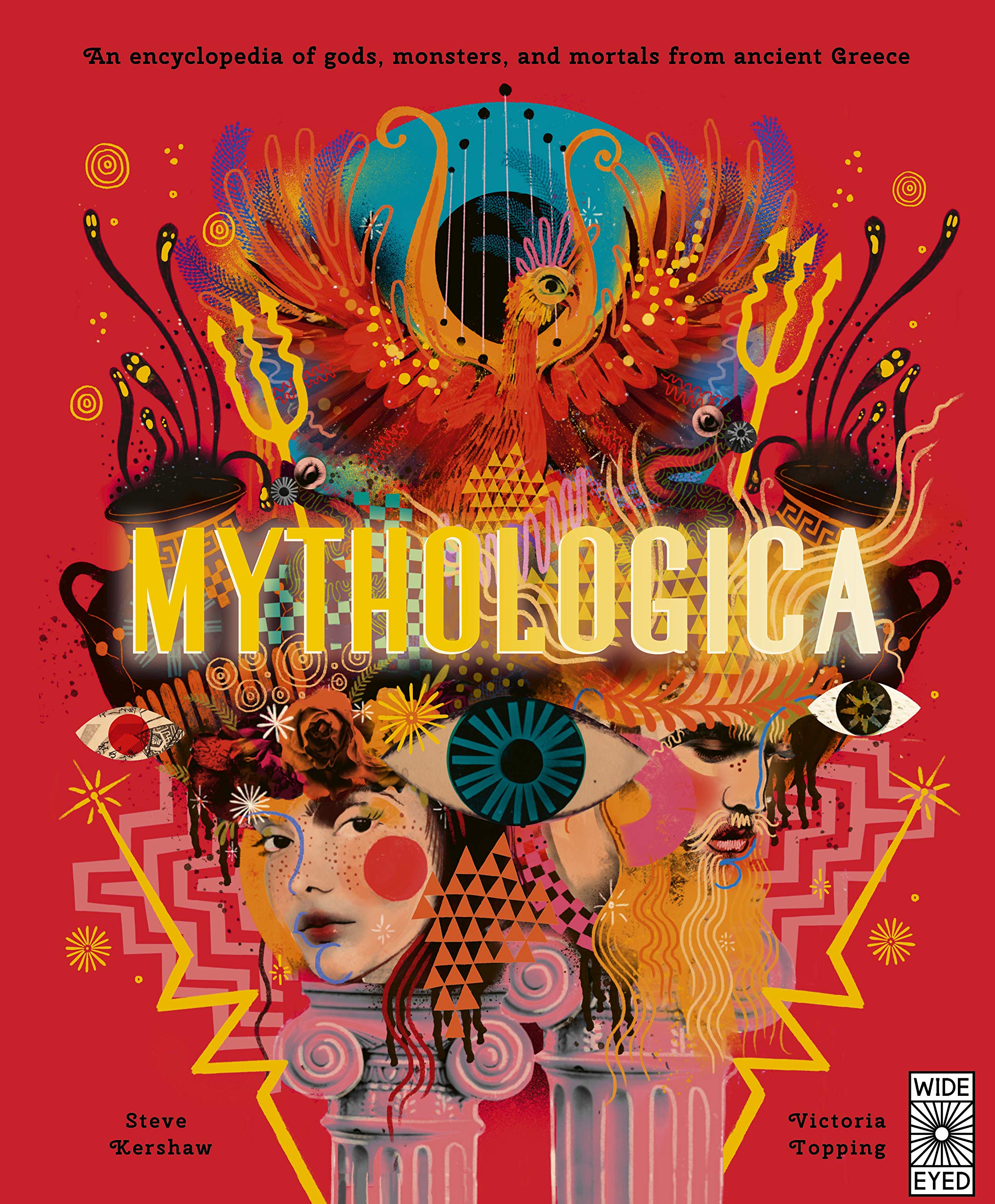
“Mythologica: An Encyclopedia of Gods, Monsters, and Mortals from Ancient Greece” by Stephen P. Kershaw (2019)

“Mythologica: An Encyclopedia of Gods, Monsters, and Mortals from Ancient Greece” (written by Stephen P. Kershaw, illustrations by Victoria Topping, ed. Wide Eyed Editions) is a very interesting example of a modern look on Greek mythology. The book was Amazon’s No. 1 Children’s Non-Fiction Book of the Year 2019.

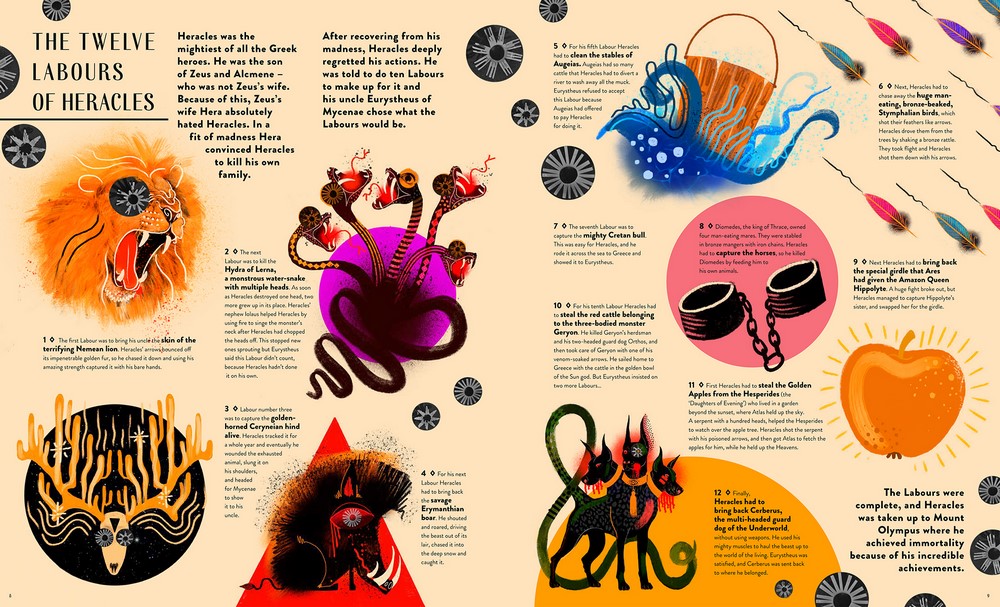
The first thing to notice are very vivid, colorful and modern illustrations, reminding poster art or collage style. Some characters look like from the alternative rock scene!

Mythologica: An encyclopedia of gods, monsters and mortals from ancient  Greek: Amazon.co.uk: Kershaw, Dr. Stephen P., Topping, Victoria:  9781786031921: Books
Cover

We can find 50 different gods and goddesses, monsters, and mortals in “Mythologica” collection, for example Harpies, the Minotaur, the Muses, and well-known deities, such as Athena and Zeus. Their presentation often challenges the stereotypes about these characters and the traditional style of their portrayals.

Kershaw provides brief descriptions of each mythological character (or group) and writes about its/their roles, origins, attributes and traits. The author also highlights the presence of mythology in the contemporary world:

“Greek mythology is everywhere.
Superstar athletes have the Midas touch, fashion designers have their muses, we undertake Herculean tasks, we make personal odysseys, and we all have our Achilles heel. This book gives you a selection of some of the greatest mortals, immortals, and monsters in Greek mythology.”

Athena [source]
Mythologica, An Encyclopedia Of Gods, Monsters And Mortals From Ancient  Greek by Stephen P. Kershaw | 9781786031921 | Booktopia
Zeus [source]
The Twelve Labours of Heracles

Below you can watch the Flip Through Review of the book and see more from the inside:

Post written by Dorota Rejter

In the Spotlight. A Look at an Interactive ebook “Medea in Performance”

Medea in Performance is an interactive ebook created by Fiona Macintosh, Claire Kenward, and Tom Wrobel, with illustrations by Thom Cuschieri. Released in 2016, it is a multimedia library of images, films, interviews and digital objects to tell the story of Euripides’ Medea (see http://www.apgrd.ox.ac.uk/ebooks-medea). Materials used in the ebook come from the collection of APGRD (Archive of Performances of Greek and Roman Drama, http://www.apgrd.ox.ac.uk/) based at the University of Oxford. The ebook is intended especially for students and teachers.

Cover [source]
(accessed: 13 January 2021)

Although Euripides’ play was first staged 2,500 years ago, it still remains a source of inspiration: “Like all myths, no two versions of the Medea story are quite the same – and there are many versions” [1]. Even though this protagonist is widely recognized as a monstrous mother, various threads of Medea’s story have been highlighted by the ebook’s authors. Broad outlook at character is especially visible in performative arts.

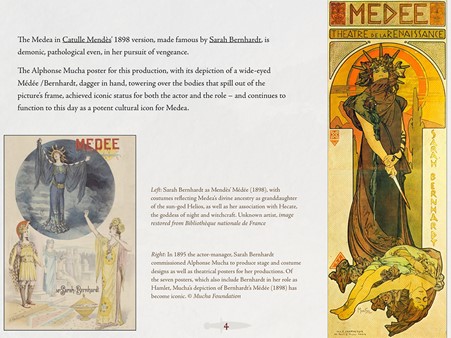
Inside the book [source]
(accessed: 13 January 2021)

The ebook is a helpful guide to various interpretations of Euripides’ play. In one place it collects sources and research, historical photographs and information on performances from different parts of the world. It shows not only what Medea is, but what she has become through reinterpretations.

A short video about ebook history, featuring APGRD Director, Fiona Macintosh is available on YouTube:

The ebook version is available for free on Apple Books (https://books.apple.com/gb/book/medea-a-performance-history/id1085751260). Also a free EPUB version is available to download from the APGRD website http://www.apgrd.ox.ac.uk/ebooks-medea (accessed: 13 January 2021).


Post prepared by Zuzanna Majorczyk, 3rd year of Collegium Artes Liberales, for the Our Mythical Childhood Seminar

[1] Fiona Macintosh, Claire Kenward, Tom Wrobel, “Medea in Performance” (APGRD, 2016), 96, http://www.apgrd.ox.ac.uk/ebooks-medea.

“Mythical Beasts Masks” by Gavin Rutherford & Tanya Batrak

Happy New Year 2021! Thank you for being with us all year round! 🙂

The carnival period will begin soon around the world and we’ve found something great for this occasion – to enjoy safely at home! We present to you our latest discovery – 3D “Mythical Beasts Masks” created by Gavin Rutheford and Tanya Batrak, published by Ivy Press (2018):

Cover [source]

Inside the book there are 10 mythical beast masks to print out and make! You can choose between a dragon, phoenix, basilisk, griffin, werewolf, unicorn, vampire, the Sphinx, a mermaid or Hydra. To introduce young readers to the world of myths and legends, the authors decided to include short, informative paragraphs introducing each creature.

Post elaborated by Dorota Rejter

“Shine Your Magic Torch: Magical Creatures and Mythical Beasts” by Professor Byron & Millie Mortimer

Our latest discovery is an interactive book titled “Shine Your Magic Torch: Magical Creatures and Mythical Beasts”, published in October 2020 by Magic Cat Publishing (reading level: 7-10 years old). The book is written by Professor Byron Mortimer and his daughter Millie. Illustrations were created by Victo Ngai“Forbes Under 30 2020: Art & Style” honoree and gold medalist of “Society of Illustrators New York”:

Book cover [source]

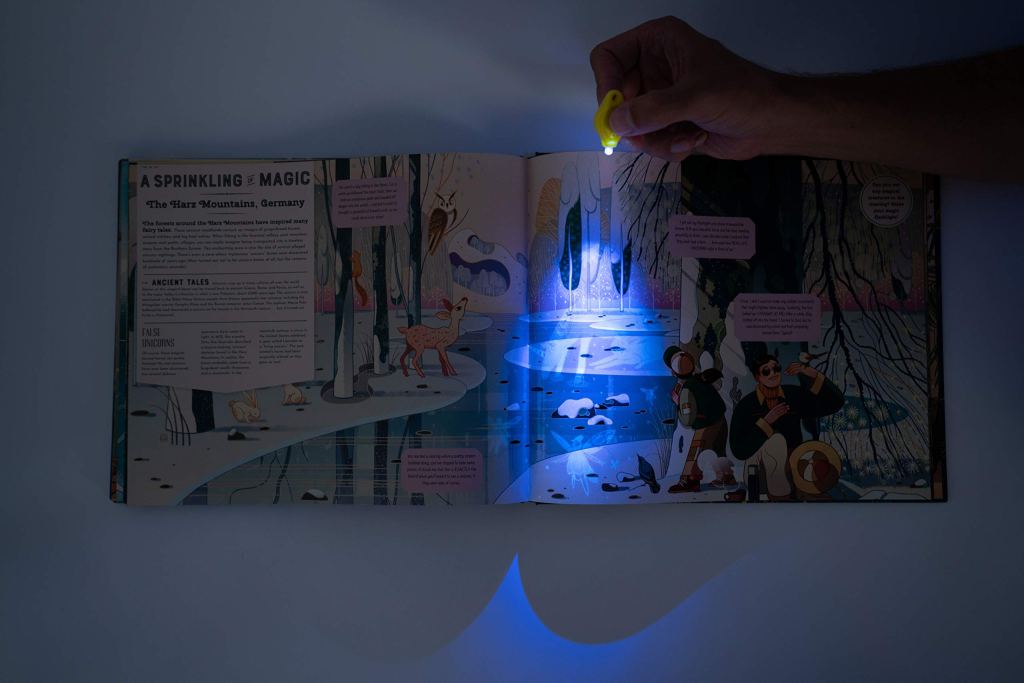
The book focuses primarily on the illustrations. It presents 18 real-life locations from around the world with hidden magical creatures that are revealed only after using the UV flashlight included with the book. Every location is briefly described, concentrating on the monsters appearing in it and its history. For example, in the forests around the Harz Mountains we read about the unicorn:

Many famous people from history apparently met unicorns, including the Mongolian warrior Genghis Khan and the Roman Emperor Julius Caesar.

It appears in relation to the De Bello Gallico 6, 26ff. where Caesar describes a series of three strange creatures that appear in the Hercynian Forest in Germany. (Find out more about “The Curious Animals of the Hercynian Forest” in the article written by Walter Woodburn Hyde and published in “The Classical Journal”, Vol. 13, No. 4, Jan., 1918, pp. 231-245 – link)

A Sprinkling of Magic – one of the chapters from the book where children meet the Unicorn [source]

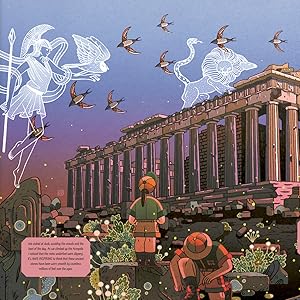
In the preview of the book we can see that children can also visit Greece and meet Chimera and the goddess Athena with an owl:

Magical Creatures and Mythical Beasts
Preview of the book [source]

Post prepared by Dorota Rejter

“Abi in malem cursem”: The Latin of Magic in “The Chilling Adventures of Sabrina” – a BA Thesis by Alessia Borriello

Alessia Borriello is a student from the Department of Classical Philology and Italian Studies at the University of Bologna. She accomplished her Erasmus training within the Our Mythical Childhood project at the Faculty of “Artes Liberales”, University of Warsaw, in the 1st term of the academic year 2019/2020.

Ever since Alessia has been in touch with us and at the moment she is preparing within the OMC project a game for children, with illustrations by her colleague Ludovica Lusvardi, student at Politecnico di Milano, Fashion Design. Alessia also writes books of fiction. Her novel “Blu e le streghe” [“Blu and the Witches”] was a finalist in the Italian Literary Contest Zeno 2019:

45′ Reception:  “Blu e le streghe” [“Blu and the Witches”] by Alessia Borriello

Recently Alessia defended at her Alma Mater her Bachelor Thesis about the Latin spells in the Netflix web series The Chilling Adventures of Sabrina – supervisor: Prof. Lucia Pasetti, reviewer: Prof. Daniele Tripaldi. Below we present you Alessia’s abstract of her research. I nostri complimenti!

Abstract:

The research collects and analyzes the Latin spells in the Netflix web series The Chilling Adventures of Sabrina (2018–ongoing). To introduce the topic (ch. 1), the television series is presented as functioning within a particular communication system: it is an adaptation of the comic book series of the same name and a reboot of the Archie Comicscharacter Sabrina from 1962. Ch. 2 analyzes some aspects of ancient magic, with a particular focus on cross-references provided in the Netflix web series, namely, the ancient Graeco-Roman defixiones (curses) (§2.2), and the interplay between ancient magic and prayer (§2.3). Next, comes a discussion of the Latin incantations divided into two parts: a quantitative analysis, which facilitates understanding of the frequency and distribution of Latin formulas and their relation to the English ones, and a qualitative one, offering a detailed treatment of individual, significant cases.

The quantitative analysis (ch. 3) arranges the spells into typological and linguistic subgroups according to: 1. the types of magic present in the lore created for the series, and 2. a linguistic categorization of ancient Latin defixiones developed by the German scholar Amina Kropp (2008).

The quantitative analysis shows that the Latin incantations are preferred to the English ones, and this tendency follows two main criteria: the degree to which an individual spell is generic, and the overall inherent ‘magical power’ of Latin.

Finally, ch. 4 provides a linguistic analysis of a sample of two of the most frequently used types of incantation: §4.1 Aufforderungsformel mit der Einbindung des Empfängers (‘wish formula with the involvement of the addressee’); §4.2 direkte Adressierung des defixus (‘direct addressing to the defixus’).

A more detailed assessment of the Latin phrases reveals that these spells are pastiches created from distorted Latin expressions and usages of non-literary Latin, coloured by loanwords from poetic memory, as well as from the Bible. This traditional material is also filtered through modern tools, available on the Internet, such as contemporary e-books of Latin spells (Carl Nagel 1986) or the Google Translate platform itself, with which modern languages speakers can produce approximate translations from and into Latin.

It is also possible to trace the origin of the deviations from standard Latin, both to the genre of the magical writing of the defixiones, characterized by a distorted application of Latin morphology and syntax, and to ‘translationalism’, semantic diffraction and grammar mistakes influenced by English usage, the mother tongue of creators and speakers of this fictitious Latin.

The research is original: there are no other studies on Latin in The Chilling Adventures of Sabrina (neither on its formal characteristics nor on its sources in ancient magical culture).

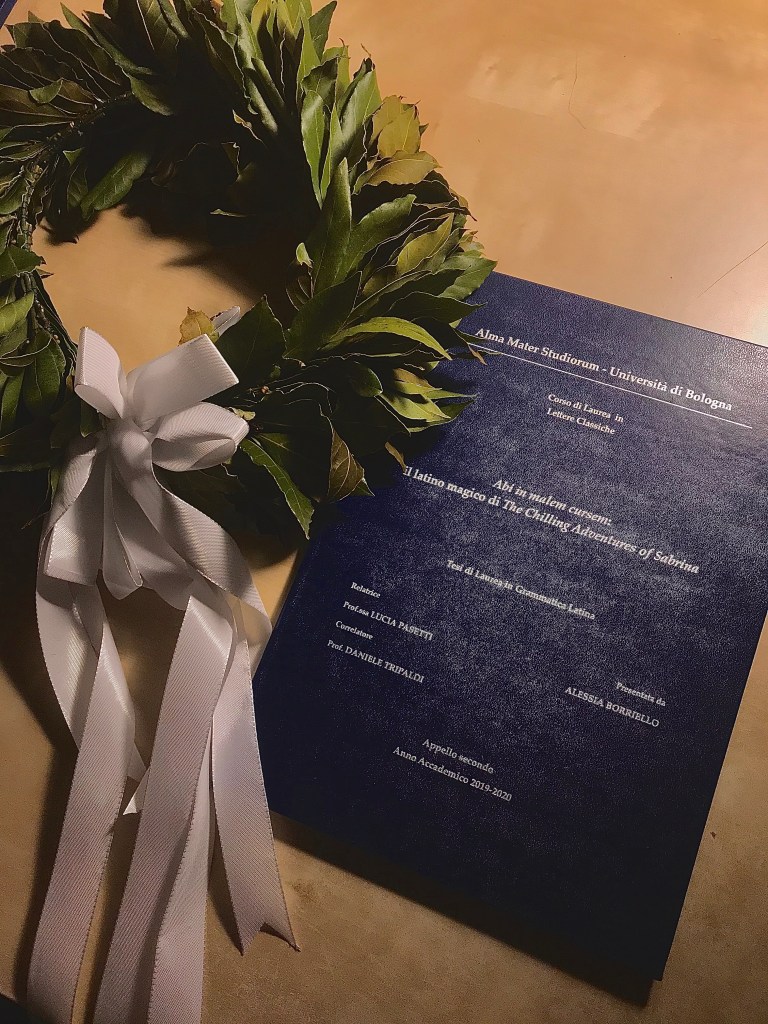
Diploma and corona laurea

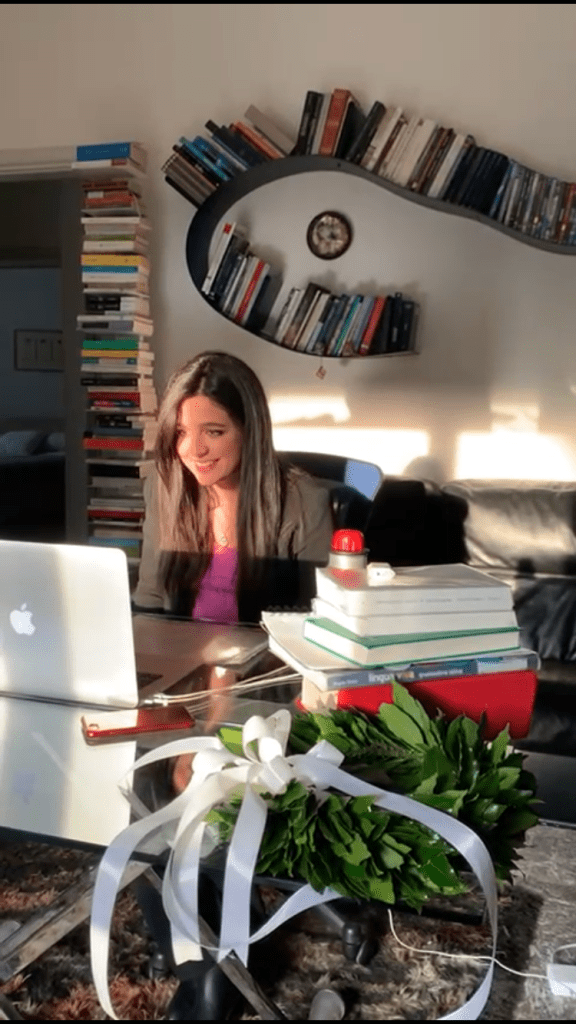
Alessia defending her thesis (a remote defense due to the pandemic situation)

Abstract by Alessia Borriello. Introduction by Katarzyna Marciniak and Dorota Rejter. Post elaborated by Dorota Rejter

Publication of the Book “Chasing Mythical Beasts…”

We are most pleased to share the good news with you: The volume “Chasing Mythical Beasts: The Reception of Ancient Monsters in Children’s and Young Adults’ Culture” edited by Katarzyna Marciniak has just been published by the Universitätsverlag Winter Heidelberg. The book summarizes the results of the stage of the “Our Mythical Childhood” programme, carried out as part of the Alexander von Humboldt Foundation Award and ERC Consolidator Grant.

We keep publishing the previews of the single chapters on the Facebook and Twitter profiles of the Centre for Studies on the Classical Tradition (OBTA) and on the OMC social media.

Table of contents

For more OMC publications please check our updates here.

Post by Olga Strycharczyk

“Roads to Rome” Family Game (2020)

“Roads to Rome” is a new family board game designed by Matthieu Podevin and illustrated by Joëlle Drans, recently published in Poland by GRANNA publishing company. The game was originally published in France by Holy Grail Games.

The official age range of the game is 8+ and the amount of players can be between 2-5 people.

Cover of the game

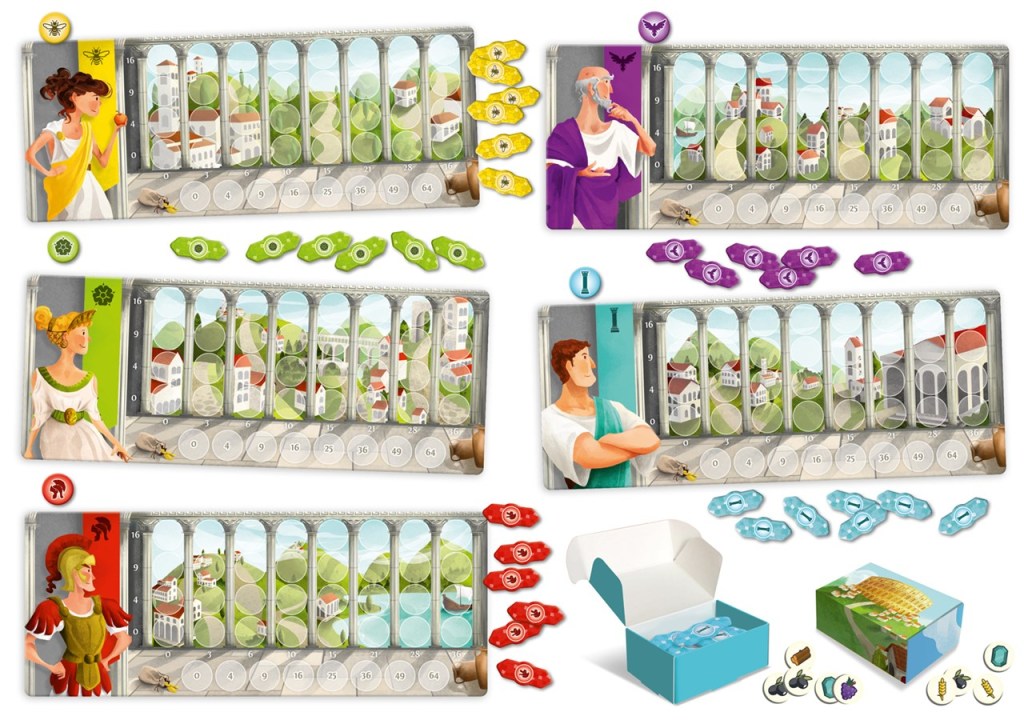
The rules of the game are very simple – each player becomes a member of one of the richest families of ancient Rome, trying to win by creating a network of roads connecting Rome with the rest of the world. What is really interesting, all city names visible on the board correspond to their authentic names in the era of the Roman Empire. Also the connections between the cities did exist during Roman times – to recreate them, Matthieu Podevin was using the project called “ORBIS”, created by Professor Walter Scheidel (a historian from the Stanford University).

Main board of “Roads to Rome” [source]
Players boards [source]
Quick play for two players

See more:

Granna’s official website – link

“Roads to Rome” on Boardgame Geek – link

Post by Dorota Rejter

Replaying “Hades” by Karol Popow

Karol Popow is MA student at the Faculty of “Artes Liberales”, University of Warsaw, member of the ALEA game research group, lifelong games passionate.

The games, unlike the previous media, have one major difference – they are interactive. Digital entertainment audiences have moved from interpassive reading or viewing to acting as reception. Reading games means playing them. At the same time, the digital form of leisure has created new research opportunities in areas such as the reception of Classical Antiquity. The key interactive features of games have a profound effect on the worlds and characters that the games represent. They are habitable thanks to the involvement of the players. So to find how Antiquity exists in games, it is necessary not only to describe the creators’ vision of it, but also the way the player inhabits and uses Antiquity.

Hades – Launch Trailer

Hades (Supergiant Games, 2020) is a recent game situated in the realm of Greek mythology. It fits in the rougelite genre – the player controls the character, crawls throughout a dungeon in runs lasting about 30 minutes, kills monsters, collects loot and treasures lasting for one run, and permanent power ups the avatar. In Hades, the mechanics of rougelite are explained by mythological narratives, especially the reverse katabasis motif. Instead of getting to the Underworld, the player-controlled character Zagreus (here: a son of the God of Hades) tries to escape from the deepest floors of Tartarus. Thus, the first and most comprehensive narrative use of Antiquity in Hades is twisted, but also it retains its basic meaning. To get to the Underworld, or in this case to escape from Hades, you need to show your skills, tame the Unknown and, most importantly, prove yourself. A chance only possible in games – play the katabasis, not just read or watch. There is also an analogy to the labyrinth motif. The state of the Underworld, upgrades, enemies, and even the rank of challenge are created randomly each time a player starts a new run. Hades uses a reverse katabasis mixed with escaping a mythical maze as a reason to take gameness seriously, and the game does it really well.

Hades [source]

Another way Hades plays with Antiquity is through its relationship with gods, heroes, and mythological monsters. They were traditionally symbols of divine and sacred powers, and in particular the gods were worshiped by mortals. In this example, the monsters remain as obstacles to be overcome (killed) by the player, and the gods and heroes, like in the case of katabasis, change appearances while revealing deeper meanings. Firstly, some of them represent the forces of nature. Poseidon rules the water, Zeus restrains the lightning. But the vision of the Hades creators stands out mostly when they present the gods like Athena, Aphrodite, and Dionysus not only as mythical figures, but also interesting game mechanical features. Thus, the goddess of wisdom endows Zagreus with defensive skills, while the other two gods weaken his enemies. If we consider Greek mythology as a set of stories explaining the world to the ancient people, we can take the classic themes in Hades not only as justifying the existence of this game-world, but also as an opportunity to enrich the player’s iteration with this world and make understandable his agency in it. The Hades mythology is not only knowledge of the world. It is part of the gameplay, mechanics, and narrative design. Mythology constitutes this world and belongs to it. Hades uses the gods as helpers to the main character, not just totemic idols. This is much closer to the ancient perception of the interference of divine powers than we imagine it today.

Poseidon [source]

Finally, the game developed by Supergiant is huge and ambitious, proving that pop culture can create new visual, literary and aural representations of Greek mythology. Each character living in the world of Hades has a unique portrait, iconography, and complete professional VoiceOver. They are so well written that create convincing illusions of living entities: watching them gossip, fight, and shout over each other is pure fun. Additionally, Hades offers to the players a coherent in-game chronicle of the Underworld, written by Achilles. Developed as the game progresses, this is an excellent example of the literary interpretation of the ancient tradition experienced by the player throughout the game. Musically, the game is also excellent. The Hades soundtrack’s composer Darren Korb uses electronics, orchestral music, and even heavy metal riffs to create a composition that is energetic and nostalgic when needed, but above all memorable. The level design of the world allows players to run around the crypts of the Tartarus, the fiery Periphlegeton pools in Asphodel, the Elysian Fields, and even a step into the void of Chaos. Paradoxically, the world of the dead has never been so alive before. All this indicates that the ancient aesthetic sense of beauty can be conveyed by modern means.

Hades – Good Riddance (Eurydice Solo feat. Ashley Barrett)
Hades – Lament of Orpheus

Replaying Hades is to be constantly torn by the need to flee the Underworld and the desire to stay there to discover one more reference, one more fun dialogue, another deadly weapon combo. This game presents a great opportunity – only available in the form of electronic entertainment – to inhabit and fall in love with this world. The Supergiant Games’ vision is an extraordinary achievement in literature, art, sound, and game mechanics, but most importantly, Hades proves that ancient tradition could and should seek new media to live on. This is an opportunity to reach new audiences, especially young people, and show them the beauty of Classical Antiquity in their native language, the language of the game. After all, replaying Hades is just fun as hell.

Blog post prepared by Karol Popow & elaborated by Dorota Rejter

For ALEA see https://www.facebook.com/ALEAUW, contact: alea.kn@uw.edu.pl.

For more on the games and the Classics see the volume edited by Christian Rollinger, Classical Antiquity in Video Games: Playing with the Ancient World, London: Bloomsbury, 2020.

“Galatea Text Game” by Paweł Machnik

The video game titled Galatea was created by the British author Emily Short. To further illustrate her creative process, we can say that the game was indeed written because it is a text game without graphic effects. When it comes to using the reception of the ancient tradition, the author refers to the myth of Pygmalion and Galatea.

The game is aimed at young adults & adults and it may contain content inappropriate for children.

Galatea.thumbnail.jpg
“Galatea” cover [source]
The opening screen of the game [source]

The action of the game begins during the opening of an AI (Artificial Intelligence) exhibition. The player notices Galatea who is placed on a pedestal with an information plaque. She is illuminated by spotlights and wears an emerald dress.[1] The player’s task will be to talk to her:

A conversation with a work of art. “47. Galatea. White Thasos marble. Non-commissioned work by the late Pygmalion of Cyprus. (The artist has since committed suicide.) Originally not an animate. The waking of this piece from its natural state remains unexplained.” [source]

At a certain point, when the player is about to leave, Galatea says, “They told me you would come”. From now the development of the story can take various scenarios that will depend on the player’s decisions expressed via words and actions.[2] The author of the game created 70 different endings and there are hundreds of ways to achieve these endings.

Emily Short at “Digital Cultures ” 2018 talking about “Galatea” and her other creations

Galatea has been awarded numerous awards:

  1. Best of Show, Portrait – 2000 IF Art Show
  2. Nominee, Best Game; Nominee, Best NPCs; Winner, Best Individual NPC –2000 XYZZY Awards
  3. 16th Place – Interactive Fiction Top 50 of All Time (2011 edition)
  4. 41st Place – Interactive Fiction Top 50 of All Time (2015 edition)
  5. 4th Place – Interactive Fiction Top 50 of All Time (2019 edition)
  6. Honorable Mention – The Top Five IF Games (Adventure Gamers, 2002)

See more:

  1. “Galatea” text game – link
  2. Emily Short’s blog – link
  3. Galatea, in: Wikipedia The Free Encyclopedia – link
  4. “Galatea” in “Electronic literature collection” volume one – link

Post written by Paweł Machnik, MA student of the Cultural Studies – Mediterranean Civilization, participant in the Grant Seminar Our Mythical Childhood at the Faculty of “Artes Liberales”, University of Warsaw

Post elaborated by Dorota Rejter