Blog for the international research project "Our Mythical Childhood… The Reception of Classical Antiquity in Children’s and Young Adults’ Culture in Response to Regional and Global Challenges", financed by the ERC Consolidator Grant led by Prof. Katarzyna Marciniak, Faculty of "Artes Liberales" of the University of Warsaw. Team members: Prof. Susan Deacy and Steve K. Simons, University of Roehampton; Prof. Elizabeth Hale and Dr Miriam Riverlea, University of New England; Prof. Lisa Maurice and Dr Ayelet Peer, Bar-Ilan University; Prof. Daniel A. Nkemleke, Dr Divine Che Neba and Dr Eleanor A. Dasi, University of Yaoundé I; Dr Elżbieta Olechowska, Dr Hanna Paulouskaya, Dr Sonya Nevin, Dott. Edoardo Pecchini, Marta Pszczolińska, Angelina Gerus and the Project Officers: Magdalena Andersen, Maria Makarewicz, and Olga Strycharczyk from the Faculty of "Artes Liberales" UW.
Mythical Realms® is one of the collection of toys created by Safari Ltd®. The pieces from the collection depict various figures and monsters from the world of mythology, like for example Poseidon, Minotaur, Chimera.
The figurine of Poseidon
The age category of the collection is 3+, however, the figurines may contain small parts that may constitute a choking hazard.
The great advantage of the Mythical Realms® are the fine-tuned details of the figurines that makes them look very realistic. All the characters have interesting descriptions on the manufacturer’s website.
Outside the collection, Safari Ltd® offers the Mythical Realms® TOOB® with 8 small figures from Greek mythology, containing Chimera, Griffin, Phoenix, Unicorn, Sea Dragon, the Minotaur, Poseidon and a Mermaid.
See more:
Mythical Realms® on the Official Website of Safari Ltd®.
Found by Dr Arlene Holmes-Henderson (University of Oxford)
„Pszczoły” (“The Book of Bees”) by Piotr Socha(text by Wojciech Grajkowski) is a Polish children’s non-fiction book from 2015 published byWydawnictwo Dwie Siostry.
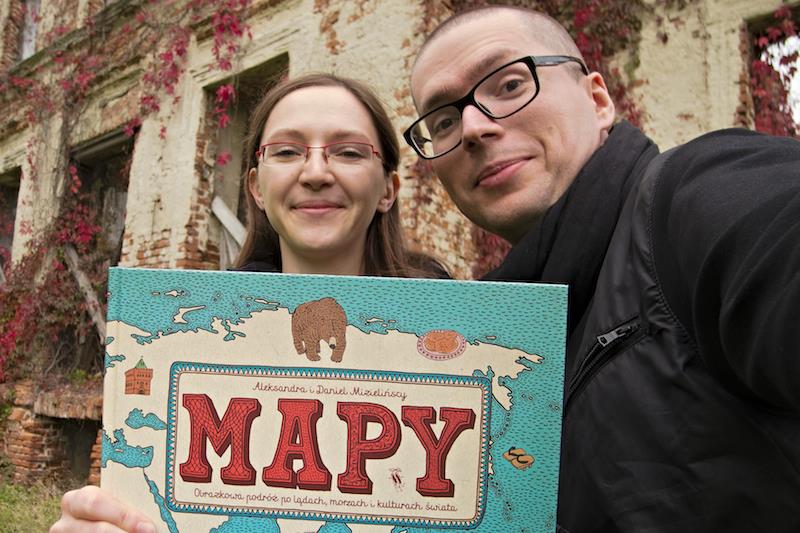
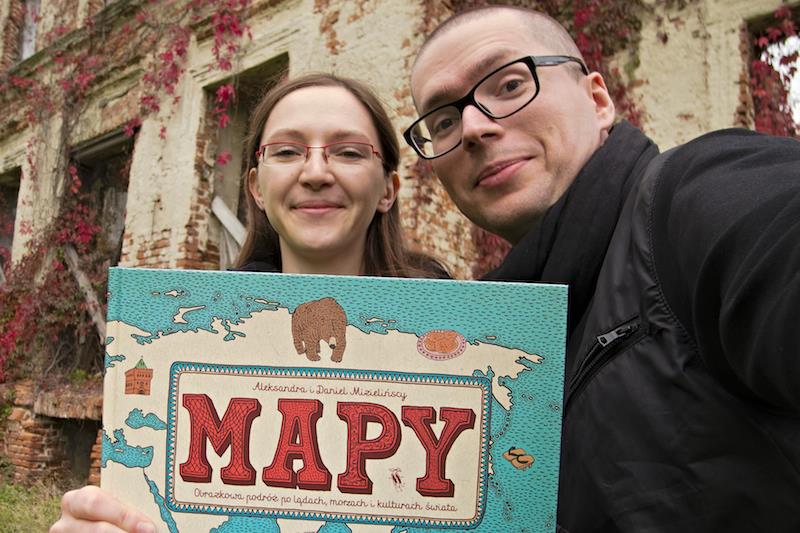
„Pszczoły” is a big format book, similar to the world-famous„Mapy” by Aleksandra and Daniel Mizielińscy from 2012 (also published by Wydawnictwo Dwie Siostry). Each spread is dedicated to another topic concerning bees: their biology, production of honey, human-bees relations during history, modern beekeeping etc. Among them ancient Egypt, Greek mythology, and ancient history (Alexander the Great and Poppaea Sabina, the second wife of the emperor Nero) are also present.
Alexander the Great (dead) in the barrel filled with honey (fragment), illustration by Piotr Socha.
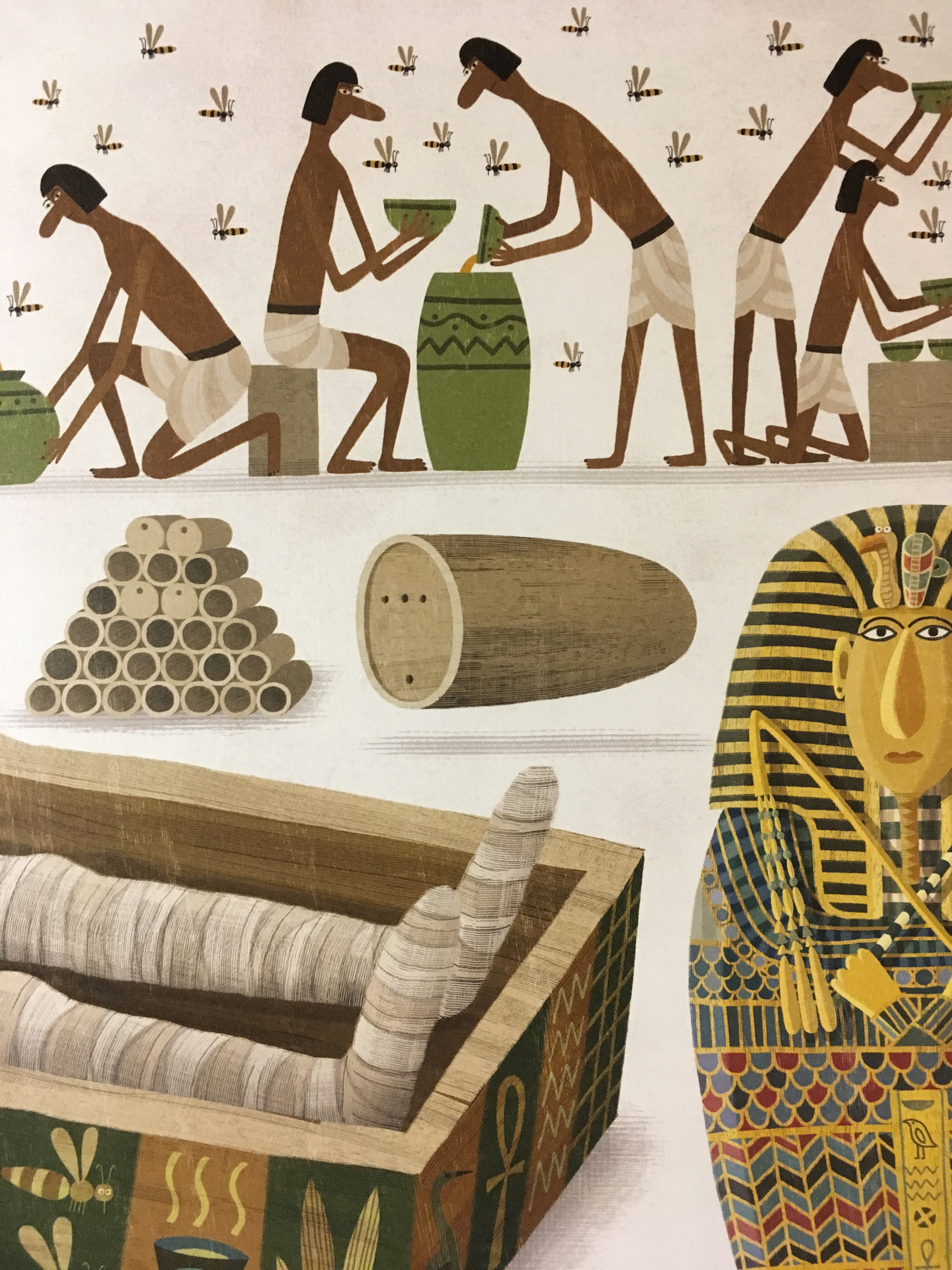
The ancient Egipt spread (fragment), illustration by Piotr Socha.
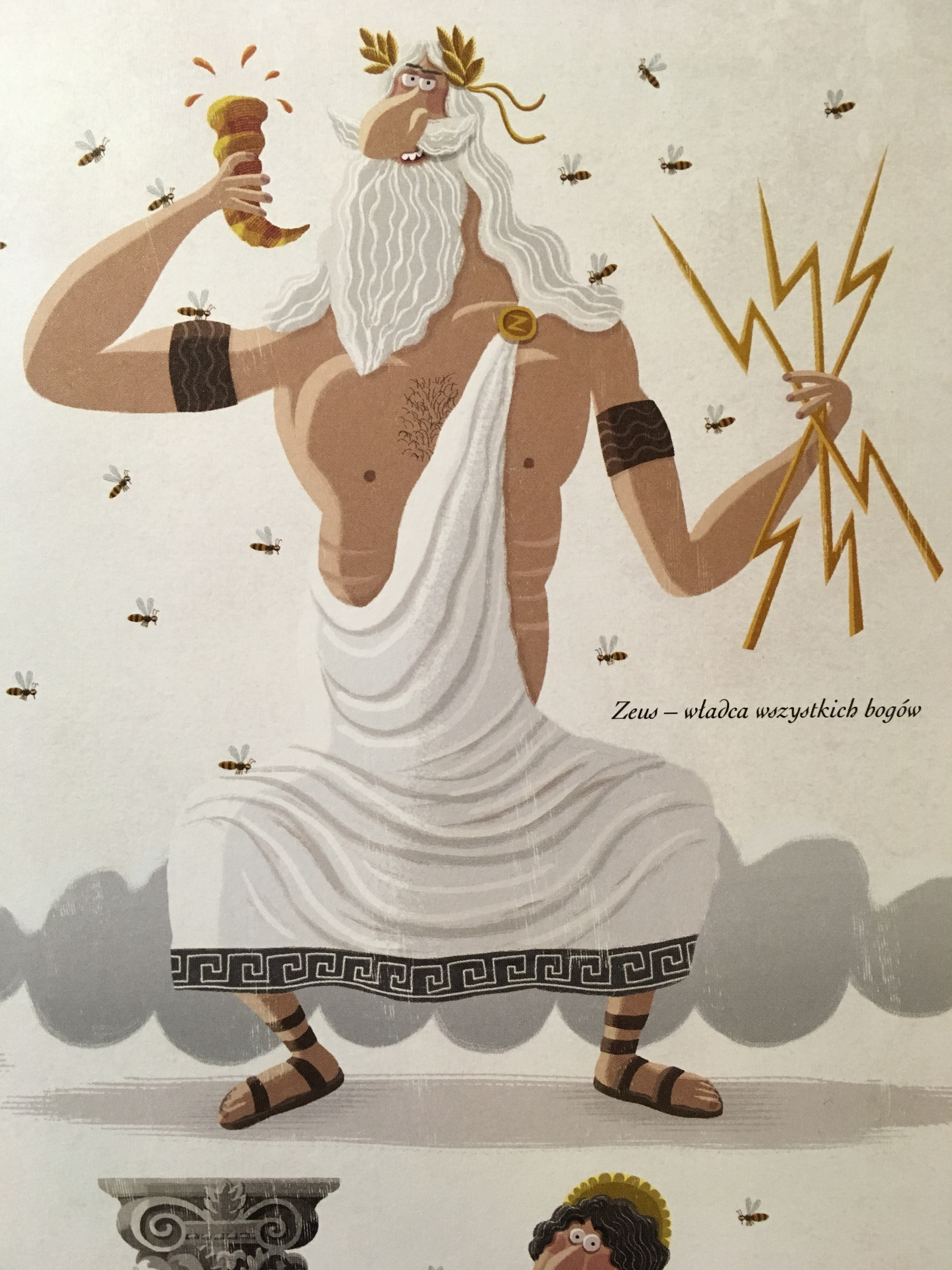
Greek Gods spread (fragment with Zeus), illustration by Piotr Socha.
Poppaea Sabina taking bath in the milk of hundred asses and applying honey to her skin (fragment), illustration by Piotr Socha.
Also there are two newspaper-like spreads, containing briefly described facts: on one of them the Aristotle is mentioned, the other – Virgil’s “Georgics”. Besides ancient historians and writers such as Strabo and Pliny the Elder are mentioned.
See more:
An interview with Agnes Monod-Gayraud, a translator of „Pszczoły” (in English):
English: 1) Piotr Socha, “The Book of Bees”, trans. Agnes Monod-Gayraud, London: Thames & Hudson Ltd., 2016 (UK), 2_ Piotr Socha,”Bees: a honeyed history”, trans. Agnes Monod-Gayraud, New York: ABRAMS Books for Young Readers, 2017 (USA).
Finnish: Piotr Socha, “Mehiläinen”, trans. Päivi Paloposki, Helsinki: Nemo, 2016.
French: Piotr Socha,”Abeilles”, trans. Lydia Waleryszak, Paris: De La Martinière jeunesse, 2016.
German: Piotr Socha, “Bienen”, trans. Thomas Weiler, Hildesheim: Garstenberg, 2016.
Italian: Piotr Socha, “Il regno delle api”, trans. Valentina Parisi, Milano: Electakids, 2016.
Aleksandra Mizielińska and Daniel Mizieliński are the creators of books for children, illustrations, fonts, applications, and websites. They run their own desing studio – Hipopotam Studio.
Aleksandra and Daniel Mizielińscy
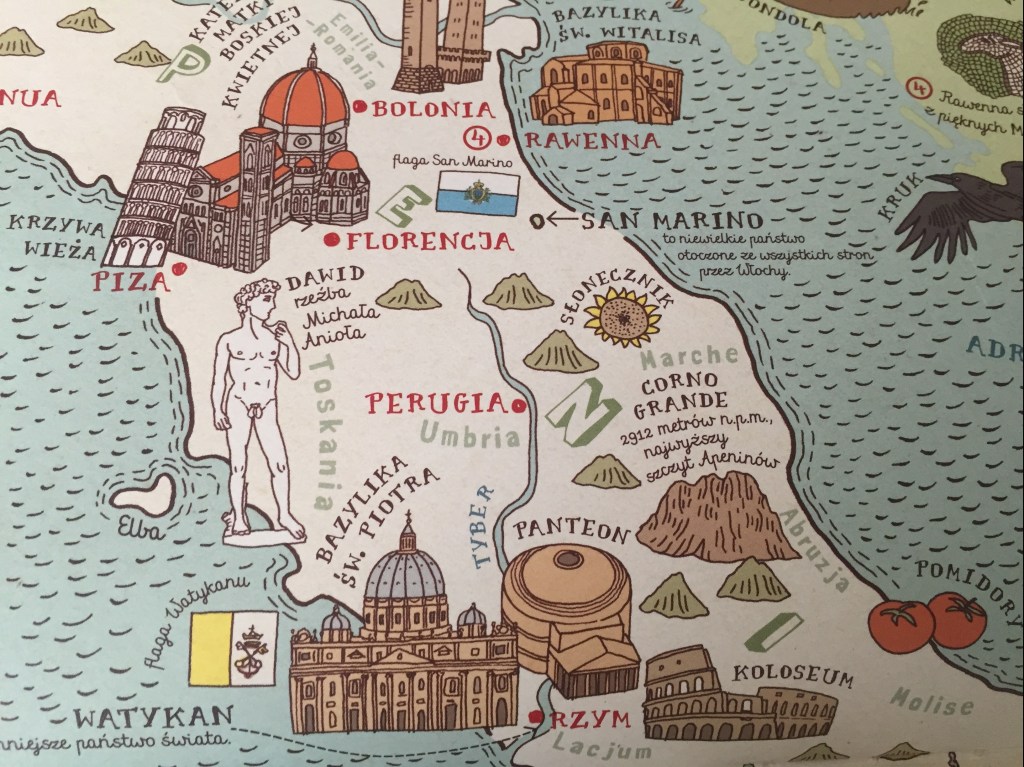
Their “MAPS: A Journey around the World in Pictures” (Polish: “Mapy: obrazkowa podróż po lądach, morzach i kulturach świata”, created by Aleksandra Mizielińska and Daniel Mizieliński), containing 51 pictorial maps for children, became an international bestseller.
Front cover of the Polish edition of “Maps”
The book was published for the first time in 2012 in Poland, by Wydawnictwo Dwie Siostry. Then, it has been translated into many different languages and was published in (approximately) 25 countries. The publication won prestigious awards, among others Prix Sorcières(2013) and Premio Andersen (2013), and was found on the list of “the six most interesting and most beautiful illustrated children’s books, released in 2013” by “New York Times” (read more).
Various world releases of “Maps”
In the book we find many traces of Graeco-Roman Antiquity – they are located on the maps of Italy and Greece. We see there some important characters (among others): Julius Caesar, Homer, and Pythagoras, as well as mythical creatures (Siren, Centaur) and the most important monuments.
The photos of the maps were taken by the author of this post.
“Tru” by Barbara Kosmowska, illustrated by Emilia Dziubakis a Polish children’s novel from 2016 published by Media Rodzina.
The cover of “Tru” [source].
The story is about a hare called Tru who lives in a town divided into two distinct districts: a rich and a poor one. Tru, as an inhabitant of the latter, is unable to buy expensive gadgets so he decides to invent them. With his new machines, toys, and vehicles, he manages to erase the differences between rich and poor communities.
In the town centre stands a statue of a local hero, Zając Herkules[Hercules the Hare]; also, a Zając Herkules award was given to Tru for creating innovations for the forest. The text does not explain the origins of the name or the deeds done by Zając Herkules for the community. By using the mythological reference, the author is able to create a modern version of the classical hero, who can be regarded as a role model for his community. It could also be the case that Tru became inspired by Zając Herkules’ deeds (although this is never made clear to the reader) and decided to fight the obstacles and injustice in the world the best he can, that is with his talent for inventing new objects which help the community. This shows the young reader that it is not only the strong and muscular, like the mythical Hercules (or his hare fellow, Zając Herkules) who may become a hero, but anyone can, if only his/her talents are used to perform good deeds.
Zając Herkules [Hercules the Hare], illustration by Emilia Dziubak.
See more:
About “Tru” (in Polish) on the official website of Media Rodzina publishing house – link
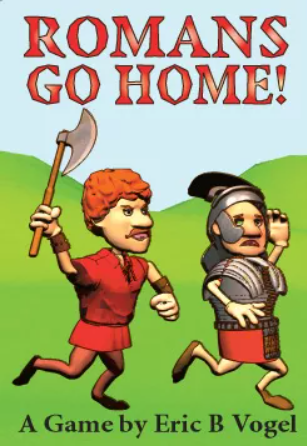
“Romans Go Home!” [PL: “Rzymanie do domu!”] is a quick card game designed by Eric B. Vogel, published for the first time in 2013 by Vainglorious Games.
Front cover of the Vainglorious Games edition
Since 2014, Lui-même publish “Romans Go Gome!” in a graphic design by FrançoisBruel. This version of the game is available in many language versions, for example German, French, English, and Polish.
Front cover of the Lui-même edition
Polish version of the game published by Trefl Joker Line
In the game we change into the Caledonians, who try to destroy the Hadrian’s Wall. Points are collected by capturing the Roman forts.
“Romans Go Gome!” is intented for 1-4 players in the age of 13+. It has only three rounds.
Romans Go Home – the famouse fragment from Monty Python’s “Life of Brain” :), a possible inspiration for the game? [May contain content inappropriate for children.]









 Our Mythical Childhood Blog