Blog for the international research project "Our Mythical Childhood… The Reception of Classical Antiquity in Children’s and Young Adults’ Culture in Response to Regional and Global Challenges", financed by the ERC Consolidator Grant led by Prof. Katarzyna Marciniak, Faculty of "Artes Liberales" of the University of Warsaw. Team members: Prof. Susan Deacy and Steve K. Simons, University of Roehampton; Prof. Elizabeth Hale and Dr Miriam Riverlea, University of New England; Prof. Lisa Maurice and Dr Ayelet Peer, Bar-Ilan University; Prof. Daniel A. Nkemleke, Dr Divine Che Neba and Dr Eleanor A. Dasi, University of Yaoundé I; Dr Elżbieta Olechowska, Dr Hanna Paulouskaya, Dr Sonya Nevin, Dott. Edoardo Pecchini, Marta Pszczolińska, Angelina Gerus and the Project Officers: Magdalena Andersen, Maria Makarewicz, and Olga Strycharczyk from the Faculty of "Artes Liberales" UW.
Irene Venturi was born in Viareggio in 1978. She received a bachelor’s degreefrom mathematics at the University of Pisa and the title of Doctor of Mathematics at the University of Genoa. Currently, she trains mathematic teachers, works on mathematic school manuals and writes books. [1] [2]
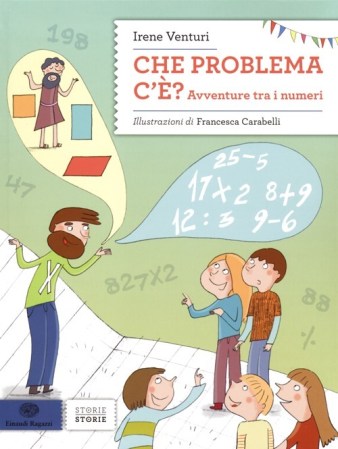
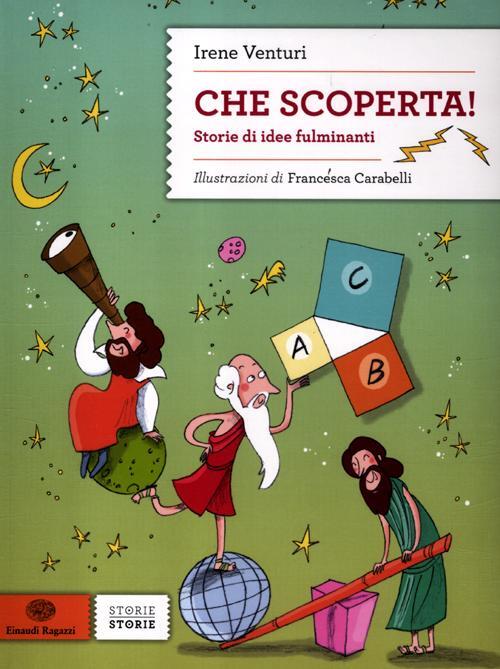
In her two books for children, titled “Che scoperta! Storie di idee fulminanti” (2012) [What a discovery! Stories of fulminating ideas”] and “Che problema c’è? Avventure tra i numeri” (2013) [“What’s the problem? Adventures among the numbers.”] Venturi explains the fundamental rights of mathematics and talks about important scientific discoveries.
The cover of the book “Che problema c’è? Avventure tra i numeri” (2013, Edizioni EL)[source]
The cover of the book “Che scoperta! Storie di idee fulminanti” (2012, Edizioni EL)[source]
In the both books we can find important figures associated with the ancient world, such as (inter alia) Dido, Hiero I, Hiero II, Marcellus, Pythagoras, Archimedes, Thales of Miletus, Herodotus, Demaratos, Xerxes, Leonidas, and others.
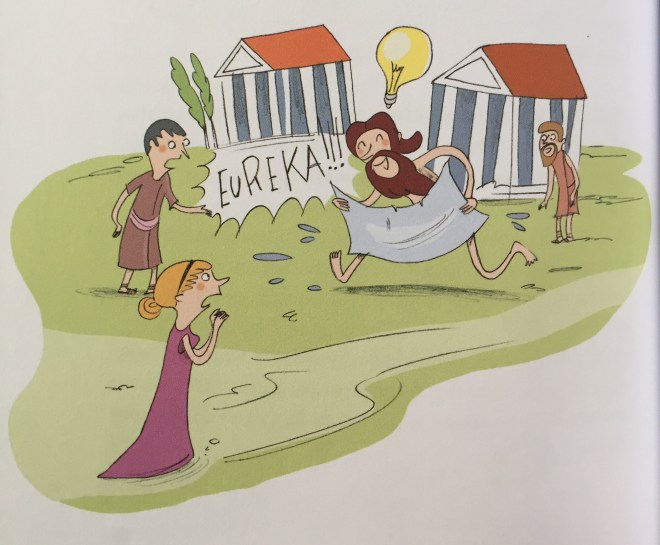
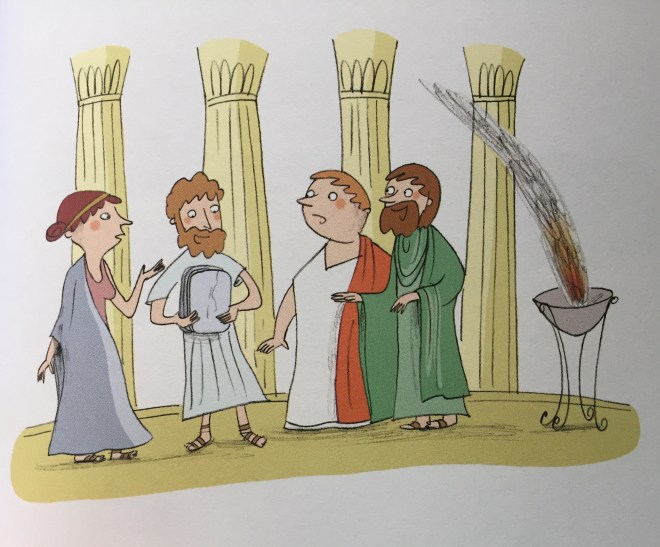
Archimedes [illustration by Francesca Carabelli from the Polish edition of “Che scoperta! Storie di idee fulminanti” ( “Ale odkrycie! Historie elektryzujących pomysłów”), Wrocław, 2016, wyd. Esteri]Pythagoras [illustration by Francesca Carabelli from the Polish edition of “Che scoperta! Storie di idee fulminanti” (“Ale okdrycie! Historie elektryzujących pomysłów”), Wrocław, 2016, wyd. Esteri]Spartans and Demaratos’ wax tables [illustration by Francesca Carabelli from the Polish edition of “Che scoperta! Storie di idee fulminanti” (“Ale odkrycie! Historie elektryzujących pomysłów”), Wrocław, 2016, wyd. Esteri]All the photos of the book were taken by the author of this post.
“Tad the Lost Explorer and the Secret of King Midas” [original title “Tadeo Jones 2: El secreto del Rey Midas] is a new Spanish animation directed by Enrique Gato.
Movie poster [source]
This is the second part of the adventures of Tad – a construction worker, who since childhood dreams to become an archaeologist. Previously, in “Tad, the Lost Explorer” (2012), Tad had an opportunity to search for the Lost City of the Incas (see the foto below):
Tad and Sara in “Tad, the Lost Explorer” (2012) [source]
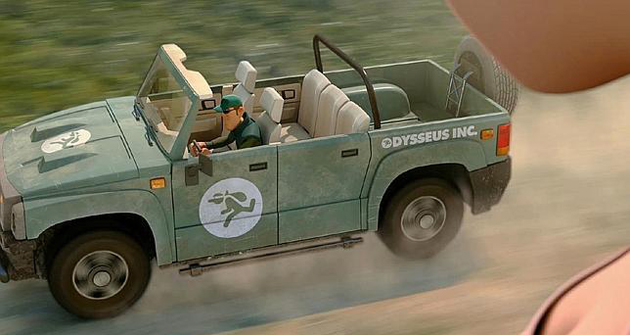
Already in the first part of Tad’s adventures, we could find some traces of the of Graeco-Roman Antiquity, like for example the name of the organization Odysseus Inc., which was the main antagonist in the movie:
In “Tad the Lost Explorer and the Secret of King Midas” (2017)however, the creators decided to build the whole story in reference to mythology:
In the movie, Tad goes to Las Vegas to visit Sara and see the exposition of her latest discoveries. It turns out that the girl found a papyrus which indicates the location of the magical necklace that belonged to the mythical King Midas. When a famous and greedy millionaire (Jack Rackham) finds out about it, he decides to steal the papyrus and kidnap Sara to force her to find the hidden secret of King Midas.
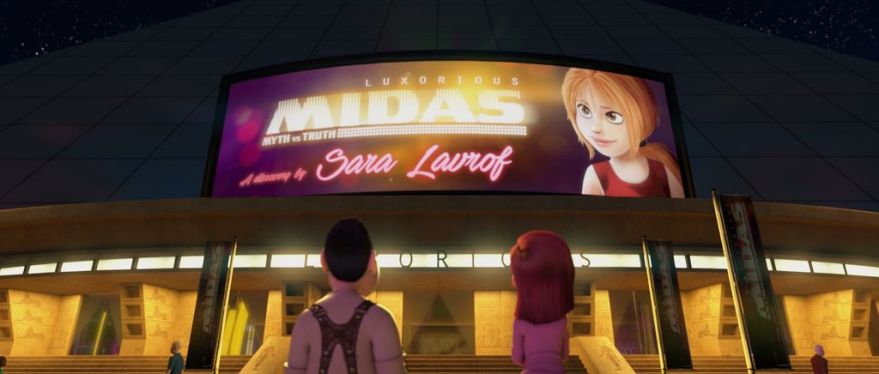
“Luxorious Midas: Myth vs Truth” – a discovery by Sara Lavrof. [source]Sara Lavrof with a papyrus [source] Interesting fact: at the beginning of the movie Tad is reading about Herodotus. 🙂
“Herodotus was considered the father of history. Cool!” [source]Found by Dr. Karolina Kulpa, elaborated by Dorota Bazylczyk
For the first time on Our Mythical Childhood Blog – a report by Dr. Katerina Volioti, University of Roehampton, from her research and dissemination venture. Katerina was educated at the Universities of Cambridge (BA in Archaeology & Anthropology), Oxford (MSc in Management), Humboldt (MA in Politics), and Reading (PhD in Classics), and she is a passionate educator.
On Thursday 14 December, 2017, I travelled to Colchester, to the campus of the University of Essex to lead a ninety-minute session at the Centre for Myth Studies. These events form part of the Myth ReadingGroup, and they are organised by Dr. Pietra Palazzolo. My session was entitled The Visual Language of (Hesiod’s) Creation in Children’s Books, and it had two aims: firstly, to explore the place of the Theogony in ancient and modern culture; and secondly, to consider whether and how we can visualise creation myths with our mind’s eye. Both aims stem from my research for the international project Our Mythical Childhood, for which I investigate the educational and anthropological meaning of illustrations in books for preliterate children, aged four and above. Mythology’s role in education – in schools, universities, and museums – was also covered at the workshop Mythology & Education: History and Practice that I co-organised at Cambridge on 27 October 2017.
Our Mythical Childhood is a five-year ERC-funded project led by Professor Katarzyna Marciniak, Faculty of “Artes Liberales,” University of Warsaw. Well into the second year of this project, there is excellent headway with writing entries on children’s literature in an open-access database, international conferences and workshops, and with specific endeavours. The latter include a multi-authored volume on mythology and national curricula by Dr. Lisa Maurice, five animations based on the Greek vases from the collection of the National Museum in Warsaw and prepared by Dr. Sonya Nevinand Steve Simons from the Panoply Vase Animation Project, Dr. Susan Deacy’s study on Autism and Classical Mythology, Dr. Elizabeth Hale’sGuide to children’s books inspired by Classical Antiquity, Dr. Elżbieta Olechowska’s volume on the reception of the Classics in recent TV series, Dr. Hanna Paulouskaya’s study on the use of mythology in Soviet cartoons, and two PhD dissertations by Dorota Bazylczyk and Anna Mik, with Dr. Karolina Kulpa’s involvement in the operation of the database.
Prior to the discussion session at the University of Essex, Dr. Palazzolo distributed three items to readers: an academic article about mythography in Antiquity (Ken Dowden, “Telling the Mythology: From Hesiod to the Fifth Century,” in Ken Dowden and Niall Livingstone, eds., A Companion to Greek Mythology, Chichester: Wiley Blackwell, 2014, 47–72); an extract from an illustrated book that is available online (Philippos Mandilaras, The Twelve Gods of Olympus, illustrated by Natalia Kapatsoulia, trans. by Alison Falkonakis, Athens: Papadopoulos Publishing, 2016); and my three-page handout with questions for discussion.
Natalia Kapatsoulia is a full time illustrator of children’s books, and author of one picture book about the bond between a child and a mother (Η μαμά πετάει[Mom wants to fly], Athens: Diaplasi, 2016). Kapatsoulia has illustrated dozens of books by Philippos Mandilaras, and their latest mythology book is about Aphrodite (Αφροδίτη, η θεά της ομορφιάς [Aphrodite, goddess of beauty], Athens: Papadopoulos Publishing, 2017). Earlier in her career, Kapatsoulia illustrated books by Eugenios Trivizas, the best-known Greek author of children’s and young adults’ literature with translations in many languages. Trivizas’ books include The Three Little Wolves and the Big Bad Pig(illustrated by Helen Oxenbury, London: Heinemann Young Books, 1993). Mandilaras’ and Kapatsoulia’s The Twelve Gods of Olympus is an extremely popular book and it has, so far, been translated also into French, German, Russian, and Spanish. This book makes mythology accessible to a wide and international audience, and, as with Trivizas’ work, opens up Greek children’s literature to the world. We had an extremely lively discussion by learned members of the Reading Group as well as by postgraduate students. In particular, we debated on the following five main points. Firstly, we contested the value of a distinction between telling a story and telling history, as implied by Classical scholarship that places Hesiod in a pre-Herodotan tradition. Secondly, we agreed on the salience of visual imagery in understanding how mythology relates to History, Archaeology, and Classical Art, but also to western modernity. For the latter, we watched President Obama’s speech before the Parthenon in Athens in November 2016, and we thought about the symbolic terms the President used, such as ‘civilisation,’ ‘humanity,’ and ‘democracy.’ Thirdly, we considered how mythographers, including Akousilaos of Argos (ca. 500 BCE) and Apollodoros, The Library (perhaps 2nd century CE), filled ostensible gapsin a story by inserting details and variations to an existing myth. These insertions are comparable to young children’s tendency to conflate narratives and to create additional stories when hearing a myth. Fourthly, we discussed when and how children develop a sense of the sacred, and whether or not creation myths impact on children’s (religious) beliefs. Fifthly, we examined the illustrations of The Twelve Gods of Olympus, noting their magnificent colour contrasts, their fun elements, and their potential for allusions to popular characters from cartoons and the news, such as Disney’s mermaid for Gaia and Richard Branson (the founder of the Virgin Group) for Zeus. We made a passing reference to the influential book Gods of Management by business thinker Charles Handy, where Zeus represents a leadership style that is based on relations of trust.
The cover of the book Gods of Management by Charles Handy[source]
At the end of the session, we returned to the argument of ‘seeing’ with the mind’s eye. The Theogony did not appear to pertain only to Classical scholarship, and to its ancient oral and mythographic traditions. Popular culture, news items, and myths from outside the Greek world were all powerful in shaping our expectations from the Theogony and from creation stories more generally. Somehow, the visual language of a creation story did not simply relate to the images within a given book, but also to images and ideas we carry in our heads, allowing each one of us to create and re-create more myths, perhaps akin to the actions of ancient mythographers and to the thinking of young children.
This slideshow requires JavaScript.
Based on participants’ feedback, the discussion was stimulating and wide-ranging, and it brought to the fore different strands in studying mythology, such as Classics, children’s literature, and the relation between text and image. I am grateful for this opportunity to present at the University of Essex and to all participants for their extremely insightful comments. I hope we can have a follow-up session on myth, Classical art, and visual culture, all of which continue to intrigue and inspire my research and teaching at the University of Roehampton.
“Reflection – Medusa” is an animation created in 2007 by Patricia Satjawatcharaphong – a visual designer from the US. The movie is accompanied by the music by Nik Phelps. It starts with a quote from Phaedrus, which points out that:
“Things are not always what they seem; outward form deceives many; rare is the mind that discerns what is carefully concealed within”.
The animation seems to concentrate the recipient’s attention mainly on Medusa’s feelings as a woman, not as a monster (following the introductory quote). As the author of the animation states:
“Reflection tells the tale of the mythological gorgon Medusa, where there is no good or evil—just sorrow.”
The whole story partly follows the Ovidian version of Medusa’s myth:
Dorota Bazylczyk and Anna Mik (PhD students from the Faculty of “Artes Liberales”) decided to talk about the interpretative potential of“Reflection – Medusa” in the context of the 21st-century problems, during their recent presentation about the “Monstrous Women in the Globalized World: Images of Selected Female Characters from Classical Mythology in the Contemporary Children’s and Young Adults’ Culture”, given during the international conference “Topographien der Globalisierung / Topographies of Globalization” (Humboldt-Kolleg supported by the Alexander von Humboldt Foundation) at the Institute of German Studies, University of Warsaw (19–21 Jan.)
“Bright” is a new movie with Will Smith distributed by Netflix. It talks about two policemen – human (Will Smith) and orc (Joel Edgerton) who try to save the world from the upcoming danger.
In the movie we get to know the vision of the world in the future, where humans live togheter with (inter aila): orcs, elves, centaurs, dwarves. Centaurs play the role of police officers.
Centaur police officer in “Bright” movie [source]Another centaur policeman in “Bright” movie [source]See more:
The Official Trailer of “Bright”: This video may contain content inappropriate for some users. This video may be unsuitable for children.
“Wielkie eksperymenty dla małych ludzi”(“Great Experiments for Little People”) byWojciech Mikołuszko illustrated by Joanna Rzezak is a Polish children’s non-fiction book from 2016 published by Wydawnictwo Agora.
The cover of the book
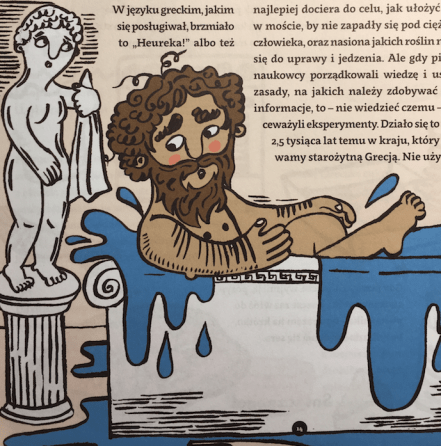
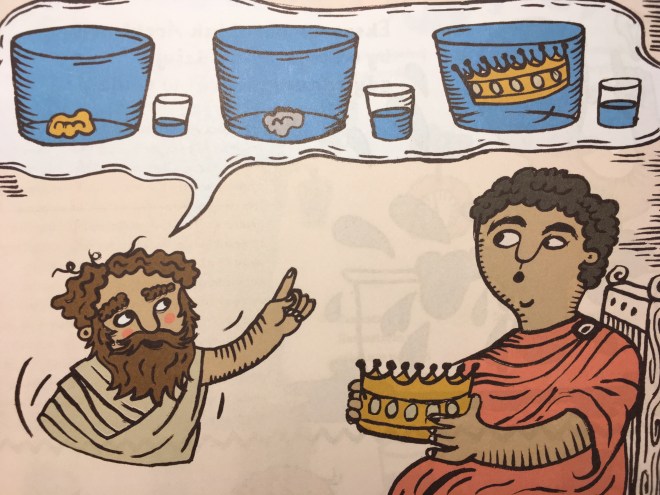
“Wielkie eksperymenty…” is a book about the great experiments from our history, not only those important for chemistry, physics etc., but also psychology. Each chapter contains a historical information about the scientist and the experiment itself and a guide how to prepare similar experiments at home, step by step. The first chapter is dedicated to Archimedes, who c. 265 BC in Syracuse shouted “Eureka!” (“Εὕρηκα!”) when taking a bath and came up with an idea which later was called after his name an Archimedes’ principle!
Archimedes in a bathtub, il. Joanna RzezakArchimedes running through Syracuse, il. Joanna RzezakArchimedes explaining his idea to the King Hiero II, il. Joanna RzezakAuthor in a modern bathtub, il. Joanna Rzezak
The text is written in a humorist manner and the illustrations by Joanna Rzezak make it even more funny (especially the naked author in a modern bathtub). Though all the informations are specific (i.a. there were no “scientists” in the Antiquity, they all were called “philosophers” etc.).
See more:
About „Wielkie eksperymenty dla małych ludzi” (in Polish) – link
The official website of Agora publishing house – link
The official website of Wojciech Mikołuszko (in Polish) – link
The official website of Joanna Rzezak (in English) – link
Found by Krzysztof Rybak
All the photos of the book were made by the author of this post.
“Reformator Marcin Luter” (“The Reformator Martin Luther”) is a graphic novel written by Michał Rzecznik and illustrated by Piotr Nowackipublished by Wydawnictwo Widnokrąg on 31st October 2017, precisely 500th years after Luther nailed his theses to the door of the church in Wittenberg.
The cover of the book
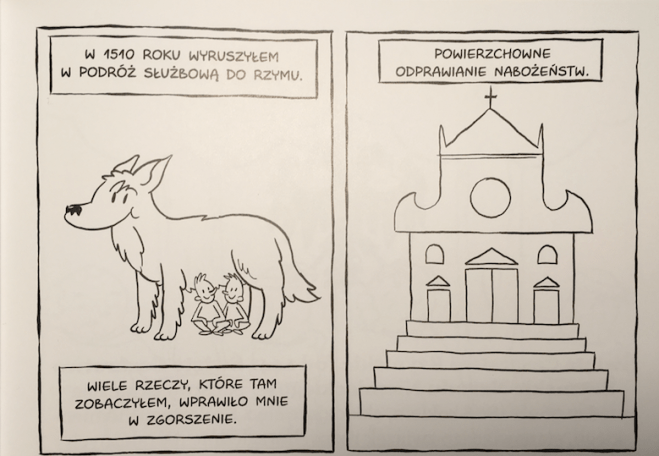
“Reformator” is a funny, biographical story about Luther, who as a storyteller explains everyday life in the times between the Middle Ages and Renaissance, and how he came with the idea of the Reformation of the Church and so on. The story finishes in the modern times, as Luther presents numbers considering the protestant churches etc. Each second page is a set of illustrations, the others contain descriptions of the important terms, objects, and people, such as Schwabacher, “The Autumn of the Middle Ages” (by Johan Huizinga), simony, or Jan Hus.
Luther as a storyteller, il. Piotr NowackiReformation spreading through Europe, il. Piotr Nowacki
One of the illustrations presents Luther’s visit to Rome, another one is the mythological she-wolf with two boys, Romulus and Remus:
See more:
About “Reformator Marcin Luter” (in Polish) – link
The official website of Widnokrąg publishing house (in Polish) – link
A current and famous example for a messianic Poseidon-figure is the hero of Aquaman in the Marvel-movieJustice League (USA, Snyder 2017), in which Poseidon is shown as a superhero.
A modern Poseidon as part of the biggest heroes of all time: Batman, Wonder Woman, Cyborg, and Flash
In the plot, he is a king who rules over the sunken empire of Atlantis, and he also has a five times jagged trident, with which he is able to cause big waves to fight against tyrannical enemies like the Parademons. Furthermore, he is a very fast swimmer and can talk to fish and other animals that live in the sea.
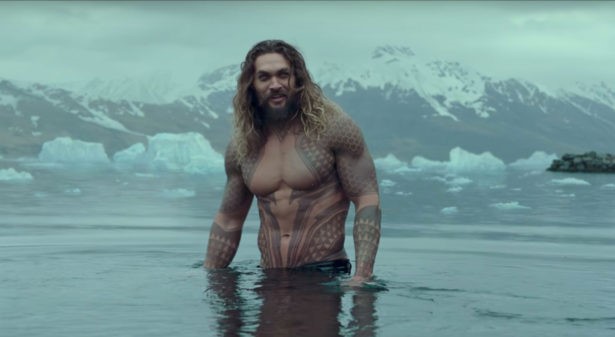
Jason Momoa plays the role of the Aquaman in “Justice League”
Aquaman with his red haired and beautiful wife Mera, an Atlantean queen, played by Amber Heard
As far as his iconography is concerned, he looks like the Poseidon statues of fountains of the Renaissance: He has a beard, long and curly hair, and an athletic body. By having bright sea-blue eyes, blond-brown hair, tanned skin, and fish-scale-tattoos all over his strong body, he is also modernized and hybridised with a handsome surfer boy.
If you wish to get to know the power of Aquaman-Poseidon, you can watch this stranger, raising from the sea:
Found by Dr. Michael Stierstorfer from the University of Regensburg.
Mythical Realms® is one of the collection of toys created by Safari Ltd®. The pieces from the collection depict various figures and monsters from the world of mythology, like for example Poseidon, Minotaur, Chimera.
The figurine of Poseidon
The age category of the collection is 3+, however, the figurines may contain small parts that may constitute a choking hazard.
The great advantage of the Mythical Realms® are the fine-tuned details of the figurines that makes them look very realistic. All the characters have interesting descriptions on the manufacturer’s website.
Outside the collection, Safari Ltd® offers the Mythical Realms® TOOB® with 8 small figures from Greek mythology, containing Chimera, Griffin, Phoenix, Unicorn, Sea Dragon, the Minotaur, Poseidon and a Mermaid.
See more:
Mythical Realms® on the Official Website of Safari Ltd®.
Found by Dr Arlene Holmes-Henderson (University of Oxford)
„Pszczoły” (“The Book of Bees”) by Piotr Socha(text by Wojciech Grajkowski) is a Polish children’s non-fiction book from 2015 published byWydawnictwo Dwie Siostry.
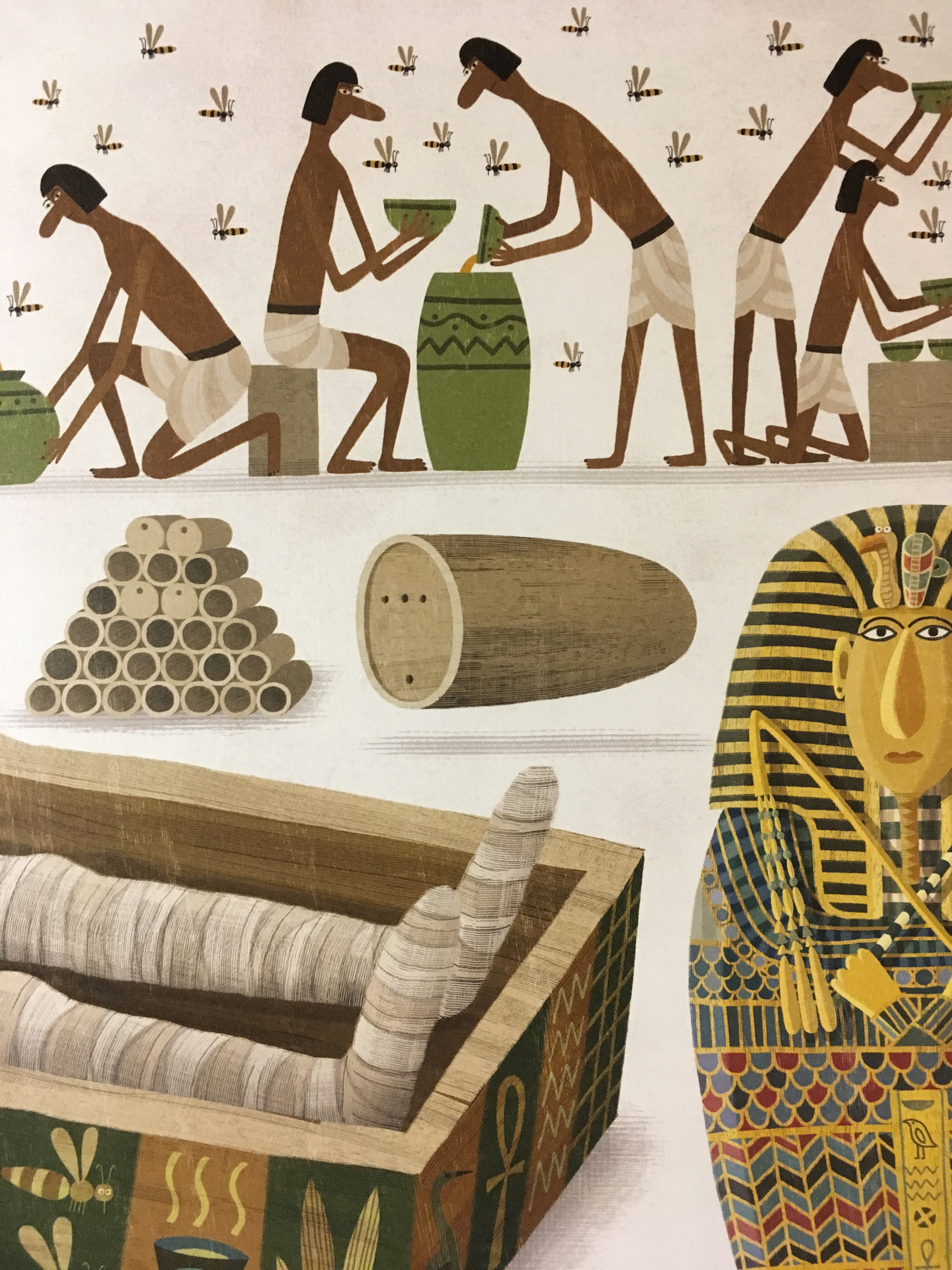
„Pszczoły” is a big format book, similar to the world-famous„Mapy” by Aleksandra and Daniel Mizielińscy from 2012 (also published by Wydawnictwo Dwie Siostry). Each spread is dedicated to another topic concerning bees: their biology, production of honey, human-bees relations during history, modern beekeeping etc. Among them ancient Egypt, Greek mythology, and ancient history (Alexander the Great and Poppaea Sabina, the second wife of the emperor Nero) are also present.
Alexander the Great (dead) in the barrel filled with honey (fragment), illustration by Piotr Socha.
The ancient Egipt spread (fragment), illustration by Piotr Socha.
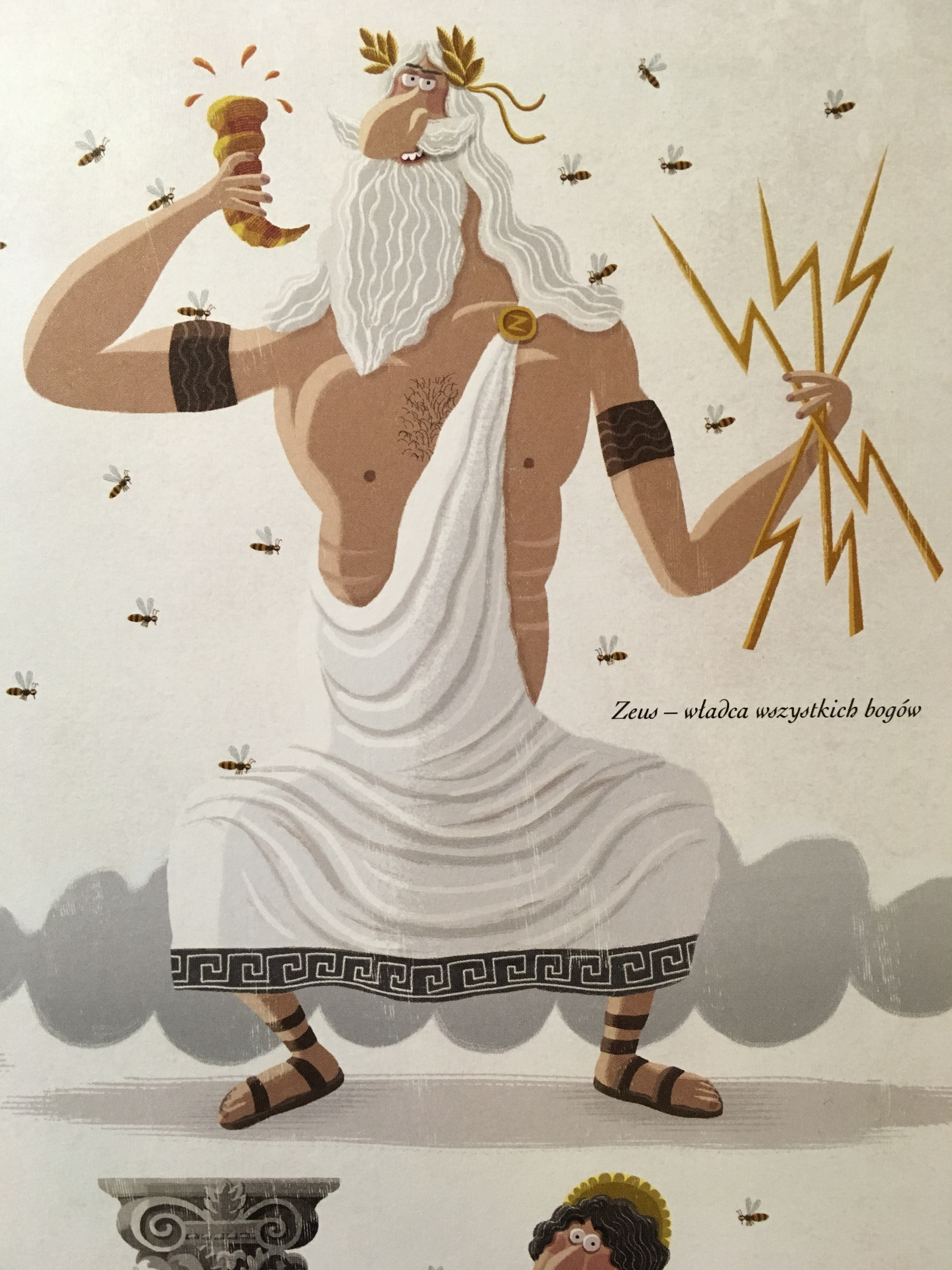
Greek Gods spread (fragment with Zeus), illustration by Piotr Socha.
Poppaea Sabina taking bath in the milk of hundred asses and applying honey to her skin (fragment), illustration by Piotr Socha.
Also there are two newspaper-like spreads, containing briefly described facts: on one of them the Aristotle is mentioned, the other – Virgil’s “Georgics”. Besides ancient historians and writers such as Strabo and Pliny the Elder are mentioned.
See more:
An interview with Agnes Monod-Gayraud, a translator of „Pszczoły” (in English):
English: 1) Piotr Socha, “The Book of Bees”, trans. Agnes Monod-Gayraud, London: Thames & Hudson Ltd., 2016 (UK), 2_ Piotr Socha,”Bees: a honeyed history”, trans. Agnes Monod-Gayraud, New York: ABRAMS Books for Young Readers, 2017 (USA).
Finnish: Piotr Socha, “Mehiläinen”, trans. Päivi Paloposki, Helsinki: Nemo, 2016.
French: Piotr Socha,”Abeilles”, trans. Lydia Waleryszak, Paris: De La Martinière jeunesse, 2016.
German: Piotr Socha, “Bienen”, trans. Thomas Weiler, Hildesheim: Garstenberg, 2016.
Italian: Piotr Socha, “Il regno delle api”, trans. Valentina Parisi, Milano: Electakids, 2016.



















 Our Mythical Childhood Blog
![[source]](https://pictures.abebooks.com/isbn/9780285623361-uk.jpg)

